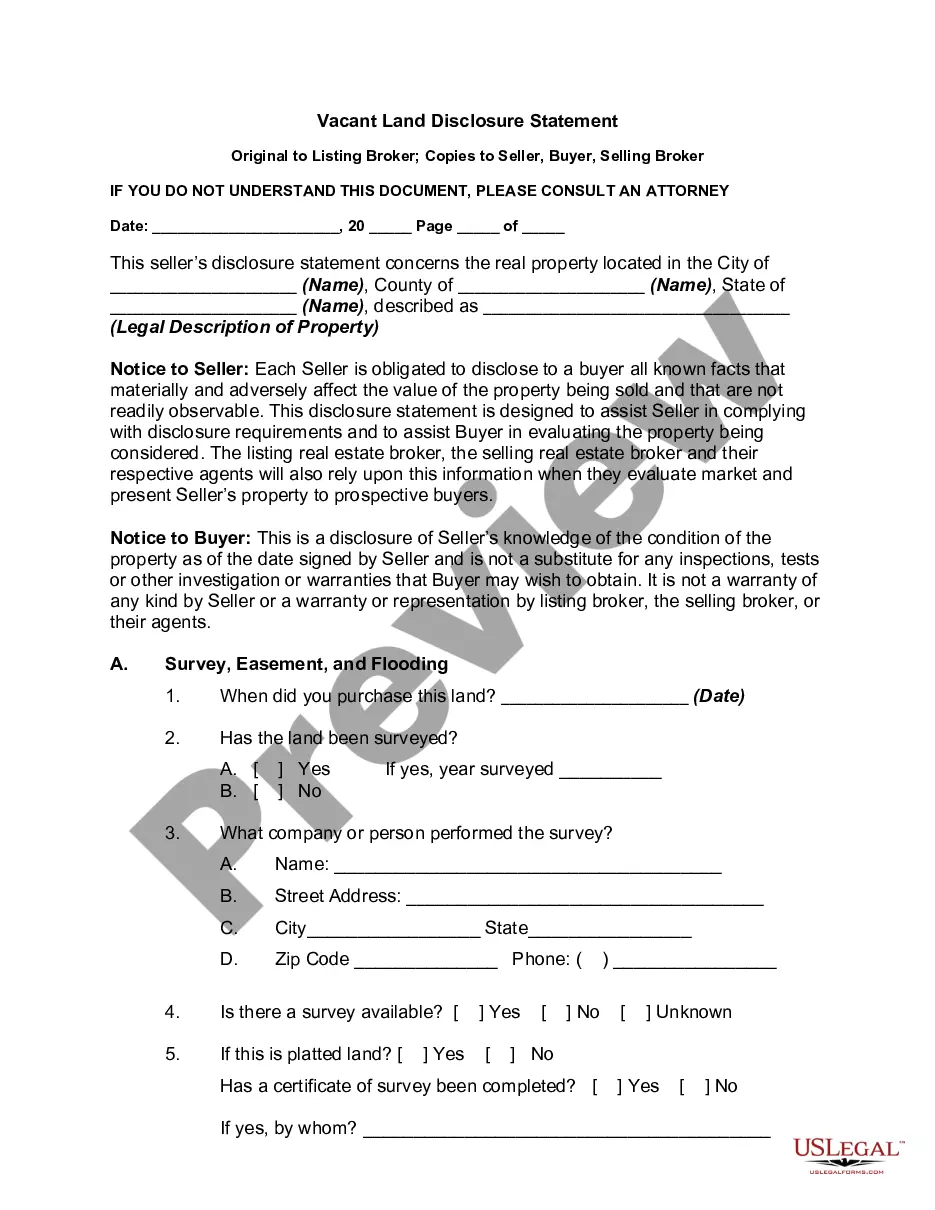
Vacant Land Disclosure Form For Ohio
Description


Get your form ready online
Our built-in tools help you complete, sign, share, and store your documents in one place.
Make edits, fill in missing information, and update formatting in US Legal Forms—just like you would in MS Word.
Download a copy, print it, send it by email, or mail it via USPS—whatever works best for your next step.
Sign and collect signatures with our SignNow integration. Send to multiple recipients, set reminders, and more. Go Premium to unlock E-Sign.
If this form requires notarization, complete it online through a secure video call—no need to meet a notary in person or wait for an appointment.
We protect your documents and personal data by following strict security and privacy standards.

Make edits, fill in missing information, and update formatting in US Legal Forms—just like you would in MS Word.

Download a copy, print it, send it by email, or mail it via USPS—whatever works best for your next step.

Sign and collect signatures with our SignNow integration. Send to multiple recipients, set reminders, and more. Go Premium to unlock E-Sign.

If this form requires notarization, complete it online through a secure video call—no need to meet a notary in person or wait for an appointment.

We protect your documents and personal data by following strict security and privacy standards.
Looking for another form?


How to fill out Vacant Land Disclosure Statement?
Whether for corporate objectives or for individual matters, everyone must handle legal situations at some stage in their existence.
Completing legal paperwork requires meticulous consideration, beginning with selecting the appropriate form template.
Once it is saved, you can complete the form using editing software or print it out and fill it out by hand. With a comprehensive US Legal Forms catalog available, you need not waste time searching the internet for the right sample. Utilize the library’s user-friendly navigation to locate the correct template for any situation.
- For example, if you select an incorrect version of the Vacant Land Disclosure Form For Ohio, it will be rejected upon submission.
- Thus, it is crucial to have a dependable source of legal documents such as US Legal Forms.
- If you need to acquire a Vacant Land Disclosure Form For Ohio template, follow these simple steps.
- Utilize the search field or browse the catalog to find the required sample.
- Review the form’s details to confirm it aligns with your circumstances, state, and county.
- Click on the form’s preview to view it.
- If it is the wrong document, return to the search feature to find the Vacant Land Disclosure Form For Ohio sample you need.
- Obtain the template if it fits your requirements.
- If you already possess a US Legal Forms account, simply click Log in to access previously saved documents in My documents.
- If you do not have an account yet, you can download the form by clicking Buy now.
- Select the suitable pricing option.
- Fill out the account registration form.
- Choose your payment method: use a credit card or PayPal account.
- Select the desired document format and download the Vacant Land Disclosure Form For Ohio.
Form popularity
FAQ
Ask the lender to terminate the lien upon payoff. A good rule of thumb is to request that your lender file a UCC-3 form with your secretary of state as soon as possible after you pay off your loan. The UCC-3 will terminate the lien on your company's assets (or assets) and remove the UCC-1 filing.
After a loan has been paid off, a borrower has the responsibility of asking the lender to remove the UCC filing on the loan.
Lapsed UCC filing: The filing has passed its effective period and no continuation has been filed. Purged UCC filing: The filing has been removed from the index and is no longer searchable in most state systems.
UCC - Frequently Asked Questions - UCC-1 and UCC-3. Most filings last for five (5) years from the date of filing. Filings for a debtor that is a transmitting utility have no expiration date. Manufactured Home filings last 30 years from the date of filing ? appropriate box must be marked.
Upon lapse, a Financing Statement ceases to be effective and any security interest or agricultural lien that was perfected by the Financing Statement becomes unperfected, unless the security interest is perfected otherwise.
For UCC and EFS, a termination creates a public record that a loan was repaid, a lien was removed, or some other obligation was met.
In general, a UCC filing is not bad for your business ? it simply serves as an official notice to other creditors that your lender has a security interest in one or all of your assets. However, UCC filings can impact your business credit, risk your company's assets and/or hinder your ability to get future financing.
From our example, the UCC-1 filing can remain in place even when the debt is paid off. In these situations, you can file a UCC-3 termination yourself with your secretary of state. You must swear under oath that you've satisfied the debt in full and complete the UCC termination form.