Collaboration Checklist For Teachers
Description
Get your form ready online
Our built-in tools help you complete, sign, share, and store your documents in one place.
Make edits, fill in missing information, and update formatting in US Legal Forms—just like you would in MS Word.
Download a copy, print it, send it by email, or mail it via USPS—whatever works best for your next step.
Sign and collect signatures with our SignNow integration. Send to multiple recipients, set reminders, and more. Go Premium to unlock E-Sign.
If this form requires notarization, complete it online through a secure video call—no need to meet a notary in person or wait for an appointment.
We protect your documents and personal data by following strict security and privacy standards.

Make edits, fill in missing information, and update formatting in US Legal Forms—just like you would in MS Word.

Download a copy, print it, send it by email, or mail it via USPS—whatever works best for your next step.

Sign and collect signatures with our SignNow integration. Send to multiple recipients, set reminders, and more. Go Premium to unlock E-Sign.

If this form requires notarization, complete it online through a secure video call—no need to meet a notary in person or wait for an appointment.

We protect your documents and personal data by following strict security and privacy standards.
Looking for another form?







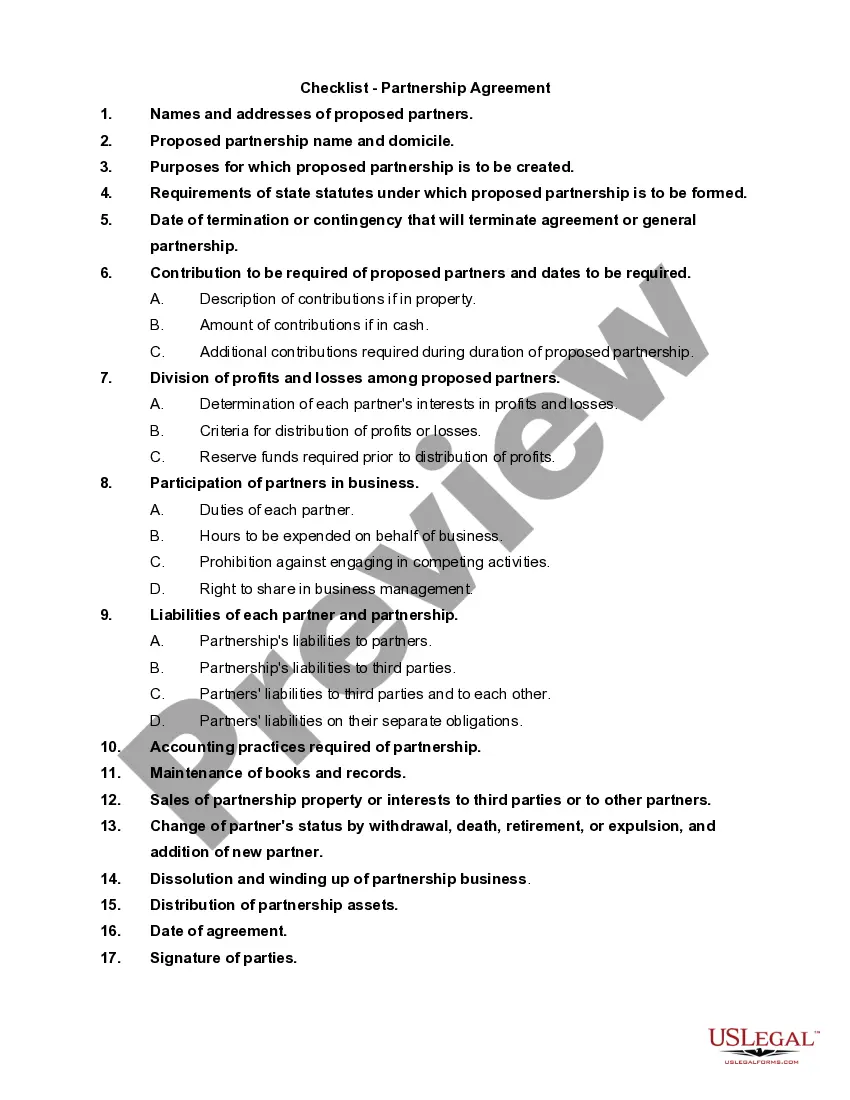
How to fill out Checklist - Partnership Agreement?
Dealing with legal documents and processes can be an arduous addition to your daily routine.
Collaboration Checklist For Educators and similar forms often necessitate that you search for them and comprehend how to fill them out accurately.
Thus, whether you are managing financial, legal, or personal issues, utilizing a comprehensive and user-friendly online repository of forms when you need them will significantly help.
US Legal Forms is the leading online source of legal templates, featuring over 85,000 state-specific documents and a variety of tools to assist you in completing your paperwork swiftly.
Is this your first time using US Legal Forms? Register and create a free account in a few minutes to gain entry to the document library and Collaboration Checklist For Educators. Then, follow the steps below to complete your document: Ensure you have the correct document using the Review feature and checking the document details. Choose Buy Now when ready, and select the monthly subscription plan that suits you. Click Download then fill out, eSign, and print the document. US Legal Forms has twenty-five years of experience assisting users with their legal documents. Obtain the document you need today and streamline any process effortlessly.
- Explore the collection of relevant documents available with just one click.
- US Legal Forms gives you access to state- and county-specific documents that can be downloaded at any time.
- Protect your document management procedures by utilizing a premium service that allows you to prepare any document within minutes without additional or hidden costs.
- Simply Log In to your account, locate Collaboration Checklist For Educators and download it immediately from the My documents section.
- You can also access previously saved documents.
Form popularity
FAQ
The 3/2-1 method is a simple strategy that helps teachers gather feedback from students. In this approach, students list three things they learned, two questions they still have, and one thing they found interesting. This method fosters collaboration and reflection, making it an excellent addition to your collaboration checklist for teachers. By implementing this method, you can enhance classroom communication and encourage student engagement.
A collaboration checklist is a tool that outlines the essential steps and best practices for effective teamwork among teachers. It helps educators stay focused on their goals, ensuring they cover important aspects like communication and shared responsibilities. By using a collaboration checklist for teachers, you can streamline your collaborative processes and enhance the overall quality of education you provide.
The four C's of collaboration are communication, cooperation, coordination, and conflict resolution. These principles guide teachers in working together effectively, fostering a positive atmosphere for student learning. Utilizing a collaboration checklist for teachers can help you incorporate these elements systematically, making your collaborative efforts even more impactful.
The five components of collaboration include clear communication, shared goals, mutual respect, trust, and accountability. These elements form the foundation for successful teamwork among educators. By following a collaboration checklist for teachers, you can ensure that each component is addressed, leading to a more unified and productive teaching environment.
An example of collaboration in teaching is when teachers work together to design a lesson plan that incorporates multiple subjects. For instance, a science and math teacher might collaborate to create a project that helps students understand measurements in real-world contexts. This teamwork not only enhances the learning experience but also aligns with the collaboration checklist for teachers, ensuring that all aspects of the lesson are covered effectively.
Teacher collaboration in education involves teachers working together to lead, instruct, and mentor students with the goal of improving student learning and achievement. Sharing ideas would have been easy under the old setup where teachers attend school on-site and attend classes face-to-face.
Strategies for Building Teacher Collaboration Create a truly shared vision and goals. The level of ownership they feel in the process influences how much teachers actually invest in collaborative work. ... Develop a sense of community. ... Identify group norms. ... Use discussion and dialogue. ... Work through conflict.
Time could be used in the planning day (with no students) to have faculty and staff share something to teach during an activity period. For example, an administrator might teach basic jewelry making, or an educational assistant might teach bullet journaling, or a teacher might share the basics of pickleball.
Teacher collaboration is usually divided into four categories: co-planning, co-teaching, co-assessing, and co-reflecting.
Strategies for Building Teacher Collaboration Create a truly shared vision and goals. The level of ownership they feel in the process influences how much teachers actually invest in collaborative work. ... Develop a sense of community. ... Identify group norms. ... Use discussion and dialogue. ... Work through conflict.