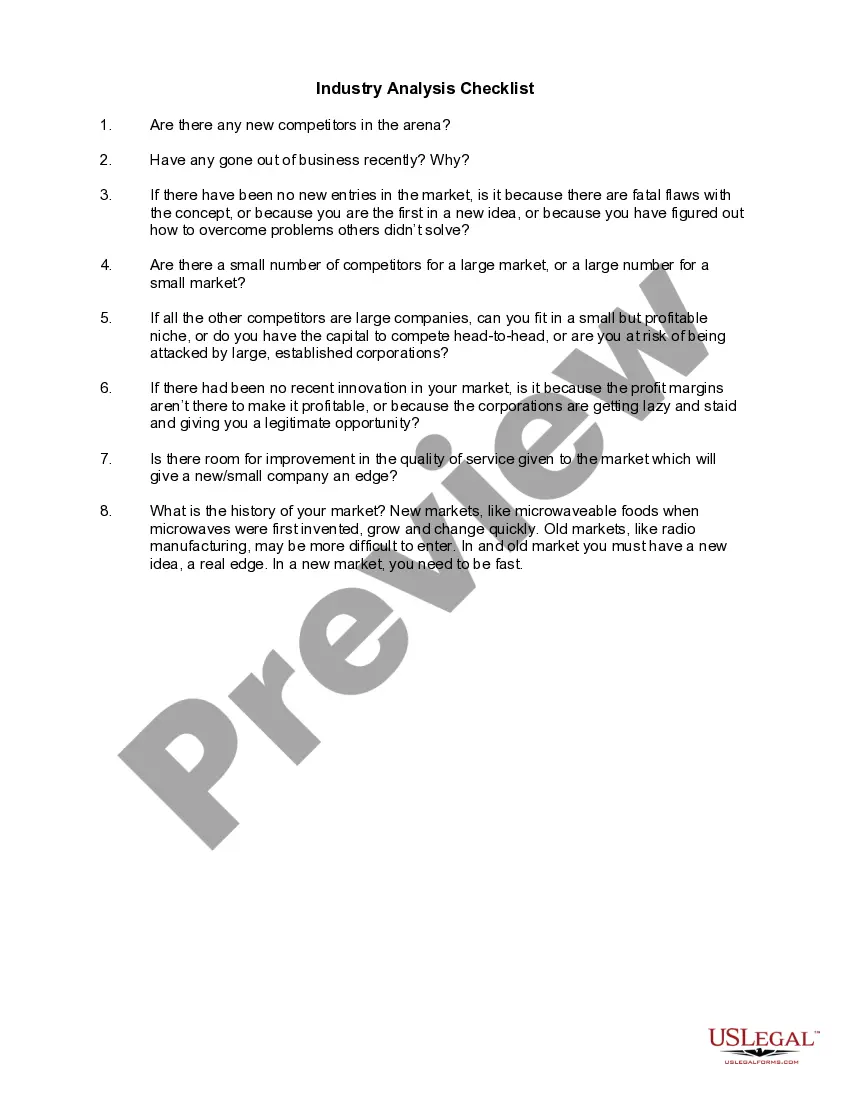
Industry Analysis Checklist For Business
Description
Get your form ready online
Our built-in tools help you complete, sign, share, and store your documents in one place.
Make edits, fill in missing information, and update formatting in US Legal Forms—just like you would in MS Word.
Download a copy, print it, send it by email, or mail it via USPS—whatever works best for your next step.
Sign and collect signatures with our SignNow integration. Send to multiple recipients, set reminders, and more. Go Premium to unlock E-Sign.
If this form requires notarization, complete it online through a secure video call—no need to meet a notary in person or wait for an appointment.
We protect your documents and personal data by following strict security and privacy standards.

Make edits, fill in missing information, and update formatting in US Legal Forms—just like you would in MS Word.

Download a copy, print it, send it by email, or mail it via USPS—whatever works best for your next step.

Sign and collect signatures with our SignNow integration. Send to multiple recipients, set reminders, and more. Go Premium to unlock E-Sign.

If this form requires notarization, complete it online through a secure video call—no need to meet a notary in person or wait for an appointment.

We protect your documents and personal data by following strict security and privacy standards.
Looking for another form?
How to fill out Industry Analysis Checklist?
Managing legal paperwork and processes can be a lengthy addition to your entire day. Industry Analysis Checklist For Business and similar forms typically necessitate that you find them and navigate how to fill them out correctly.
As a result, whether you are handling financial, legal, or personal affairs, utilizing a comprehensive and user-friendly online directory of forms readily available will greatly assist.
US Legal Forms is the leading online platform for legal templates, boasting over 85,000 state-specific forms and numerous resources that will enable you to finalize your documents swiftly.
Browse the collection of suitable documents accessible to you with just one click.
Next, follow these steps to complete your form: Ensure you have found the correct form by using the Preview feature and reviewing the form details. Select Buy Now when ready, and choose the subscription plan that fits you. Click Download then fill out, eSign, and print the form. US Legal Forms has 25 years of experience assisting clients with their legal documents. Find the form you need today and streamline any process effortlessly.
- US Legal Forms offers you state- and county-specific forms available for download at any time.
- Protect your document management processes by utilizing a high-quality service that allows you to create any form in minutes without any extra or hidden charges.
- Simply Log In to your account, locate Industry Analysis Checklist For Business, and obtain it immediately from the My documents section.
- You can also reach previously saved forms.
- Is it your first time using US Legal Forms? Register and set up your account in just a few minutes and you will gain access to the form directory and Industry Analysis Checklist For Business.
Form popularity
FAQ
While a SWOT analysis focuses on the strengths, weaknesses, opportunities, and threats of a specific business, it can complement an industry analysis. You can use the insights gained from an industry analysis checklist for business to inform your SWOT analysis, as understanding the broader industry context enhances your strategic planning. Thus, both analyses serve different purposes but can work together effectively.
To obtain an industry analysis, consider using online resources, industry reports, and market research databases. Additionally, platforms like US Legal Forms provide tools and templates that can simplify the process. By following an industry analysis checklist for business, you can ensure that you cover all essential aspects and gather comprehensive insights for your evaluation.
The 5 industry analysis refers to the five forces framework developed by Michael Porter, which helps assess industry competitiveness. These forces include the threat of new entrants, bargaining power of suppliers, bargaining power of buyers, threat of substitute products, and existing industry rivalry. Utilizing an industry analysis checklist for business enables you to systematically evaluate these forces, guiding your strategic planning effectively.
To carry out an industry analysis, start by gathering data on your target industry, including market trends, competitors, and customer demographics. Next, use an industry analysis checklist for business to evaluate key factors such as market size, growth potential, and regulatory environment. This structured approach allows you to identify opportunities and threats within the industry, helping you make informed decisions.
An example of industry analysis can be seen in the technology sector, where firms assess market trends, consumer demands, and competitor strategies. For instance, a company might examine the rise of cloud computing, shifting user preferences towards subscription models, and the competitive landscape among major tech companies. Utilizing an industry analysis checklist for business enables firms to adapt and innovate effectively, ensuring they remain competitive in a rapidly changing environment.
An industry analysis checklist for business typically includes a detailed examination of market dynamics, competition, and regulatory factors. This encompasses understanding the supply chain, key players, and potential barriers to entry. Moreover, it should assess the economic environment, consumer behavior, and emerging trends that could impact the industry. Such a comprehensive approach provides valuable insights for strategic decision-making.
An industry analysis checklist for business should cover several key elements. First, identify the industry’s size, growth rate, and trends, as these factors highlight the market's potential. Next, analyze the competitive landscape by evaluating major players, their market share, and competitive strategies. Additionally, consider customer demographics and preferences to understand the target audience better.
The four key steps to conducting an industry analysis are defining the industry, analyzing market trends, assessing competitive forces, and evaluating potential challenges. By following these steps, you can gain valuable insights that inform your business strategy. Incorporating an industry analysis checklist for business can ensure that you cover all essential aspects and make informed decisions.
To conduct an industry analysis for a business plan, start by researching the industry’s current state and future outlook. Utilize tools and frameworks to analyze competitors and market dynamics. An industry analysis checklist for business can guide you through key factors to include, such as customer demographics, market trends, and potential barriers to entry.
The five steps of business analysis include defining the problem, gathering data, analyzing the data, proposing solutions, and implementing those solutions. Each step builds on the previous one, ensuring a thorough approach to understanding business needs. By using an industry analysis checklist for business, you can streamline these steps and enhance your decision-making process.