Beneficiary Estate Form For 401k
Description
Get your form ready online
Our built-in tools help you complete, sign, share, and store your documents in one place.
Make edits, fill in missing information, and update formatting in US Legal Forms—just like you would in MS Word.
Download a copy, print it, send it by email, or mail it via USPS—whatever works best for your next step.
Sign and collect signatures with our SignNow integration. Send to multiple recipients, set reminders, and more. Go Premium to unlock E-Sign.
If this form requires notarization, complete it online through a secure video call—no need to meet a notary in person or wait for an appointment.
We protect your documents and personal data by following strict security and privacy standards.

Make edits, fill in missing information, and update formatting in US Legal Forms—just like you would in MS Word.

Download a copy, print it, send it by email, or mail it via USPS—whatever works best for your next step.

Sign and collect signatures with our SignNow integration. Send to multiple recipients, set reminders, and more. Go Premium to unlock E-Sign.

If this form requires notarization, complete it online through a secure video call—no need to meet a notary in person or wait for an appointment.

We protect your documents and personal data by following strict security and privacy standards.
Looking for another form?




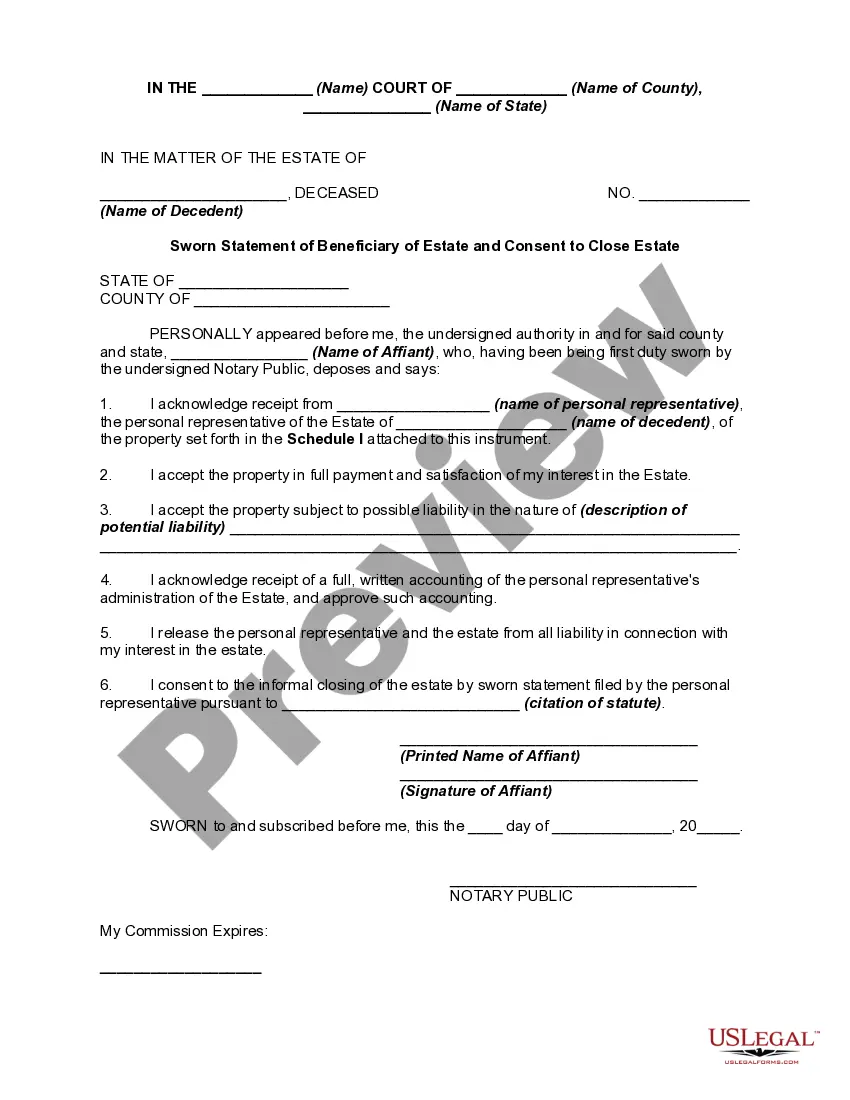
How to fill out Sworn Statement Of Beneficiary Of Estate And Consent To Close Estate - Uniform Probate Code?
Obtaining legal document examples that adhere to federal and state guidelines is essential, and the internet provides many choices to choose from.
However, why spend time searching for the right Beneficiary Estate Form For 401k template online when the US Legal Forms virtual library already has such documents gathered in one location.
US Legal Forms is the top online legal repository with over 85,000 editable templates created by lawyers for various professional and personal needs. They are simple to navigate with all documents categorized by state and purpose.
All documents you discover through US Legal Forms are reusable. To re-download and complete previously saved forms, navigate to the My documents section in your profile. Enjoy the widest and most user-friendly legal paperwork service!
- Our experts keep up to date with legal modifications, ensuring your form is current and compliant when you obtain a Beneficiary Estate Form For 401k from our platform.
- Acquiring a Beneficiary Estate Form For 401k is swift and straightforward for both existing and new customers.
- If you already possess an account with an active subscription, Log In and store the document sample you need in your desired format.
- If you're a newcomer to our site, follow the steps outlined below.
- Review the template using the Preview feature or through the text description to confirm it fulfills your needs.
Form popularity
FAQ
The deceased's estate should never be the beneficiary of a 401(k). To do that, either on purpose or simply by failing to name a beneficiary, means the 401(k) money will be disposed of by probate court, which may also delay the distribution of assets to heirs for months.
Roll the inherited 401(k) directly into your own 401(k) or IRA: This choice gives the inherited money more time to grow further. Regular 401(k) rules apply for withdrawals prior to retirement age, meaning you'll pay a 10 percent penalty for early withdrawals before age 59 ½.
You have four options as a surviving non-spouse beneficiary: Transferring to an inherited IRA. ... Take a lump-sum distribution. ... Withdraw funds over a 5 or 10 year period. ... Take the required minimum distributions based on your life expectancy.
Beneficiaries can decline to inherit their portion, in which case assets would go to the next eligible beneficiaries. If there are no other beneficiaries or they disclaim as well, the assets will pass to the account owner's estate and become subject to probate.
Write the names of the first beneficiary(ies) you would like to receive your benefit after you die. You may name an individual(s), entity (such as a charity, business, religious organization, funeral home, etc.), trust, or estate. You may name more than one.