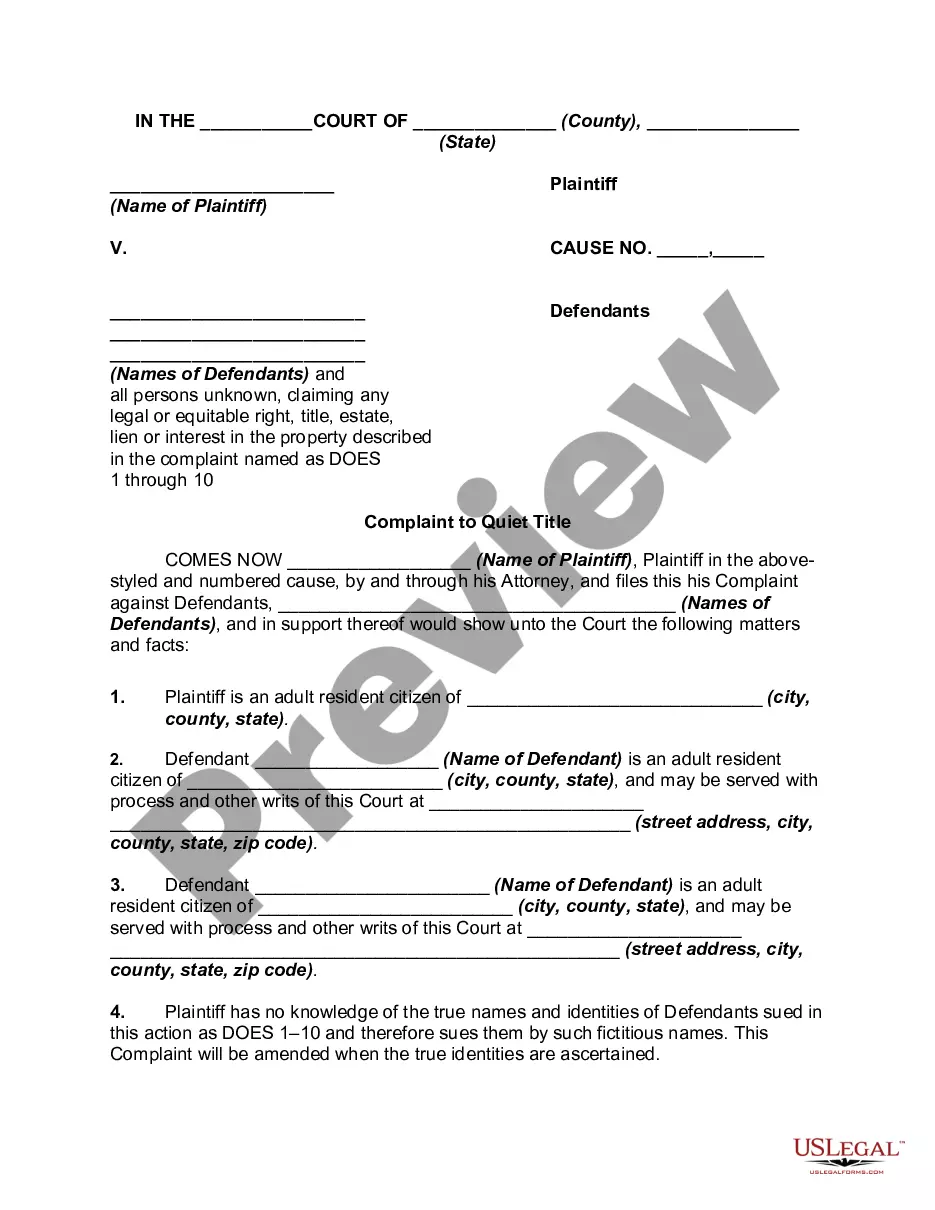
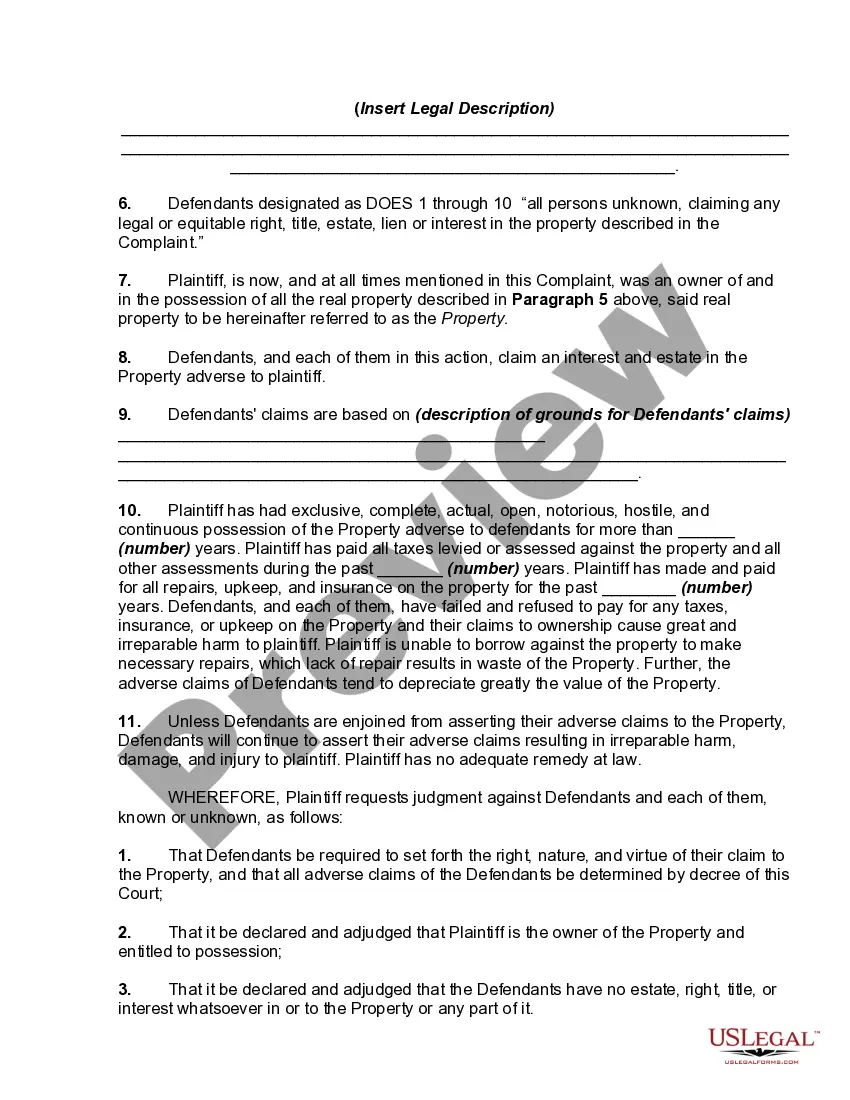
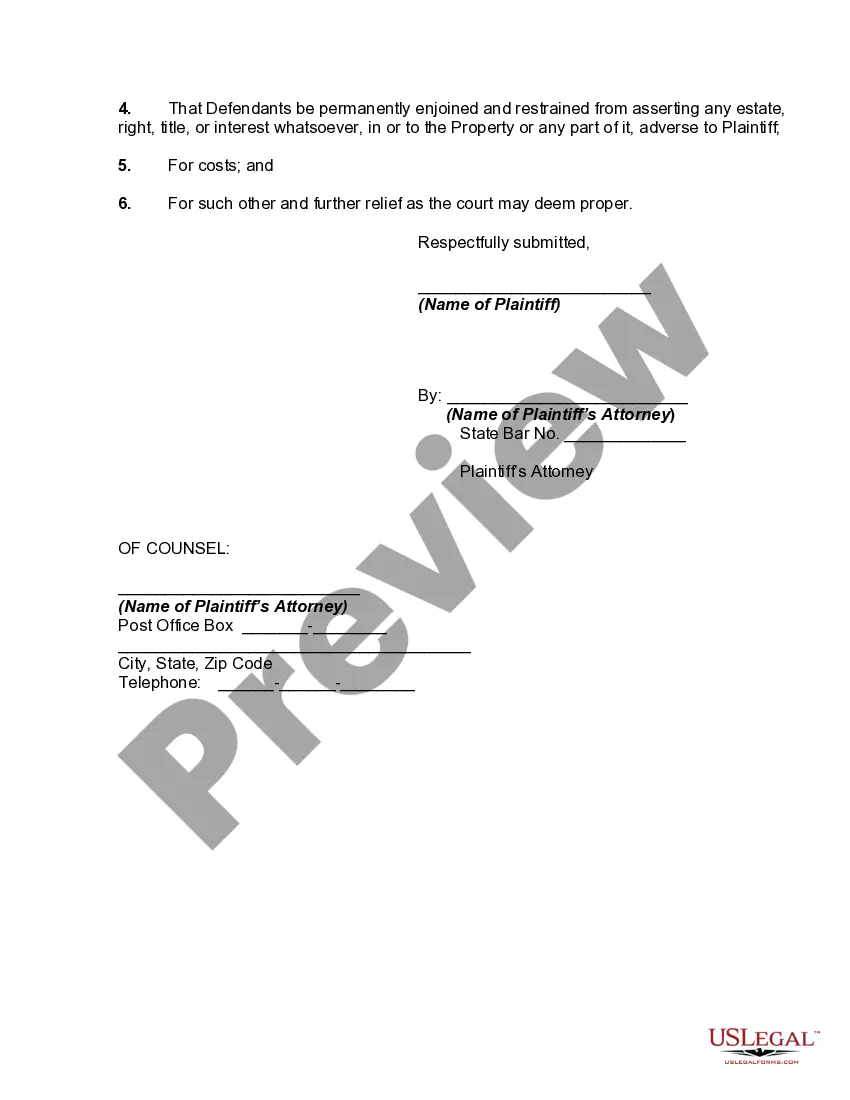
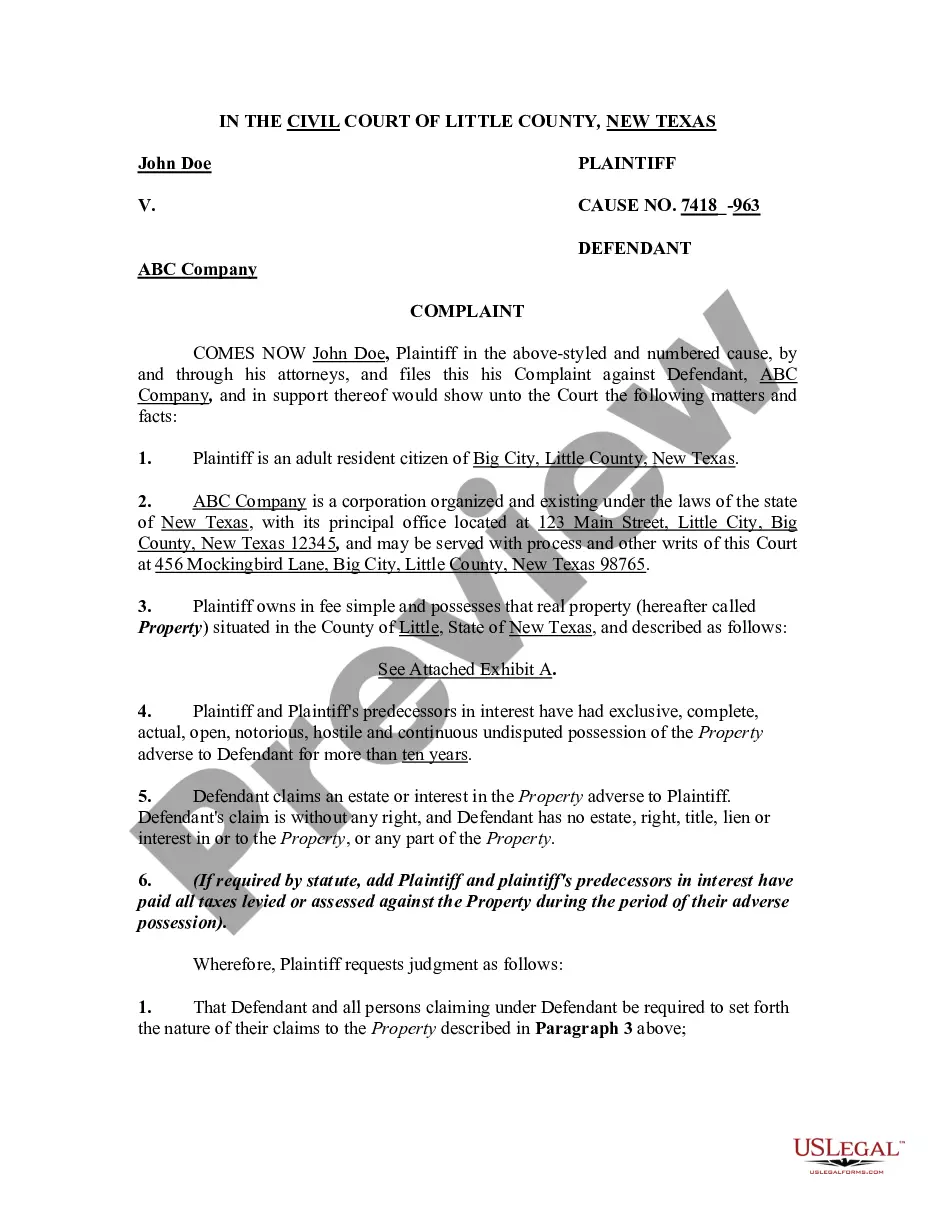
Quiet Title Action California Sample With Notice

Description
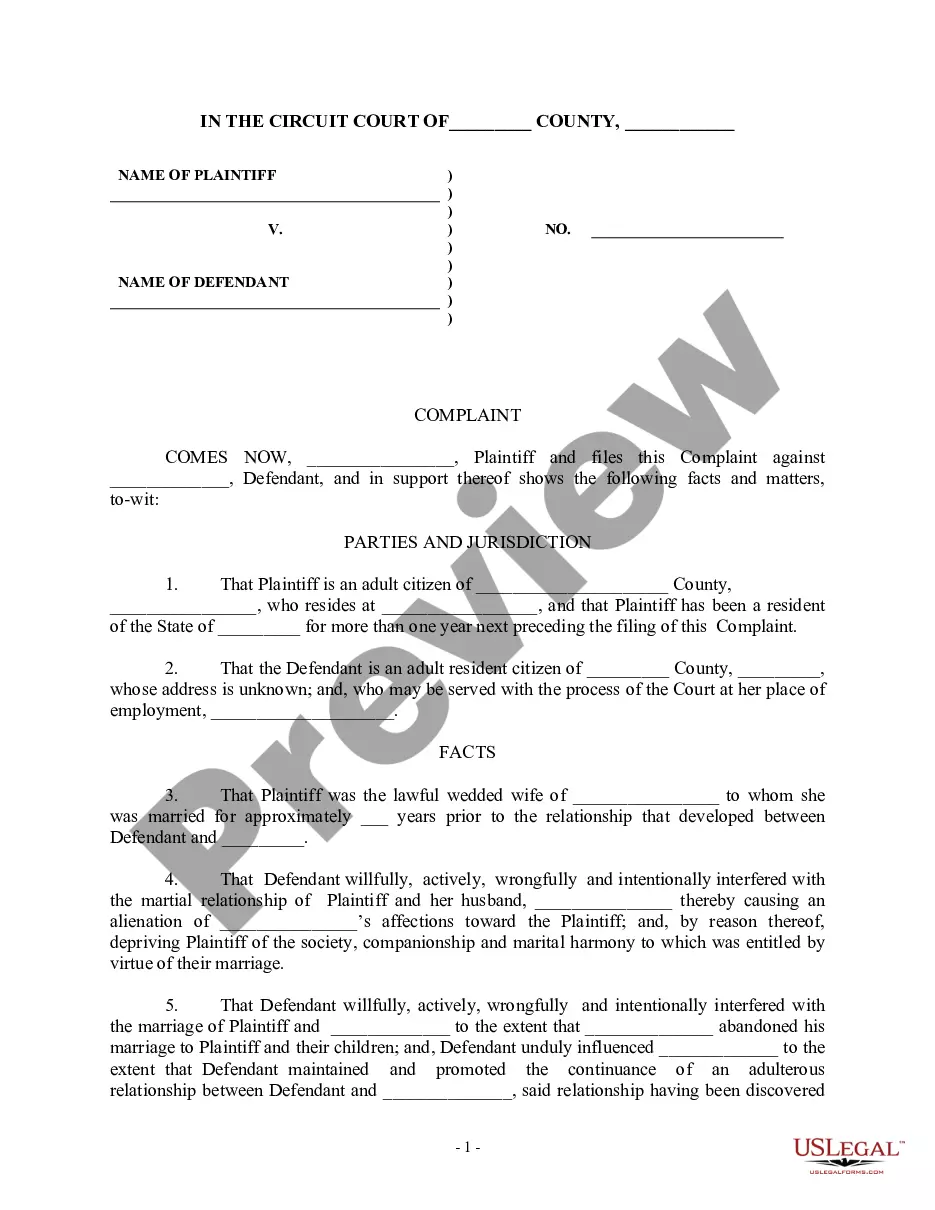
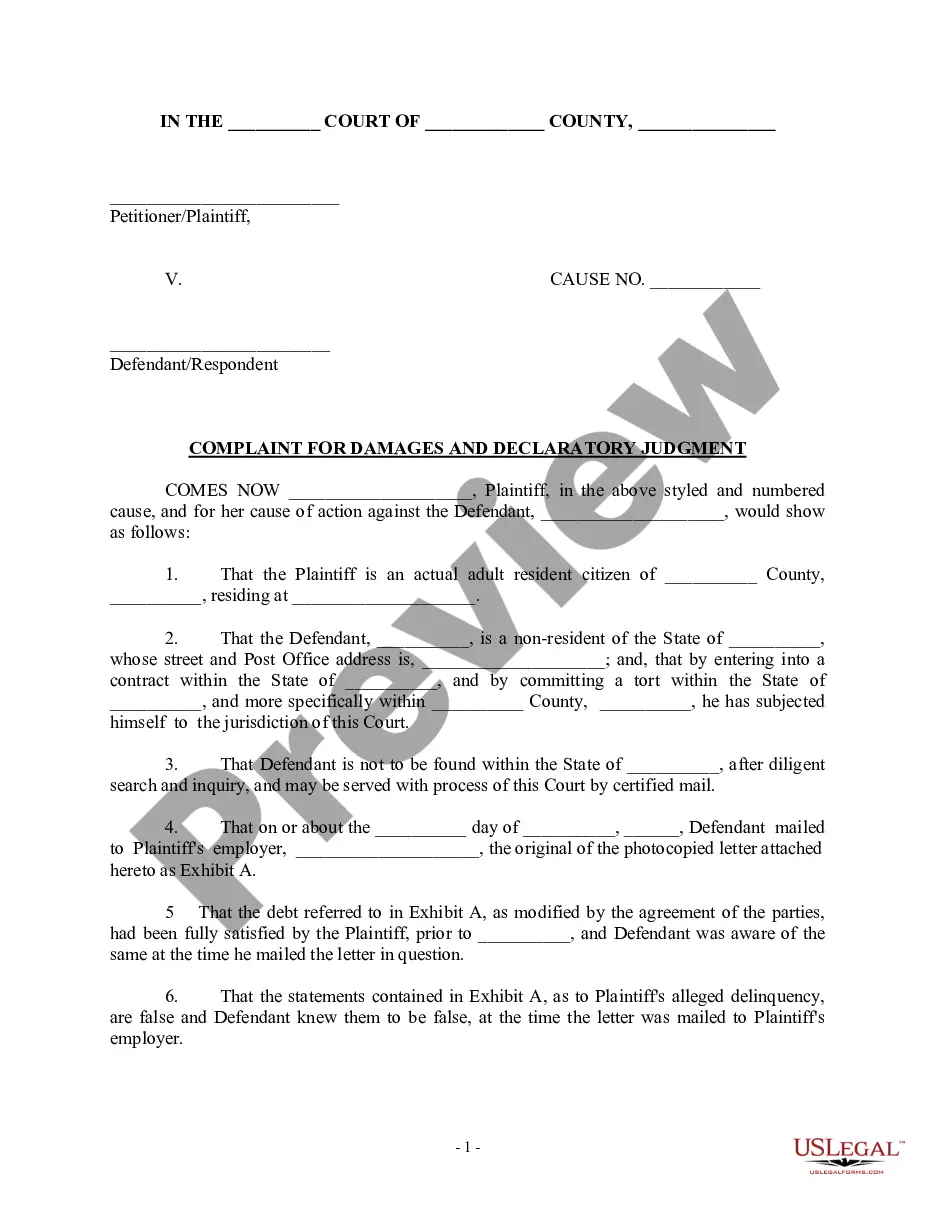
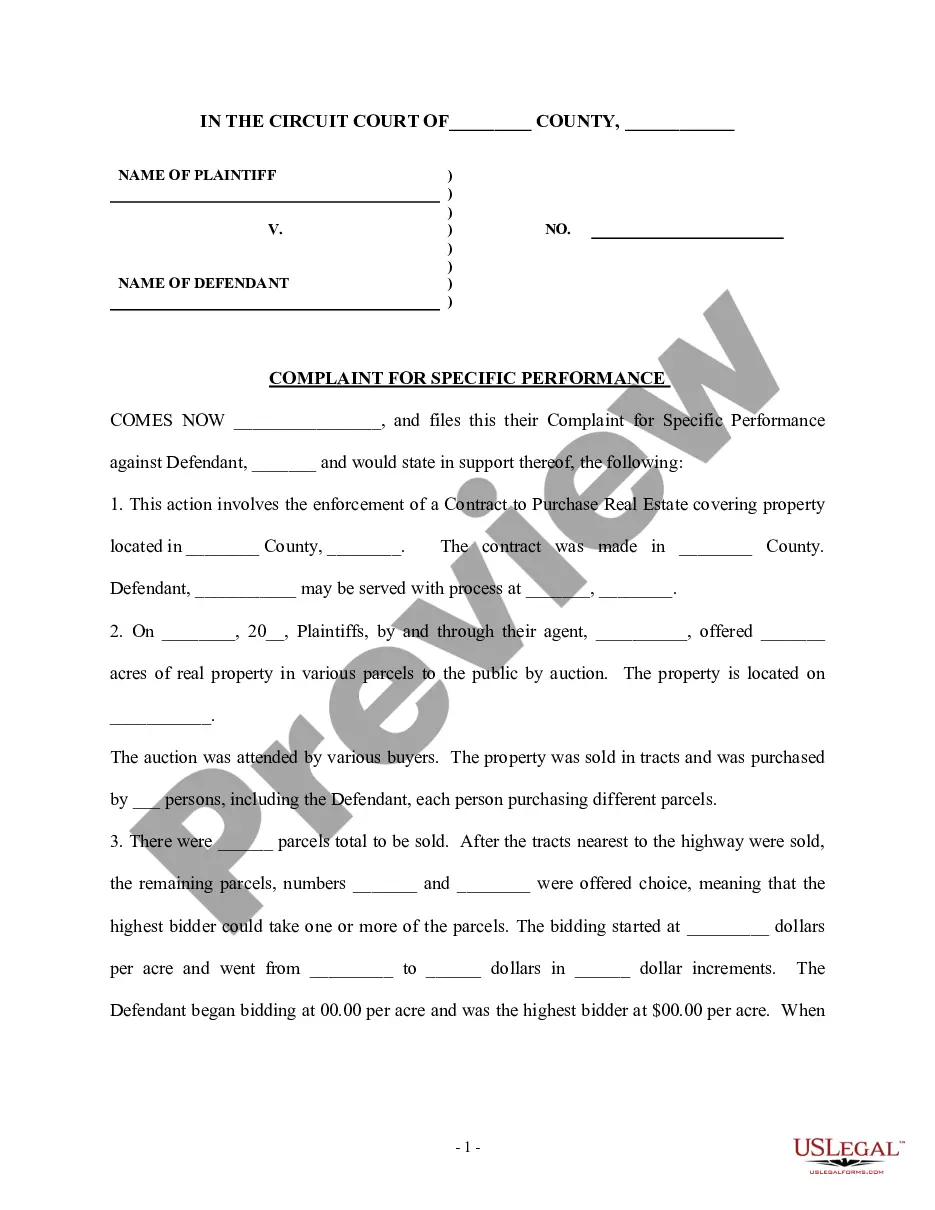
Get your form ready online
Our built-in tools help you complete, sign, share, and store your documents in one place.
Make edits, fill in missing information, and update formatting in US Legal Forms—just like you would in MS Word.
Download a copy, print it, send it by email, or mail it via USPS—whatever works best for your next step.
Sign and collect signatures with our SignNow integration. Send to multiple recipients, set reminders, and more. Go Premium to unlock E-Sign.
If this form requires notarization, complete it online through a secure video call—no need to meet a notary in person or wait for an appointment.
We protect your documents and personal data by following strict security and privacy standards.

Make edits, fill in missing information, and update formatting in US Legal Forms—just like you would in MS Word.

Download a copy, print it, send it by email, or mail it via USPS—whatever works best for your next step.

Sign and collect signatures with our SignNow integration. Send to multiple recipients, set reminders, and more. Go Premium to unlock E-Sign.

If this form requires notarization, complete it online through a secure video call—no need to meet a notary in person or wait for an appointment.

We protect your documents and personal data by following strict security and privacy standards.
Looking for another form?
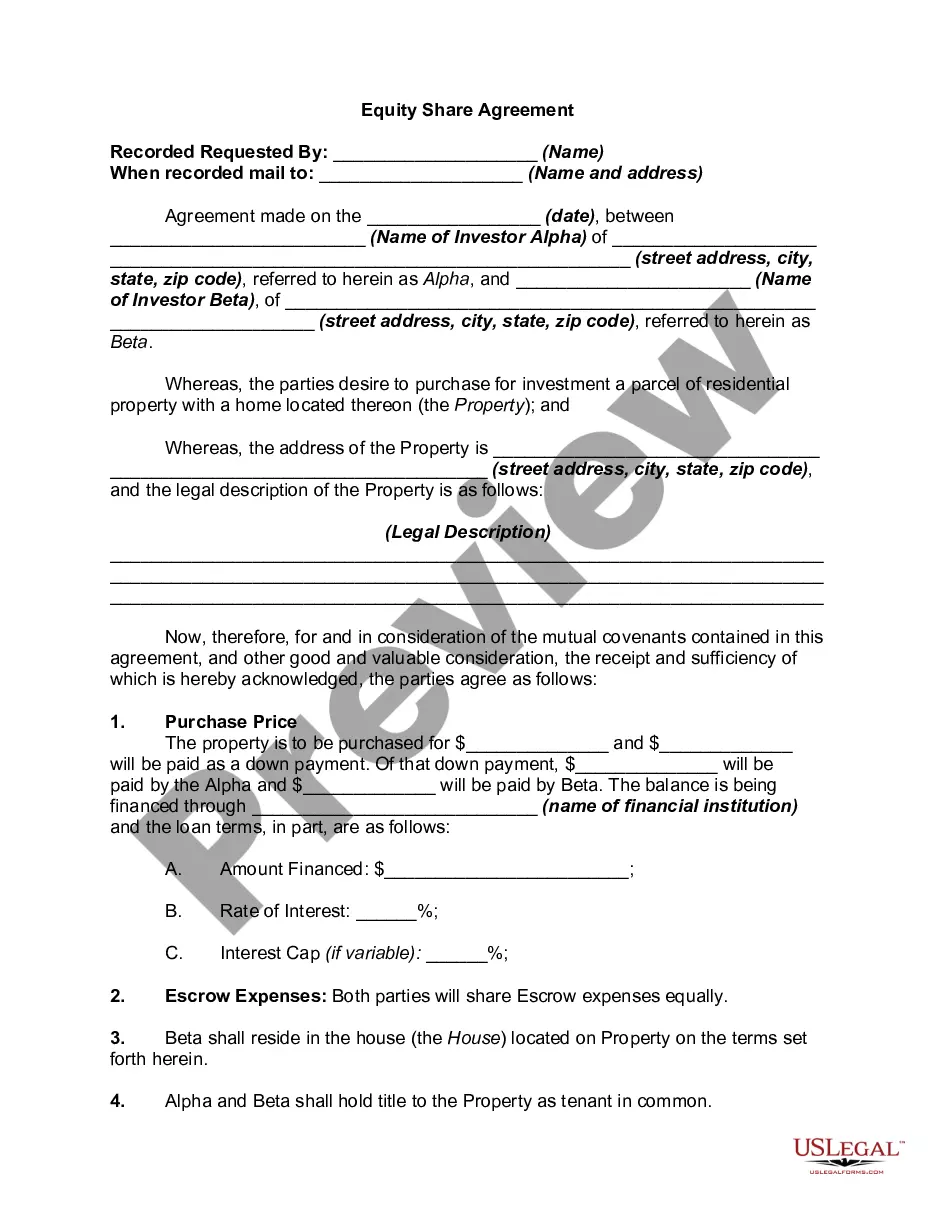
How to fill out Complaint To Quiet Title By Adverse Possessor With Unknown Defendants?
Whether for corporate reasons or personal matters, everyone eventually encounters legal situations in their lifetime.
Filling out legal documents demands meticulous attention, starting from choosing the right form template.
Once saved, you can fill out the form using editing software or print it to complete it by hand. With a vast US Legal Forms catalog at your disposal, you will never need to waste time searching for the right sample online. Utilize the library’s intuitive navigation to find the appropriate form for any occasion.
- For example, selecting the incorrect version of a Quiet Title Action California Sample With Notice will result in its rejection upon submission.
- Consequently, it is vital to acquire a trustworthy source of legal documents like US Legal Forms.
- If you need to obtain a Quiet Title Action California Sample With Notice template, adhere to these straightforward steps.
- Locate the sample you need via the search bar or catalog browsing.
- Review the form’s details to confirm it aligns with your circumstances, state, and locality.
- Click on the form’s preview to inspect it.
- If it is the wrong document, return to the search function to find the Quiet Title Action California Sample With Notice template you require.
- Download the file if it meets your requirements.
- If you already possess a US Legal Forms account, click Log in to access previously saved documents in My documents.
- If you have yet to create an account, you may acquire the form by clicking Buy now.
- Select the suitable pricing option.
- Complete the profile registration form.
- Choose your payment method: either a credit card or PayPal account.
- Select the document format you prefer and download the Quiet Title Action California Sample With Notice.
Form popularity
FAQ
Filing a quiet title action in California involves several straightforward steps. Start by drafting a complaint that clearly states your claim, and consider using a quiet title action California sample with notice for guidance. After preparing the necessary documents, file them in your local Superior Court. Don't forget to provide proper notice to all parties with a legal interest in the property, enabling them to contest your claim if necessary.
To quiet title in California, you need to begin by gathering all relevant documentation regarding your claim. This includes property deeds and any existing liens. Using a quiet title action California sample with notice as a reference, you should prepare and file your complaint in the appropriate court. Following this, make sure to serve notice to all interested parties, allowing them to participate in the proceedings.
The process of initiating a quiet title action typically involves several key steps. First, you should file a complaint that outlines your claim to the property, often including a quiet title action California sample with notice. Next, you will serve the necessary parties with notice, allowing them the opportunity to respond. Finally, a court hearing will take place, where you present your case and the court renders a decision regarding ownership.
In a quiet title action in California, the burden of proof lies with the party seeking to establish their claim to the property. They must provide sufficient evidence to demonstrate that their ownership rights are superior to any other claims. This often includes submitting relevant documents, such as the quiet title action California sample with notice, to support their case. Ultimately, the court evaluates the evidence presented to determine the rightful owner.
A situation where a property owner faces challenges from multiple claims is typically considered a quiet title action. This can include disputes arising from tax liens, boundary issues, or claims made by previous owners. It is advisable to look at a quiet title action California sample with notice to understand the framework and strategy for resolving such disputes effectively.
In California, the burden of proof in a quiet title action lies with the person filing the suit. They must demonstrate their rightful ownership through evidence, which may include property records, previous titles, and relevant documents. To illustrate the requirements, reviewing a quiet title action California sample with notice can be beneficial.
A quiet title is a legal action aimed at resolving disputes about ownership of property. For example, if someone inherits property but the title remains unclear due to old claims, they might file a quiet title action to establish clear title. Studying a quiet title action California sample with notice can help you understand the typical components of such a case.
An example of a quiet title action would be when a homeowner wants to resolve a dispute over a property line that has not been legally defined. For instance, if two neighbors claim part of the same land, a quiet title action can clarify ownership. Reviewing a quiet title action California sample with notice can provide valuable insights into the process and necessary documentation.
To achieve a successful quiet title action in California, it is essential to provide clear evidence of your ownership. Begin by gathering all relevant documents, like your deed or prior title records, that support your claim. Additionally, serve proper notice to all parties with a potential interest in the property, as outlined in a quiet title action California sample with notice.
An example of a quiet title action involves a property owner seeking to clarify ownership disputes. Suppose you inherit a property with multiple claims on it, you would initiate a quiet title action to remove these claims. In California, this process includes filing a notice to inform all interested parties about the action. For a clear understanding, consider reviewing a 'Quiet title action California sample with notice' to see how the documents are structured.