Account Estate Forms For Nc
Description
Get your form ready online
Our built-in tools help you complete, sign, share, and store your documents in one place.
Make edits, fill in missing information, and update formatting in US Legal Forms—just like you would in MS Word.
Download a copy, print it, send it by email, or mail it via USPS—whatever works best for your next step.
Sign and collect signatures with our SignNow integration. Send to multiple recipients, set reminders, and more. Go Premium to unlock E-Sign.
If this form requires notarization, complete it online through a secure video call—no need to meet a notary in person or wait for an appointment.
We protect your documents and personal data by following strict security and privacy standards.

Make edits, fill in missing information, and update formatting in US Legal Forms—just like you would in MS Word.

Download a copy, print it, send it by email, or mail it via USPS—whatever works best for your next step.

Sign and collect signatures with our SignNow integration. Send to multiple recipients, set reminders, and more. Go Premium to unlock E-Sign.

If this form requires notarization, complete it online through a secure video call—no need to meet a notary in person or wait for an appointment.

We protect your documents and personal data by following strict security and privacy standards.
Looking for another form?




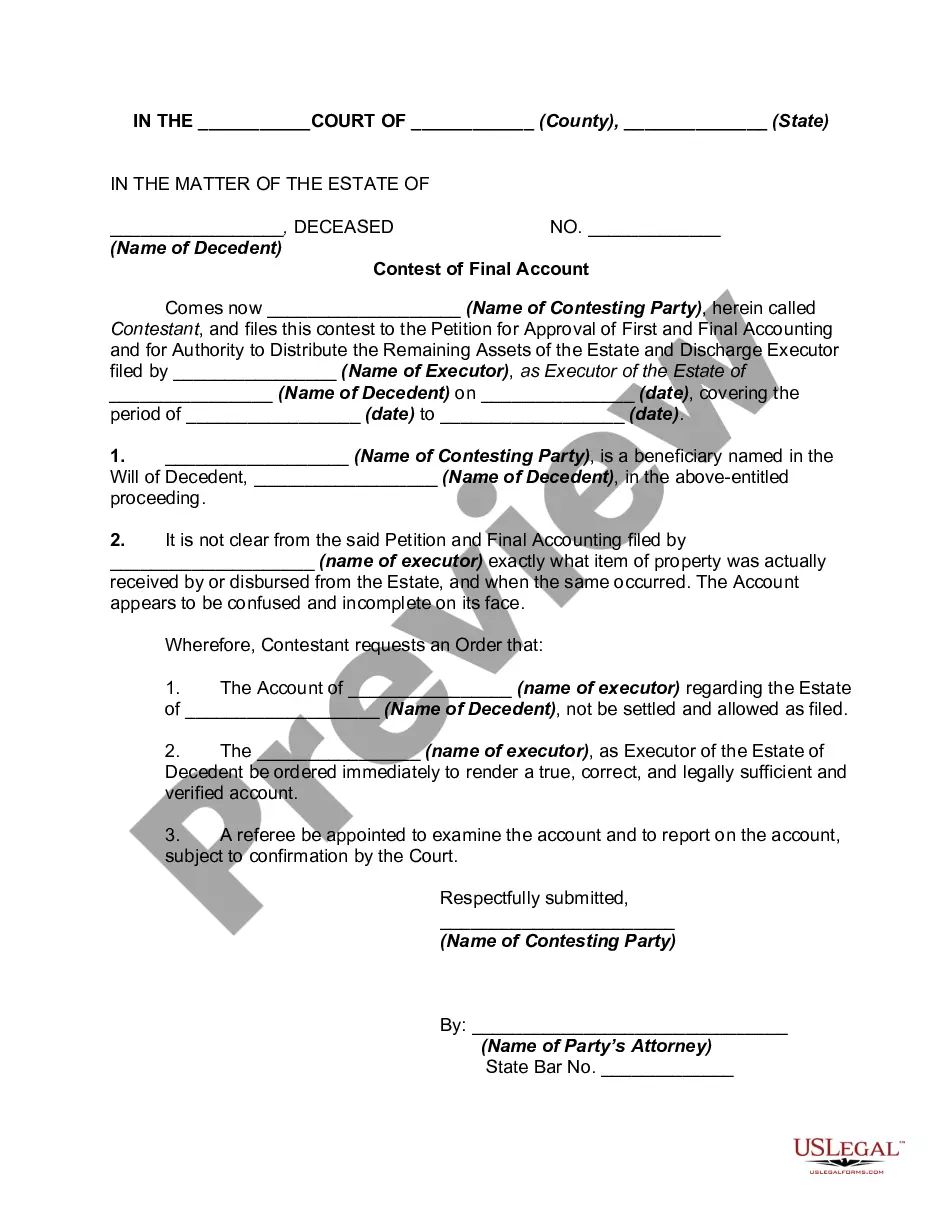
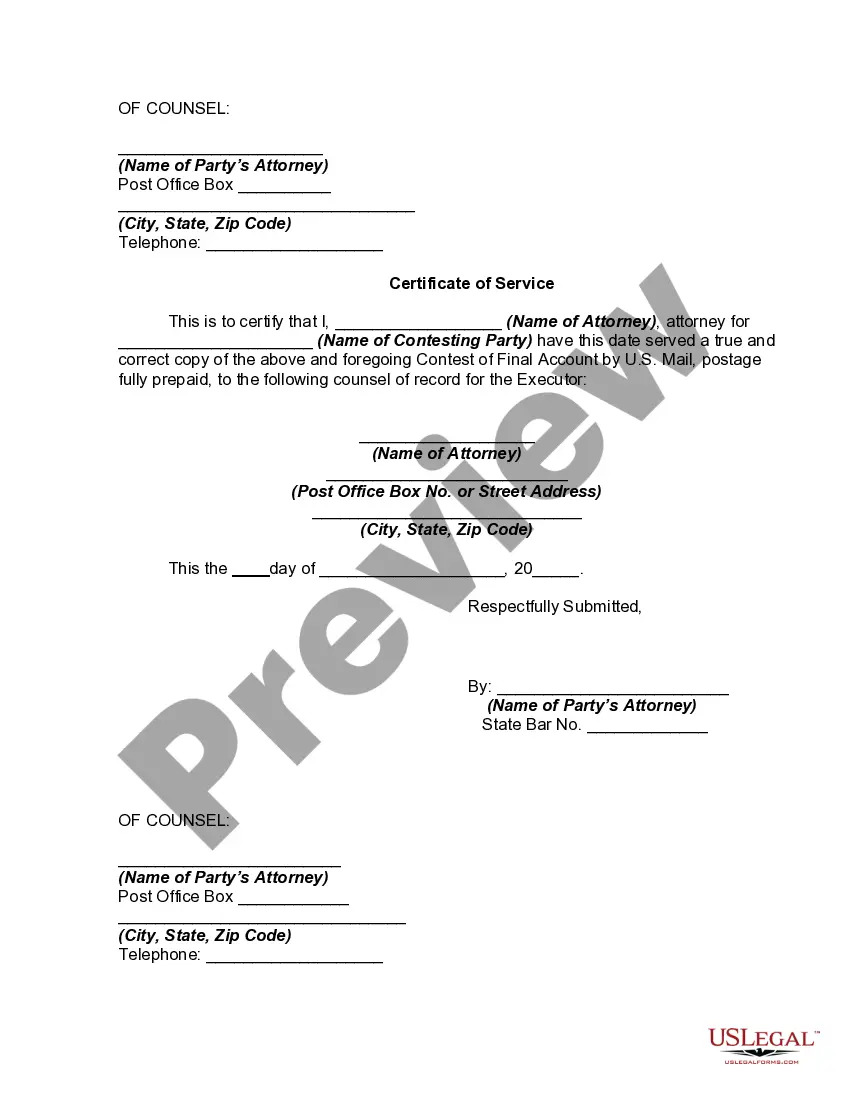
How to fill out Contest Of Final Account And Proposed Distributions In A Probate Estate?
Whether for commercial objectives or for individual matters, everyone must deal with legal issues at some point in their lives.
Filling out legal documents demands meticulous care, beginning with selecting the appropriate form example. For example, if you select an incorrect version of the Account Estate Forms For Nc, it will be rejected upon submission. Thus, it is essential to obtain a reliable source of legal documents like US Legal Forms.
With a comprehensive US Legal Forms catalog available, you do not need to waste time searching for the correct template online. Utilize the library’s user-friendly navigation to find the suitable template for any event.
- Locate the template you require by using the search bar or browsing through the catalog.
- Review the form’s description to ensure it aligns with your circumstances, state, and county.
- Click on the form’s preview to inspect it.
- If this is the incorrect document, return to the search feature to find the Account Estate Forms For Nc sample you need.
- Obtain the file once it meets your requirements.
- If you already possess a US Legal Forms account, click Log in to access previously saved templates in My documents.
- If you do not have an account yet, you can download the form by clicking Buy now.
- Select the appropriate pricing option.
- Complete the account registration form.
- Choose your payment method: a bank card or PayPal account can be used.
- Select the file format you desire and download the Account Estate Forms For Nc.
- After downloading, you can fill out the form using editing software or print it and complete it by hand.
Form popularity
FAQ
You should bring: (1) the will if there was one, (2) a certified death certificate, (3) an application and preliminary inventory of the decedent's property; and (4) a $120 filing fee. Forms needed may be obtained from the clerk of court's office or on this website.
On the 90-day inventory form, you will need to list the following information: The decedent's county of residence. The decedent's name. Any accounts in the sole name of the decedent and their value. Any joint accounts, the percentage the decedent owned, and their value.
If the value of the estate isn't too large, North Carolina offers an unusual procedure, which lets you get approval from the local probate (superior) court to wind up the estate without formal probate. All you need to do is to file one simple form with the court.
Do All Estates Have to Go Through Probate in North Carolina? Smaller estates with probate-qualified assets valued at less than $20,000 can avoid the formal probate proceeding. If the surviving spouse inherits the whole estate, however, the estate's value can't exceed $30,000 if probate is to be avoided.
If a year has passed since the Executor was qualified, the Executor must either submit a Final Account [Form AOC-E-506] to close out the estate, or an Annual Account [also Form AOC-E-506] if the estate is not ready to be closed.