Account Estate Application With No Will
Description
Get your form ready online
Our built-in tools help you complete, sign, share, and store your documents in one place.
Make edits, fill in missing information, and update formatting in US Legal Forms—just like you would in MS Word.
Download a copy, print it, send it by email, or mail it via USPS—whatever works best for your next step.
Sign and collect signatures with our SignNow integration. Send to multiple recipients, set reminders, and more. Go Premium to unlock E-Sign.
If this form requires notarization, complete it online through a secure video call—no need to meet a notary in person or wait for an appointment.
We protect your documents and personal data by following strict security and privacy standards.

Make edits, fill in missing information, and update formatting in US Legal Forms—just like you would in MS Word.

Download a copy, print it, send it by email, or mail it via USPS—whatever works best for your next step.

Sign and collect signatures with our SignNow integration. Send to multiple recipients, set reminders, and more. Go Premium to unlock E-Sign.

If this form requires notarization, complete it online through a secure video call—no need to meet a notary in person or wait for an appointment.

We protect your documents and personal data by following strict security and privacy standards.
Looking for another form?


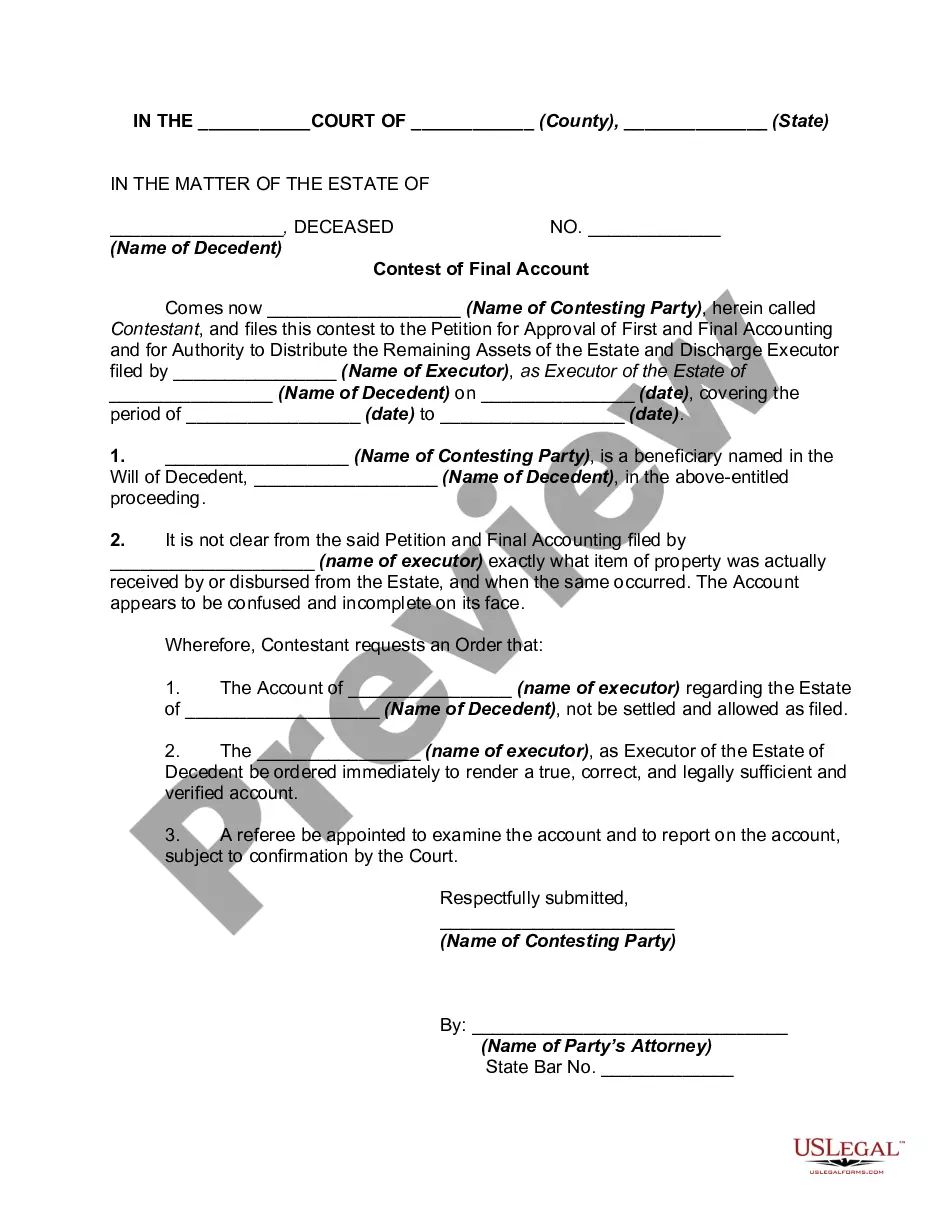
How to fill out Contest Of Final Account And Proposed Distributions In A Probate Estate?
Regardless of whether for commercial reasons or personal matters, everyone must confront legal circumstances at some point in their lives.
Completing legal documents demands meticulous consideration, beginning with selecting the suitable form template. For example, if you choose an incorrect version of an Account Estate Application Without a Will, it will be rejected upon submission.
With an extensive US Legal Forms collection available, you do not need to waste time searching for the right template online. Make use of the library’s straightforward navigation to find the appropriate template for any scenario.
- Locate the template you require using the search bar or catalog browsing.
- Review the form’s description to confirm it aligns with your circumstances, state, and county.
- Click on the form’s preview to examine it.
- If it is the incorrect form, return to the search feature to locate the Account Estate Application Without a Will sample you need.
- Download the template when it satisfies your requirements.
- If you already possess a US Legal Forms profile, simply click Log in to access previously stored documents in My documents.
- If you do not yet have an account, you can download the form by clicking Buy now.
- Select the relevant pricing option.
- Fill out the profile registration form.
- Choose your payment method: you can utilize a credit card or PayPal account.
- Select the file format you desire and download the Account Estate Application Without a Will.
- After downloading, you can complete the form using editing software or print it and finish it by hand.
Form popularity
FAQ
'Estate of' accounts can be opened at any bank. All Executor(s)/Administrator(s)/next of kin must visit their chosen branch with the Death Certificate and Will (if applicable) and advise the staff that they wish to open an 'Estate of' account.
The first thing to understand is that the check belongs to the decedent's estate, not to you. As such, you'll need legal authority to cash or deposit the check. Typically, this requires being named as the executor or administrator of the estate via the probate process.
If you have no spouse or children, your property will be split among your parents and/or siblings, depending on who survives you: If both parents are still living, ½ goes to Mother and ½ goes to Father. If one parent and siblings (or siblings' descendants) are still living, ½ goes to surviving parent and ½ to siblings.
How to open an estate account Begin the probate process. The steps for beginning this process depend on the state in which the deceased person resided. ... Obtain a tax ID number for the estate account. ... Bring all required documents to the bank. ... Open the estate account.
This depends on whether they had the right documents and how the property and debt are categorized. Probate may still be necessary depending on the estate's size and type of property and debt.