Copyright Book Rights For Music
Description
Get your form ready online
Our built-in tools help you complete, sign, share, and store your documents in one place.
Make edits, fill in missing information, and update formatting in US Legal Forms—just like you would in MS Word.
Download a copy, print it, send it by email, or mail it via USPS—whatever works best for your next step.
Sign and collect signatures with our SignNow integration. Send to multiple recipients, set reminders, and more. Go Premium to unlock E-Sign.
If this form requires notarization, complete it online through a secure video call—no need to meet a notary in person or wait for an appointment.
We protect your documents and personal data by following strict security and privacy standards.

Make edits, fill in missing information, and update formatting in US Legal Forms—just like you would in MS Word.

Download a copy, print it, send it by email, or mail it via USPS—whatever works best for your next step.

Sign and collect signatures with our SignNow integration. Send to multiple recipients, set reminders, and more. Go Premium to unlock E-Sign.

If this form requires notarization, complete it online through a secure video call—no need to meet a notary in person or wait for an appointment.

We protect your documents and personal data by following strict security and privacy standards.
Looking for another form?









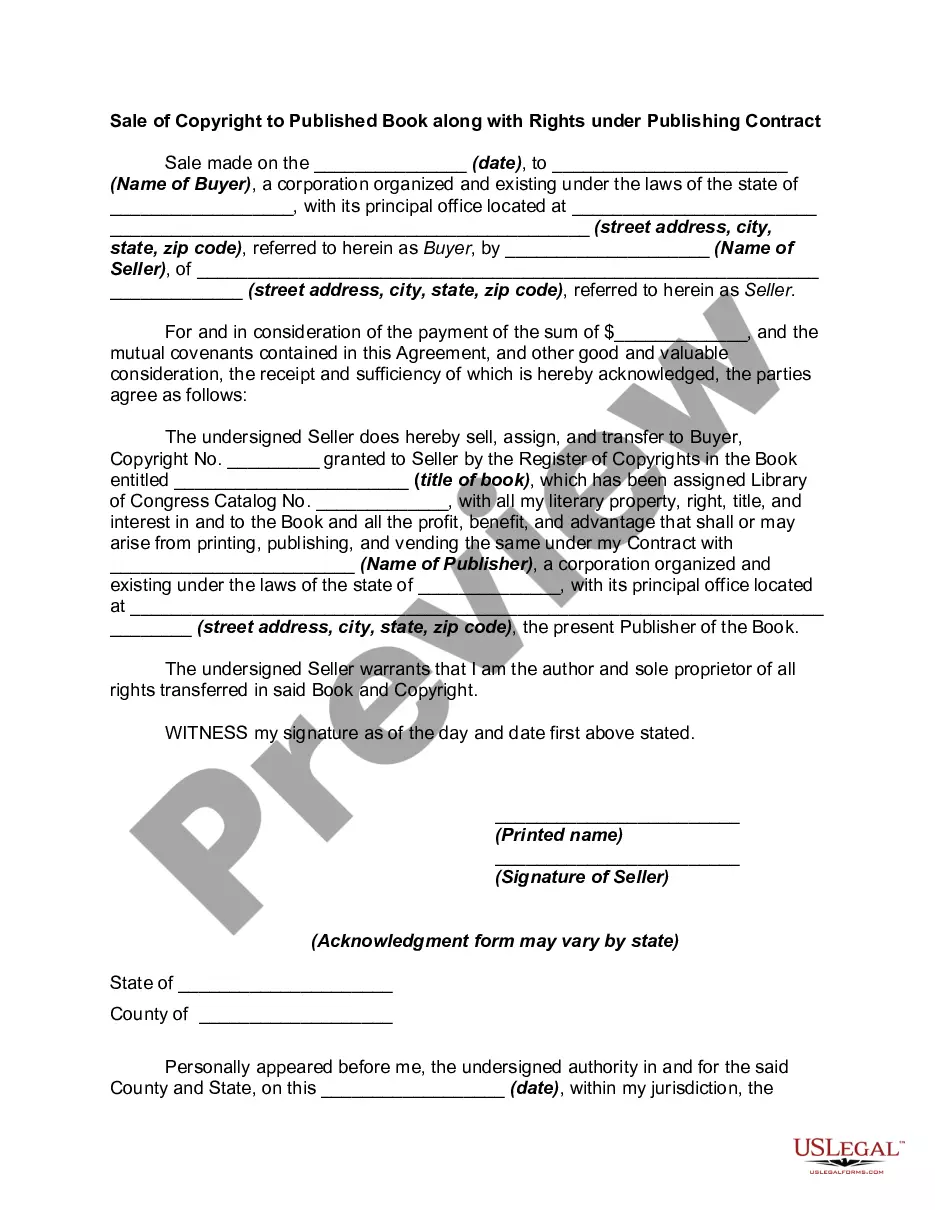
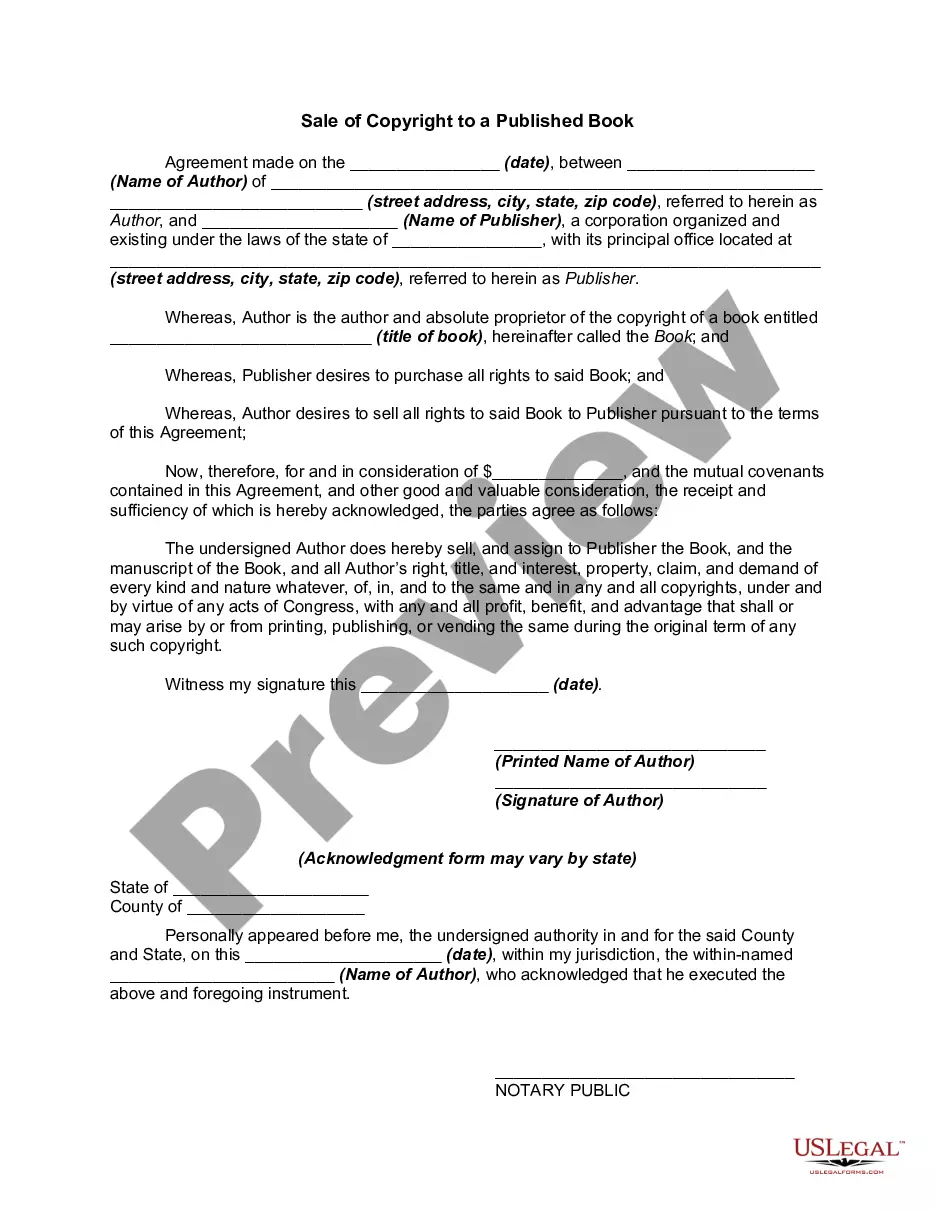
How to fill out Sale Of Copyright To Published Book Along With Rights Under Publishing?
It’s well known that you cannot transform into a legal authority in a single night, nor can you swiftly acquire the ability to draft Copyright Book Rights For Music without possessing a specialized skill set.
Formulating legal documents is a labor-intensive undertaking that demands specific training and expertise. So why not delegate the preparation of the Copyright Book Rights For Music to the experts.
With US Legal Forms, which boasts one of the largest collections of legal templates, you can discover everything from court documents to templates for internal corporate communications.
You can revisit your documents anytime from the My documents section. If you’re a current client, you can simply Log In and locate and download the template from the same section.
Regardless of the objective of your documents—be it financial and legal or personal—our platform has you covered. Give US Legal Forms a try today!
- Recognize the form you require using the search bar located at the top of the webpage.
- Preview it (if applicable) and review the accompanying description to ascertain whether Copyright Book Rights For Music meets your needs.
- Initiate your search anew if you need another form.
- Sign up for a free account and select a subscription plan to purchase the template.
- Click Buy now. Once the payment is finalized, you can obtain the Copyright Book Rights For Music, complete it, print it, and send or mail it to the appropriate individuals or organizations.
Form popularity
FAQ
To clearly state that you do not own the rights to a piece of music, you can write, 'I do not own the rights to this music.' This phrase not only informs your audience but also protects you legally. Including this wording can help avoid copyright issues, particularly when sharing copyrighted music. Always ensure you respect copyright law by being transparent about music ownership.
Form and Placement of the Copyright Notice: The symbol © (the letter C in a circle), or the word "Copyright" or the abbreviation "Copr."; The year of first publication of the work; and. The name of the owner of copyright in the work.
The page should contain your name, the year of publication, an International Standard Book Number (ISBN) for identification, a reservation of rights, the book edition, the copyright symbol, and a disclaimer that informs the reader that any advice or information taken from their book is entirely at their own discretion.
In general, the permissions process involves a simple five-step procedure: Determine if permission is needed. Identify the owner. Identify the rights needed. Contact the owner and negotiate whether payment is required. Get your permission agreement in writing.
Using a disclaimer such as ?I do not own the rights to this music? does not make it legal to use copyrighted songs without permission or proper licensing. Such a disclaimer can be seen as an admission of guilt, acknowledging that the user knows they are using copyrighted material without authorisation.
Luckily, this is really easy to do! In fact, music is automatically copyrighted the moment you create it in a tangible medium; like on paper or on an audio recording. That's right! All you have to do is write your original song down on paper or record it, and you own the copyright.