Copyright 2001
Description
Get your form ready online
Our built-in tools help you complete, sign, share, and store your documents in one place.
Make edits, fill in missing information, and update formatting in US Legal Forms—just like you would in MS Word.
Download a copy, print it, send it by email, or mail it via USPS—whatever works best for your next step.
Sign and collect signatures with our SignNow integration. Send to multiple recipients, set reminders, and more. Go Premium to unlock E-Sign.
If this form requires notarization, complete it online through a secure video call—no need to meet a notary in person or wait for an appointment.
We protect your documents and personal data by following strict security and privacy standards.

Make edits, fill in missing information, and update formatting in US Legal Forms—just like you would in MS Word.

Download a copy, print it, send it by email, or mail it via USPS—whatever works best for your next step.

Sign and collect signatures with our SignNow integration. Send to multiple recipients, set reminders, and more. Go Premium to unlock E-Sign.

If this form requires notarization, complete it online through a secure video call—no need to meet a notary in person or wait for an appointment.

We protect your documents and personal data by following strict security and privacy standards.
Looking for another form?


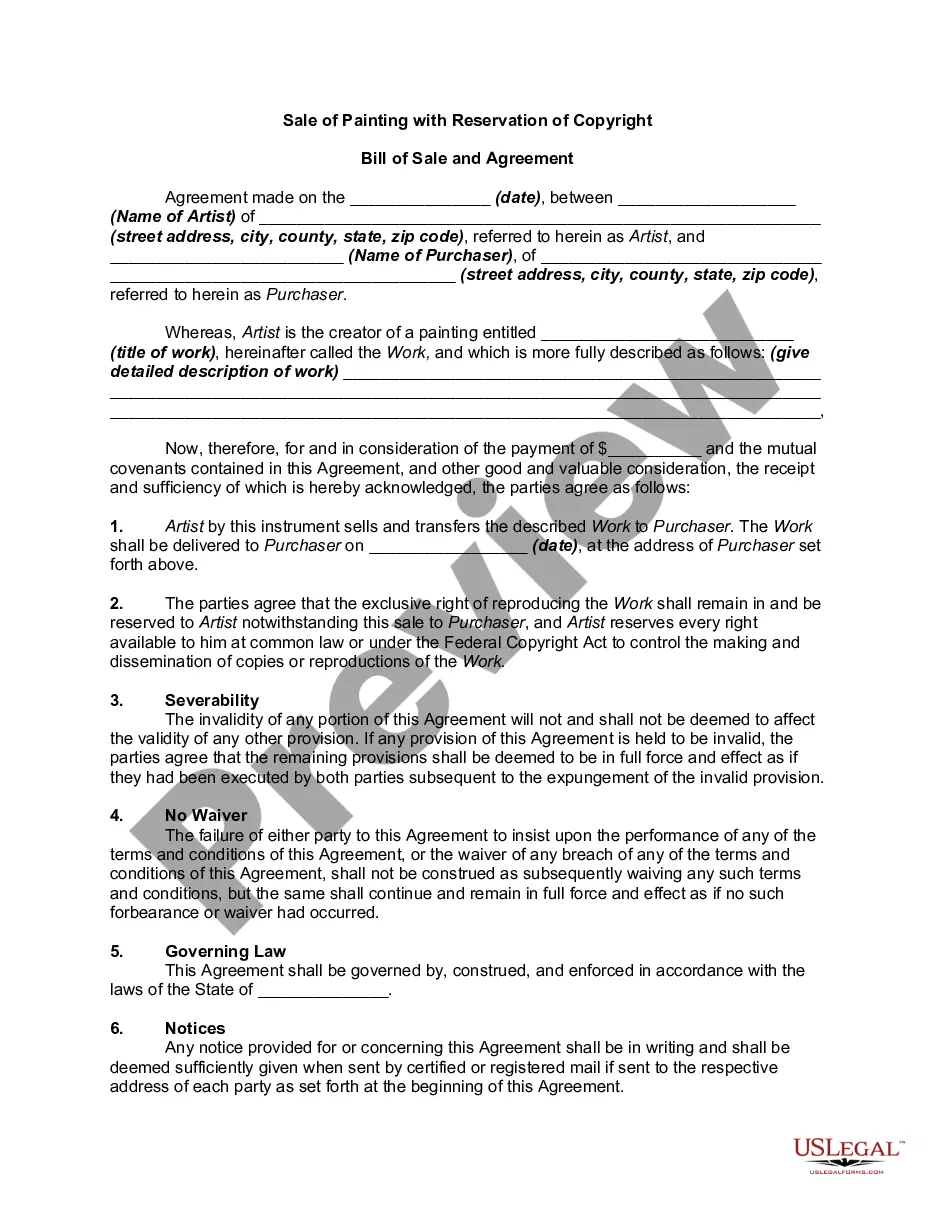
How to fill out Sale Of Painting With Reservation Of Copyright?
Utilizing legal document examples that comply with federal and state regulations is essential, and the internet provides numerous alternatives to select from.
However, what is the benefit of expending time hunting for the suitable Copyright 2001 example online if the US Legal Forms digital library has aggregated such templates in one location.
US Legal Forms represents the largest online legal database, featuring over 85,000 editable templates created by attorneys for various business and personal circumstances.
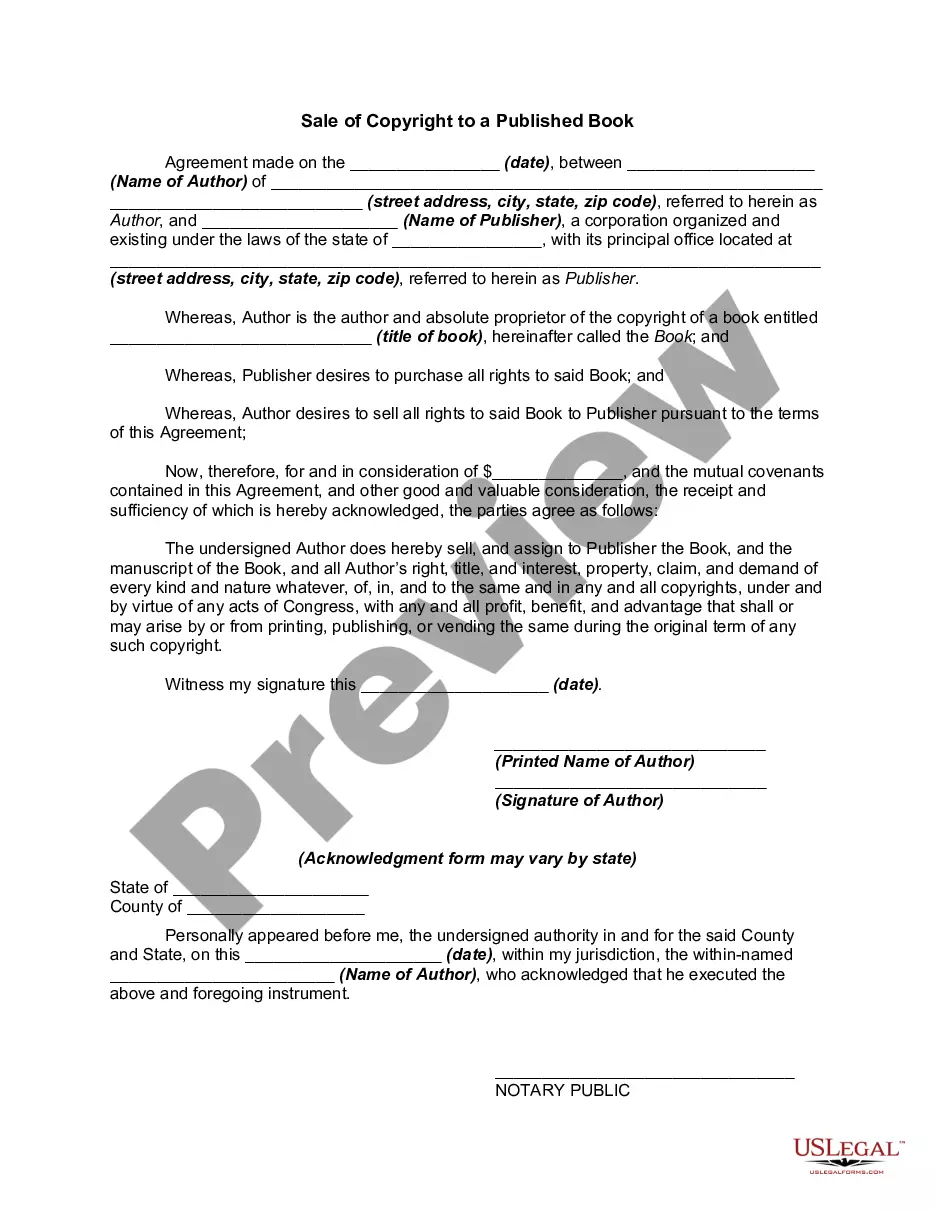
Review the template using the Preview option or via the text description to verify it suits your requirements.
- They are simple to navigate with all files organized by state and purpose of use.
- Our specialists keep abreast of legislative changes, ensuring that your documents are always current and compliant when obtaining a Copyright 2001 from our site.
- Acquiring a Copyright 2001 is straightforward and prompt for both existing and new users.
- If you already possess an account with an active subscription, Log In and store the document sample you need in the correct format.
- If you are new to our platform, follow the instructions below.
Form popularity
FAQ
A good example of copyright is a novel published in 2001, where the author holds exclusive rights to reproduce and distribute that work. Copyright protects the author's expression, allowing them to control how their work is shared and used. This not only benefits the author but also enriches the cultural landscape by safeguarding creative works from misuse.
To submit a copyright claim, you need to fill out the appropriate application and include your work with it. This can typically be done online through the U.S. Copyright Office portal. Ensure your forms are accurate and your submission includes any requisite fees. Understanding these procedures dating back to Copyright 2001 can streamline the process.
Creating your own copyright is simple and begins with the act of fixing your original work in a tangible medium. Once your work is complete, use the correct copyright notice as previously explained. It's essential to remember that the act of creation automatically gives you certain rights, and understanding this is vital, especially for works emerging after Copyright 2001.
To write copyright correctly, start with the copyright symbol © followed by the name of the author or creator, and then add the year the work was first published. For example, if you created an artwork in 2001, you would write it as '© Your Name, 2001'. This format is crucial for ensuring that your copyright claim is recognized and respected.
Writing your own copyright statement involves clearly stating your ownership of the work. Typically, you’ll include the copyright symbol ©, followed by your name and the year of publication, such as '© Your Name, 2001'. This straightforward process can help establish your rights immediately, especially relevant for works created in or after Copyright 2001.
Determining which years are out of copyright generally depends on when the work was published. Works published before 1923 are typically in the public domain, while those published from 1923 to 1977 may still hold copyright if not renewed. In recent years, the copyright laws have evolved, and it’s important to stay informed. For more detailed information about copyright laws and their implications, visit the USLegalForms platform.
Obtaining a copyright involves several straightforward steps. First, you must create an original work, such as a song, book, or artwork. Next, you can register your copyright with the U.S. Copyright Office, which provides added legal benefits. Should you need assistance with the registration process, consider using the USLegalForms platform to streamline your experience.
Yes, songs released before 1978 can still hold copyright under certain conditions. For instance, many songs from earlier years were published with a copyright notice, which means they remain protected. However, it's essential to check specific details related to copyrights for each song. If you need guidance on how copyright laws apply, the USLegalForms platform can help you navigate this process.
When writing the date and copyright, start with the word 'Copyright', follow with the year of the first publication (e.g., 2001), and conclude with your name. This format not only protects your work legally but also provides clear attribution. The clarity and structure of your copyright statement will help others recognize your ownership.
Creating a copyright example is straightforward. You should write 'Copyright 2001 Your Name or Organization' at the bottom of your work, ensuring it is visible. This simple statement marks your ownership and deters unauthorized use of your work, reinforcing your rights as the creator.