Deceased Decedent Estate Withholding Tax
Description
Get your form ready online
Our built-in tools help you complete, sign, share, and store your documents in one place.
Make edits, fill in missing information, and update formatting in US Legal Forms—just like you would in MS Word.
Download a copy, print it, send it by email, or mail it via USPS—whatever works best for your next step.
Sign and collect signatures with our SignNow integration. Send to multiple recipients, set reminders, and more. Go Premium to unlock E-Sign.
If this form requires notarization, complete it online through a secure video call—no need to meet a notary in person or wait for an appointment.
We protect your documents and personal data by following strict security and privacy standards.

Make edits, fill in missing information, and update formatting in US Legal Forms—just like you would in MS Word.

Download a copy, print it, send it by email, or mail it via USPS—whatever works best for your next step.

Sign and collect signatures with our SignNow integration. Send to multiple recipients, set reminders, and more. Go Premium to unlock E-Sign.

If this form requires notarization, complete it online through a secure video call—no need to meet a notary in person or wait for an appointment.

We protect your documents and personal data by following strict security and privacy standards.
Looking for another form?










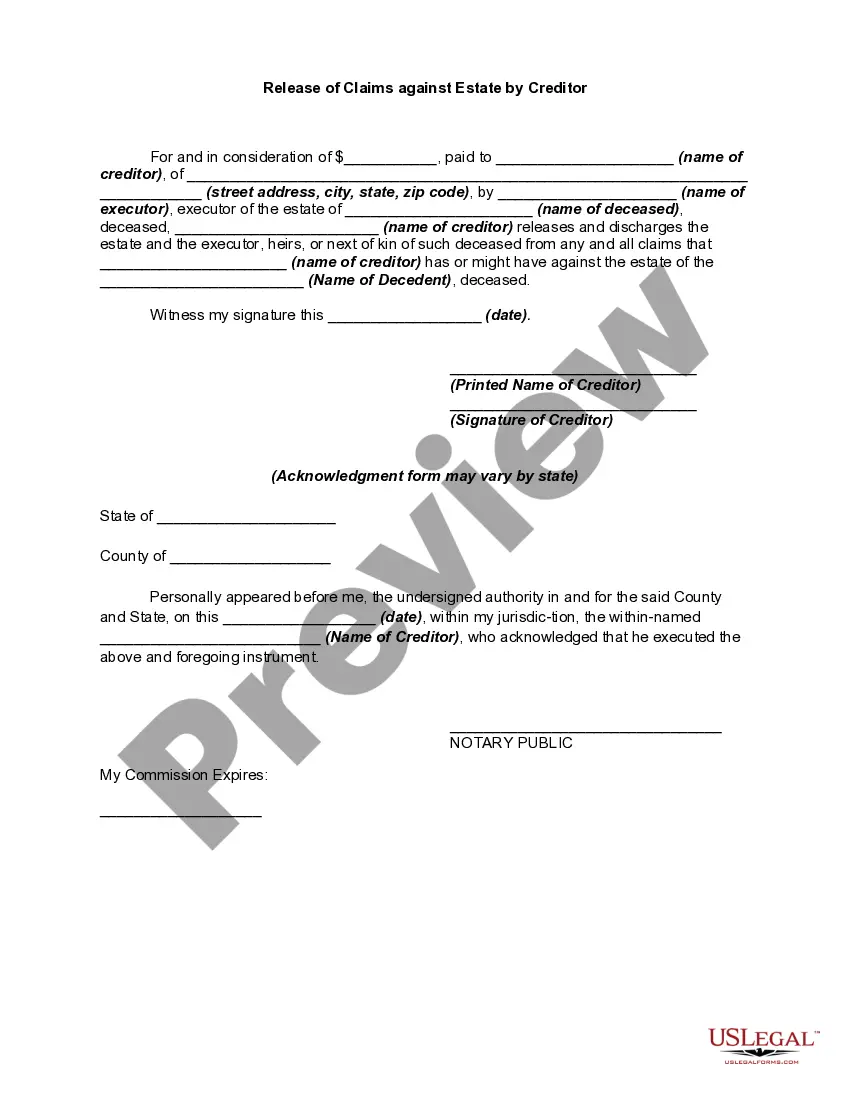
How to fill out Release Of Claims Against Estate By Creditor?
The Expired Estate Tax Withholding Document you observe on this page is a reusable official format created by expert attorneys in accordance with federal and state laws.
For over 25 years, US Legal Forms has supplied individuals, companies, and legal practitioners with more than 85,000 validated, state-specific documents for any business and personal event. It’s the quickest, easiest, and most dependable method to secure the paperwork you require, as the service ensures the utmost level of data protection and anti-malware security.
Choose the format you desire for your Expired Estate Tax Withholding Document (PDF, Word, RTF) and save the example on your device.
- Examine the document you require and verify it.
- Review the file you sought and preview it or assess the form description to ensure it meets your needs. If it doesn’t, use the search bar to find the right one. Click Buy Now when you have located the format you need.
- Register and Log In.
- Choose the pricing option that fits you and set up an account. Use PayPal or a credit card to make a swift payment. If you already possess an account, Log In and check your subscription to continue.
- Obtain the editable template.
Form popularity
FAQ
The tax collected on the transfer of the estate of a deceased person is known as the deceased decedent estate withholding tax. This tax applies to the assets transferred to beneficiaries and is typically withheld by the estate executor. Understanding this tax is crucial for ensuring compliance and proper estate management. By utilizing resources like US Legal Forms, you can navigate the complexities of the deceased decedent estate withholding tax effectively.
Yes, the estate of a deceased person often has to file a tax return. This includes reporting income generated during the estate's administration, which falls under the deceased decedent estate withholding tax. Filing a tax return ensures compliance with federal and state laws, and it helps clarify any tax obligations. Utilizing platforms like US Legal Forms can assist in managing these filings efficiently.
Not all estates are required to file Form 706, but many larger estates must do so. This form is used for reporting the estate tax liability of the deceased decedent estate. If the total value of the estate exceeds the federal exemption limit, filing is mandatory. To navigate these requirements efficiently, using resources from US Legal Forms can simplify the process.
Yes, an estate can pass the deceased decedent estate withholding tax to beneficiaries under certain circumstances. When the estate distributes income to beneficiaries, that income may be subject to withholding taxes. It's important for beneficiaries to understand their tax obligations related to the distributions they receive. Consulting with a tax professional or using a platform like US Legal Forms can help clarify these details.
Yes, withholding taxes on a deceased person is a common practice. The deceased decedent estate withholding tax applies to the income generated by the estate after a person's death. Executors or administrators should ensure that any income earned during the estate's administration is reported and taxed appropriately. This helps prevent tax liabilities from falling on beneficiaries and maintains compliance with tax regulations.
In general, file and prepare the final individual income tax return of a deceased person the same way you would if the person were alive. Report all income up to the date of death and claim all eligible credits and deductions.
Income tax on income generated by assets of the estate of the deceased. If the estate generates more than $600 in annual gross income, you are required to file Form 1041, U.S. Income Tax Return for Estates and Trusts. An estate may also need to pay quarterly estimated taxes.
If paper-filed, write ?Deceased,? the taxpayer's name, and the taxpayer's date of death across the top of the final return. If e-filed, follow the directions provided by the tax software and be sure to indicate the taxpayer is deceased and the date of death.
If you are preparing the decedent's final return and you have received a Form 1099-INT for the decedent that includes amounts belonging to the decedent and to another recipient (the decedent's estate or another beneficiary), report the total interest shown on Form 1099-INT on Schedule B (Form 1040), Interest and ...