Sue Use Vehicle For Force
Description
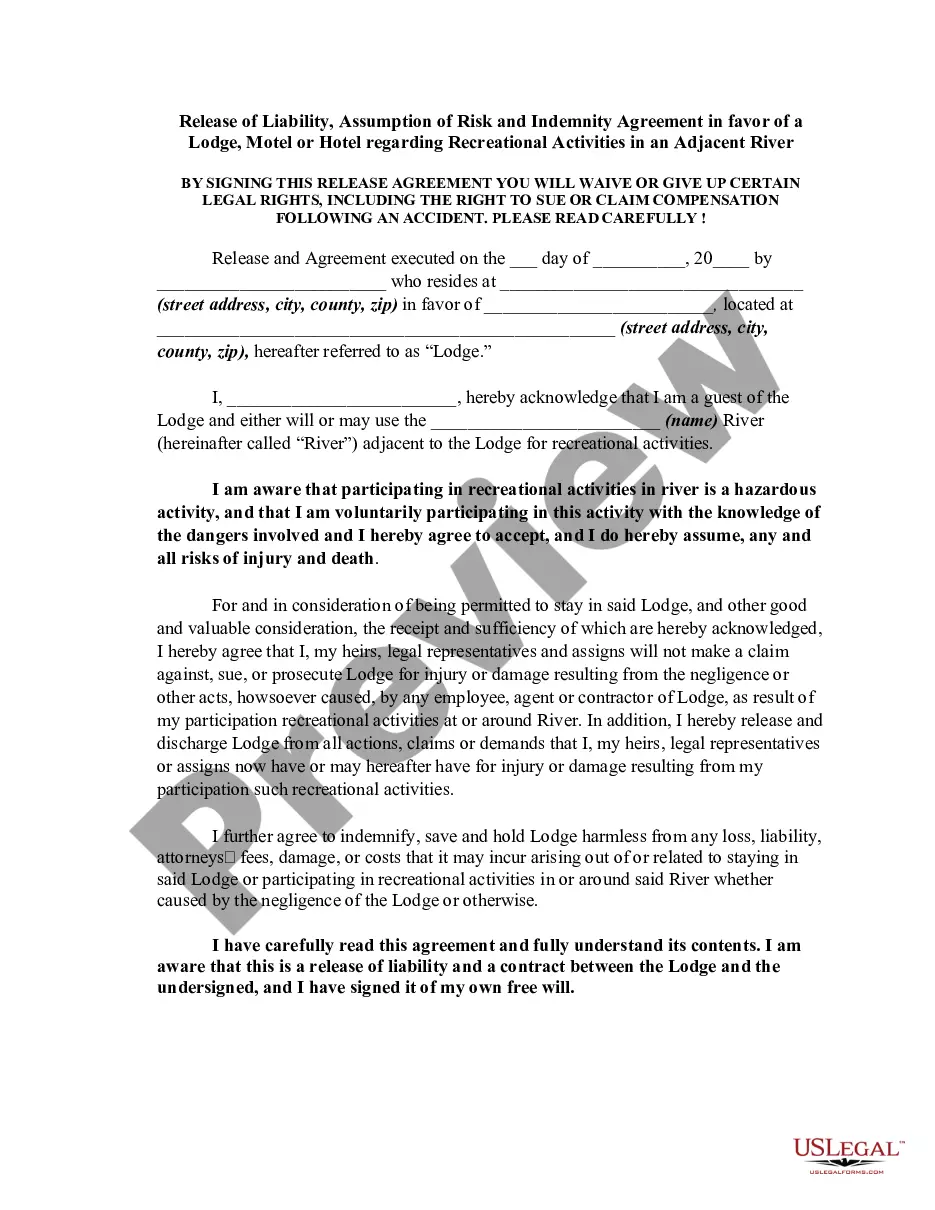
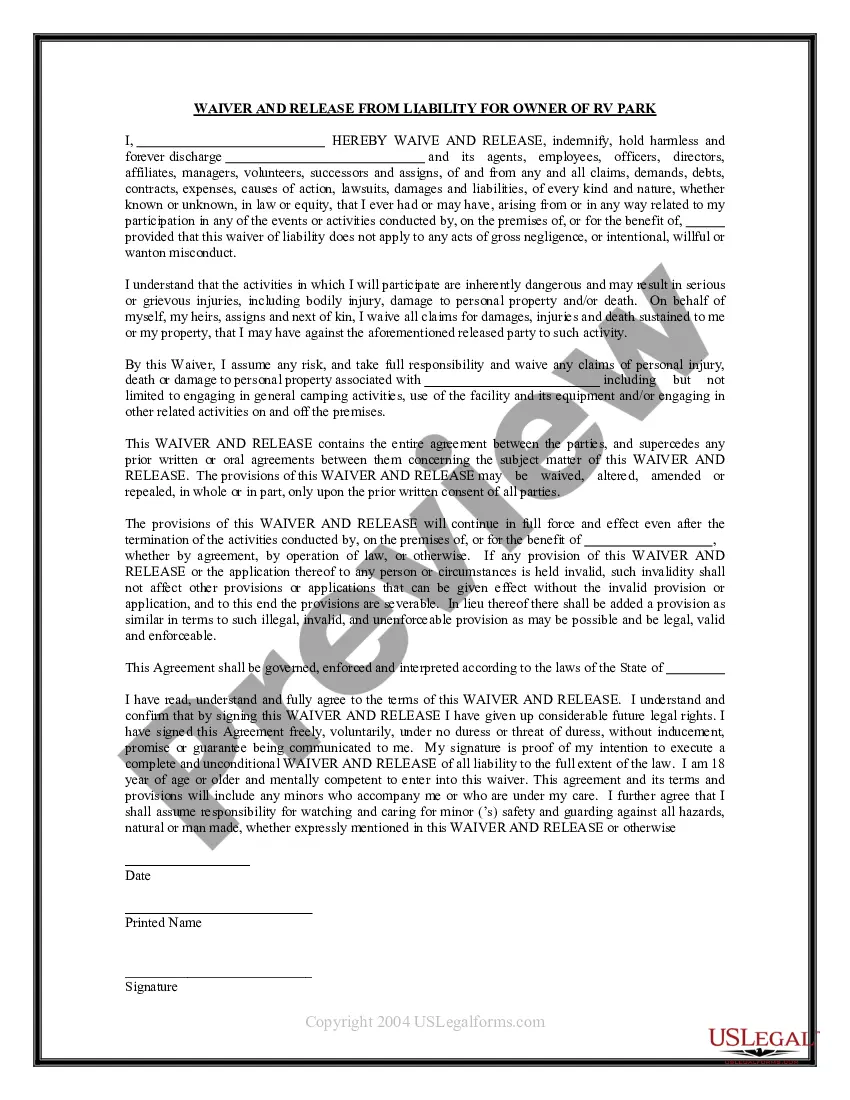
Get your form ready online
Our built-in tools help you complete, sign, share, and store your documents in one place.
Make edits, fill in missing information, and update formatting in US Legal Forms—just like you would in MS Word.
Download a copy, print it, send it by email, or mail it via USPS—whatever works best for your next step.
Sign and collect signatures with our SignNow integration. Send to multiple recipients, set reminders, and more. Go Premium to unlock E-Sign.
If this form requires notarization, complete it online through a secure video call—no need to meet a notary in person or wait for an appointment.
We protect your documents and personal data by following strict security and privacy standards.

Make edits, fill in missing information, and update formatting in US Legal Forms—just like you would in MS Word.

Download a copy, print it, send it by email, or mail it via USPS—whatever works best for your next step.

Sign and collect signatures with our SignNow integration. Send to multiple recipients, set reminders, and more. Go Premium to unlock E-Sign.

If this form requires notarization, complete it online through a secure video call—no need to meet a notary in person or wait for an appointment.

We protect your documents and personal data by following strict security and privacy standards.
Looking for another form?
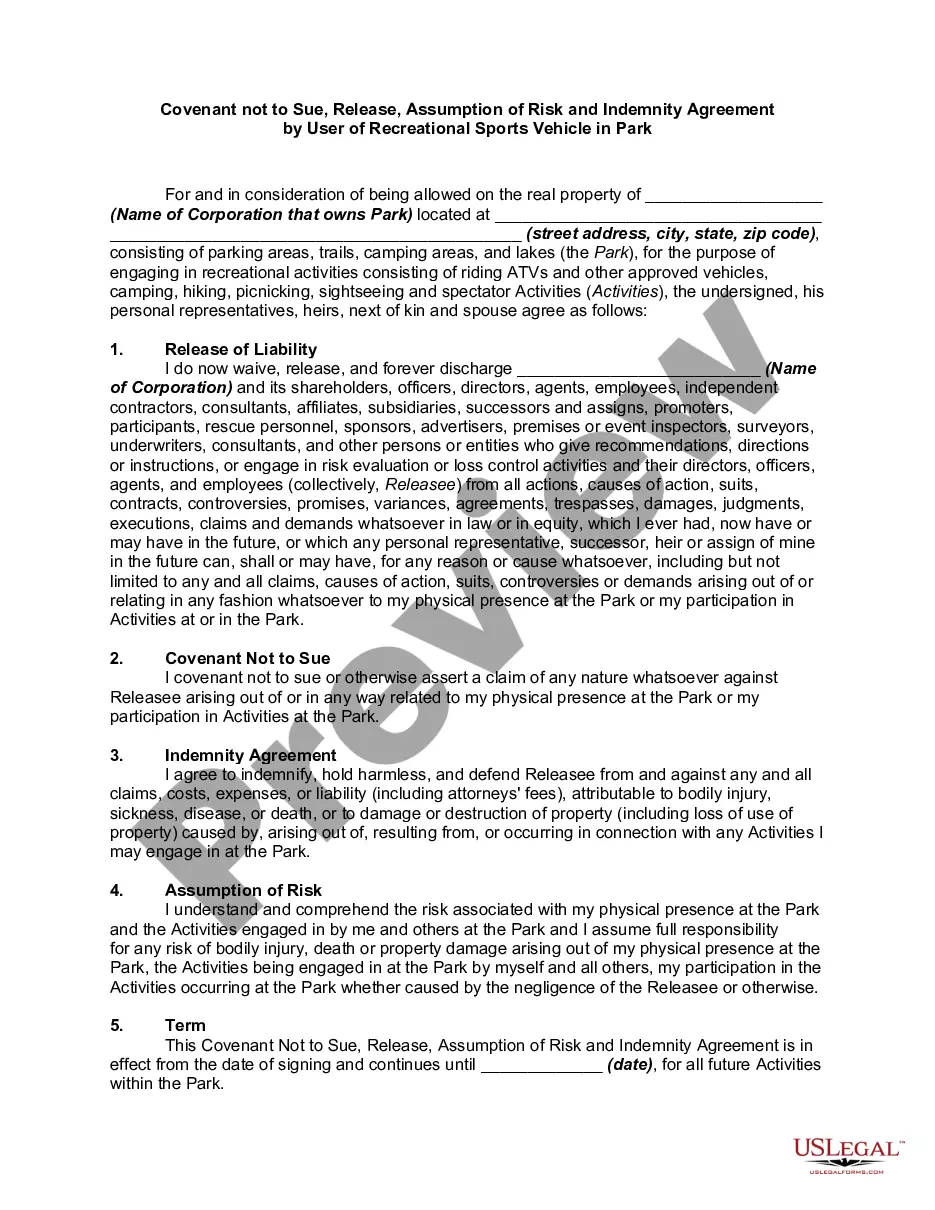
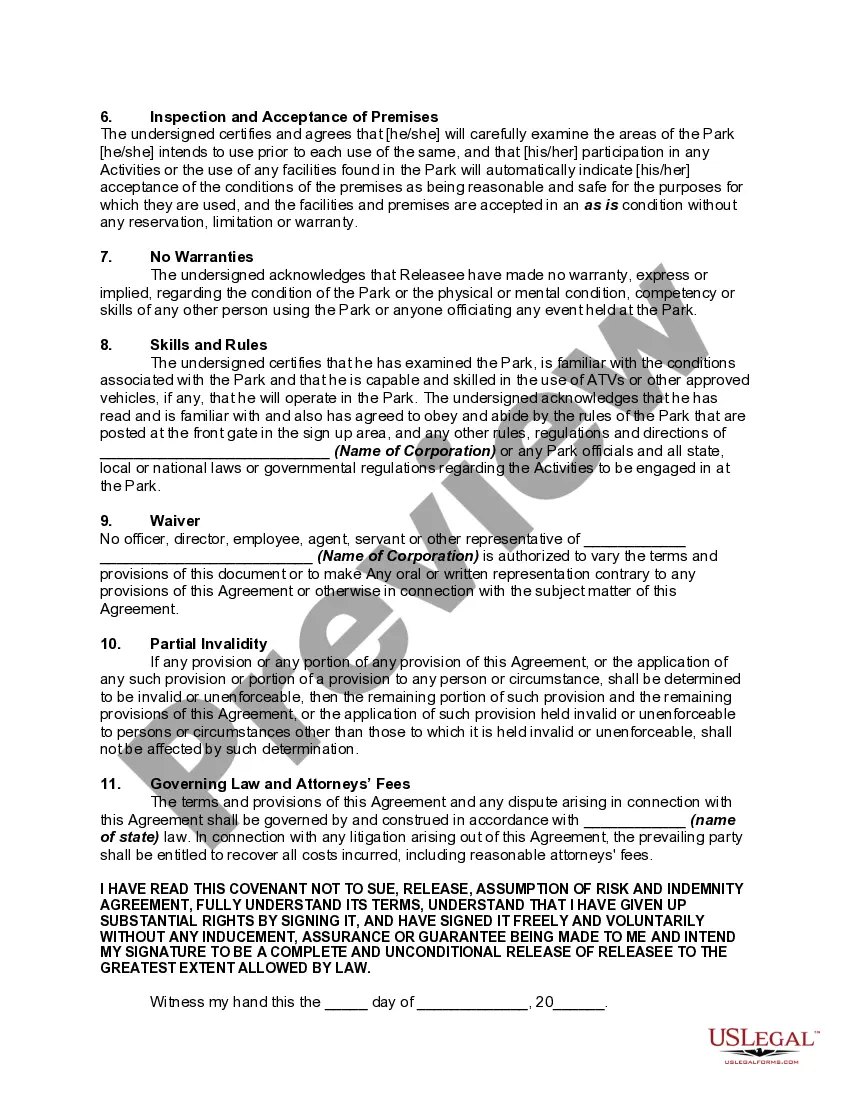
How to fill out Covenant Not To Sue, Release, Assumption Of Risk And Indemnity Agreement By User Of Recreational Sports Vehicle In Park?
Locating a trusted source for obtaining the latest and applicable legal documents is a significant part of navigating bureaucracy.
Selecting the appropriate legal forms requires accuracy and meticulousness, which highlights the importance of acquiring samples of Sue Use Vehicle For Force exclusively from trustworthy providers, such as US Legal Forms. An incorrect document can consume your time and postpone the issue at hand. With US Legal Forms, your concerns are significantly minimized. You can access and review all pertinent information regarding the document's application and suitability for your situation in your specific state or county.
Eliminate the stress associated with your legal documentation. Explore the extensive US Legal Forms collection where you can discover legal templates, evaluate their relevance to your situation, and download them instantly.
- Utilize the library navigation or search option to find your template.
- Examine the form's description to verify if it meets the needs of your state and county.
- Check the form preview, if available, to ensure it is the document you require.
- Continue searching to locate the appropriate document if the Sue Use Vehicle For Force does not match your specifications.
- If you are confident about the form's applicability, proceed to download it.
- If you are a registered user, click Log in to validate your identity and access your selected templates in My documents.
- If you have not created an account yet, click Buy now to purchase the document.
- Select the pricing tier that fits your needs.
- Proceed to the registration to complete your transaction.
- Finalize your purchase by selecting a payment option (credit card or PayPal).
- Choose the format for downloading Sue Use Vehicle For Force.
- After obtaining the form on your device, you may edit it using the editor or print it out and complete it manually.
Form popularity
FAQ
A notice of claim may be handed to you personally by the party suing you or by another person, or it can be sent to you by registered mail. If you're hard to find, the court may order that you be notified in some other way, such as by a notice posted on your front door or an ad in the local newspaper.
If your lawsuit is for more than $200, the filing fee is $26, plus $12 for each person or business you are suing. If your lawsuit is for $200 or less, the filing fee is $21, plus $12 for each person or business you are suing. If you win the judgment will include your filing & service fees.
A letter of intent to sue is used to notify an individual or business that legal action may be taken against them if the demands included in the letter are not met. By sending an intent to sue letter, you may be able to resolve the dispute without having to initiate a costly lawsuit.
Military Pay Claims at the U.S. Court of Federal Claims Federal law allows you to sue the U.S. government for payment of money as a result of the wrongful discharge, improper retirement, denial of promotion, service-related disability, and incorrect military records under some circumstances.
If you don't have enough tangible assets to satisfy a judgment, you might be forced to turn over a portion of your wages to the person or business who sued you until they've recouped what a court has determined you owe them. Other expected (future) assets besides wages can also be seized.