Transmutation Formula In Excel
Description
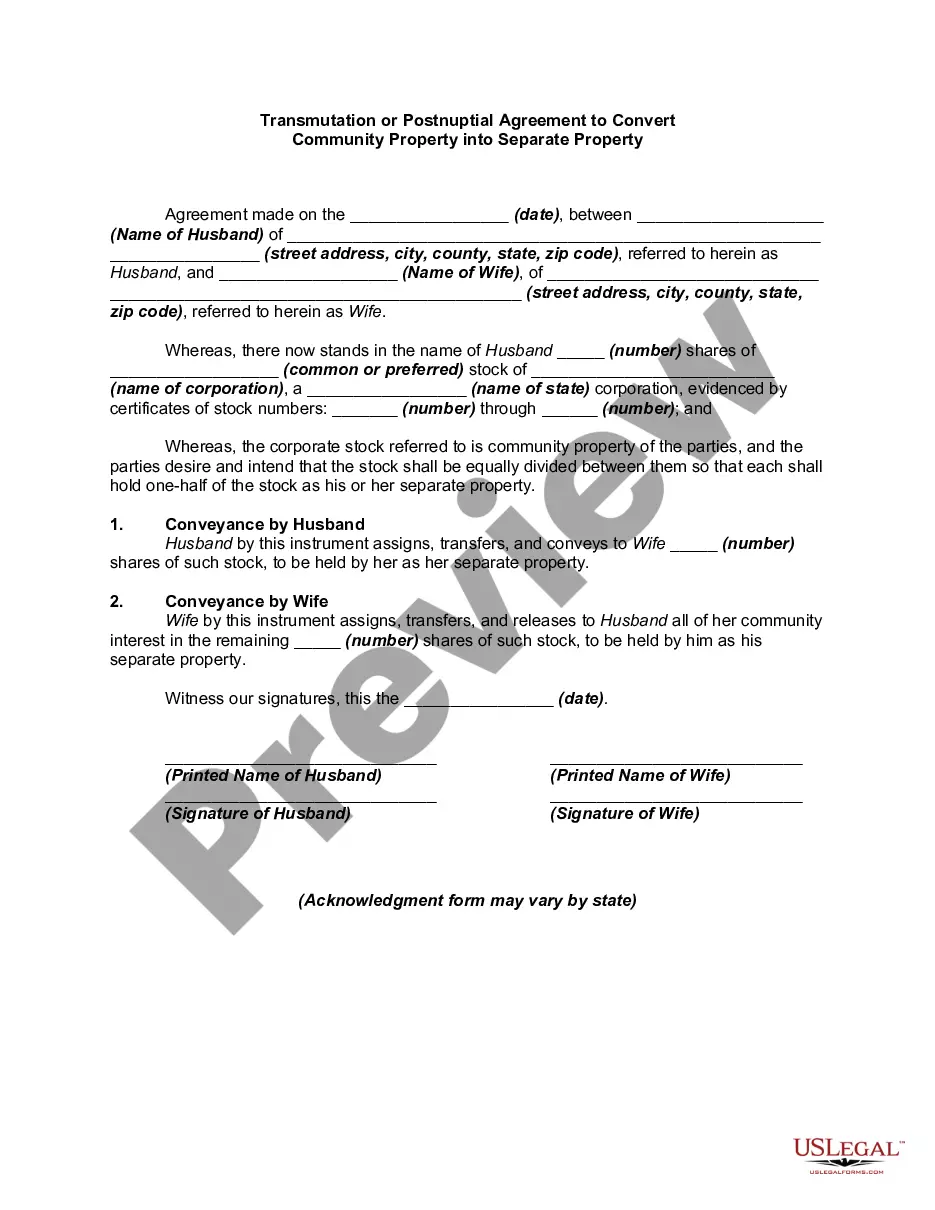



How to fill out Transmutation Or Postnuptial Agreement To Convert Community Property Into Separate Property?
Legal administration can be overwhelming, even for experienced professionals.
If you are seeking a Transmutation Formula In Excel and lack the opportunity to dedicate time towards finding the appropriate and current version, the processes can be stressful.
Tap into a repository of articles, guides, and materials related to your situation and requirements.
Save time and effort searching for the documents you need, and use US Legal Forms’ advanced search and Preview feature to find Transmutation Formula In Excel and retrieve it.
Take advantage of the US Legal Forms online repository, backed by 25 years of experience and trustworthiness. Transform your routine document management into a straightforward and user-friendly process today.
- If you have a subscription, Log In to your US Legal Forms account, search for the form, and retrieve it.
- Check the My documents tab to view the documents you have downloaded and manage your folders as you wish.
- If this is your first experience with US Legal Forms, create a free account and gain unlimited access to all the advantages of the library.
- Follow these steps after obtaining the form you require.
- Confirm it is the correct document by previewing it and reviewing its description.
- Ensure that the template is valid in your state or county.
- Click Buy Now when you are ready.
- Select a monthly subscription plan.
- Choose the format you need, then Download, complete, eSign, print, and submit your documents.
- Access state- or county-specific legal and business documents.
- US Legal Forms addresses any needs you may have, from personal to corporate paperwork, all in one place.
- Utilize advanced tools to complete and manage your Transmutation Formula In Excel.
Form popularity
FAQ
Writing a transmutation equation involves identifying the original values and the relationships between them. In Excel, you can construct your equation by using cell references and appropriate functions within a formula. This will allow you to create a dynamic equation that adjusts automatically as you change your inputs, enhancing your workflow with the transmutation formula in Excel.
To do a fill formula in Excel, first enter your formula in the initial cell. Once you have your formula set up, click and drag the fill handle, a small square at the cell's bottom right corner, to apply the formula to adjacent cells. This allows you to quickly populate a range of cells with the same formula, streamlining your work with the transmutation formula in Excel.
To perform transmutation, first define the values and the desired outcome. Using the transmutation formula in Excel, enter the initial values into specific cells, then apply the formulas that correspond to your conversion needs. Excel provides an intuitive interface to adjust your calculations easily, allowing for precise results.
Transmutation is the process of converting one type of data into another. For example, when dealing with numbers in different units, you can use the transmutation formula in Excel to convert inches to centimeters. By entering the original value and applying the appropriate conversion factor in an Excel cell, you can achieve the desired result in a systematic way.
To compute for transmutation, you can use the transmutation formula in Excel. Begin by identifying the values you want to transmute and input them into the corresponding cells. Use basic arithmetic operations, along with Excel functions such as SUM or AVERAGE to process the data. By structuring your calculations properly, you can easily derive the results you need.
Transmutation refers to the process of changing one form of data into another while preserving certain numerical properties. For example, if you have a series of income figures and wish to express them in thousands for better readability, you can transform $1,000,000 into 1,000 using a transmutation formula in Excel. This simplification makes financial reports clearer and enhances data interpretation, allowing for more efficient decision-making.
The Trimmean formula in Excel calculates the mean of a dataset while excluding a specified percentage of the highest and lowest values. This function is particularly useful when you want to reduce the impact of outliers on your average, making it more representative of your data. When utilizing the transmutation formula in Excel, you can enhance your data analysis and achieve more accurate results by applying techniques like Trimmean to filter out extreme values.
The formula for grading in Excel often combines multiple functions like IF, AVERAGE, and COUNT. A well-structured transmutation formula in Excel enables you to categorize and convert numeric scores into grades effortlessly. By leveraging Excel’s functionalities, you enhance your grading systems and provide clearer evaluations.
Automatic grading in Excel can be implemented by using conditional formatting and formulas. By setting conditions for grades according to score ranges, you use a transmutation formula in Excel that updates grades automatically as scores change. This automation greatly reduces manual errors and saves time.
The formula for calculating grades typically involves averaging scores and applying predefined thresholds for letter grades. You can implement a transmutation formula in Excel that combines functions like AVERAGE and IF to automatically determine letter grades based on numerical scores. This approach simplifies the grading process and ensures consistency.