Petition Law
Description
Get your form ready online
Our built-in tools help you complete, sign, share, and store your documents in one place.
Make edits, fill in missing information, and update formatting in US Legal Forms—just like you would in MS Word.
Download a copy, print it, send it by email, or mail it via USPS—whatever works best for your next step.
Sign and collect signatures with our SignNow integration. Send to multiple recipients, set reminders, and more. Go Premium to unlock E-Sign.
If this form requires notarization, complete it online through a secure video call—no need to meet a notary in person or wait for an appointment.
We protect your documents and personal data by following strict security and privacy standards.

Make edits, fill in missing information, and update formatting in US Legal Forms—just like you would in MS Word.

Download a copy, print it, send it by email, or mail it via USPS—whatever works best for your next step.

Sign and collect signatures with our SignNow integration. Send to multiple recipients, set reminders, and more. Go Premium to unlock E-Sign.

If this form requires notarization, complete it online through a secure video call—no need to meet a notary in person or wait for an appointment.

We protect your documents and personal data by following strict security and privacy standards.
Looking for another form?







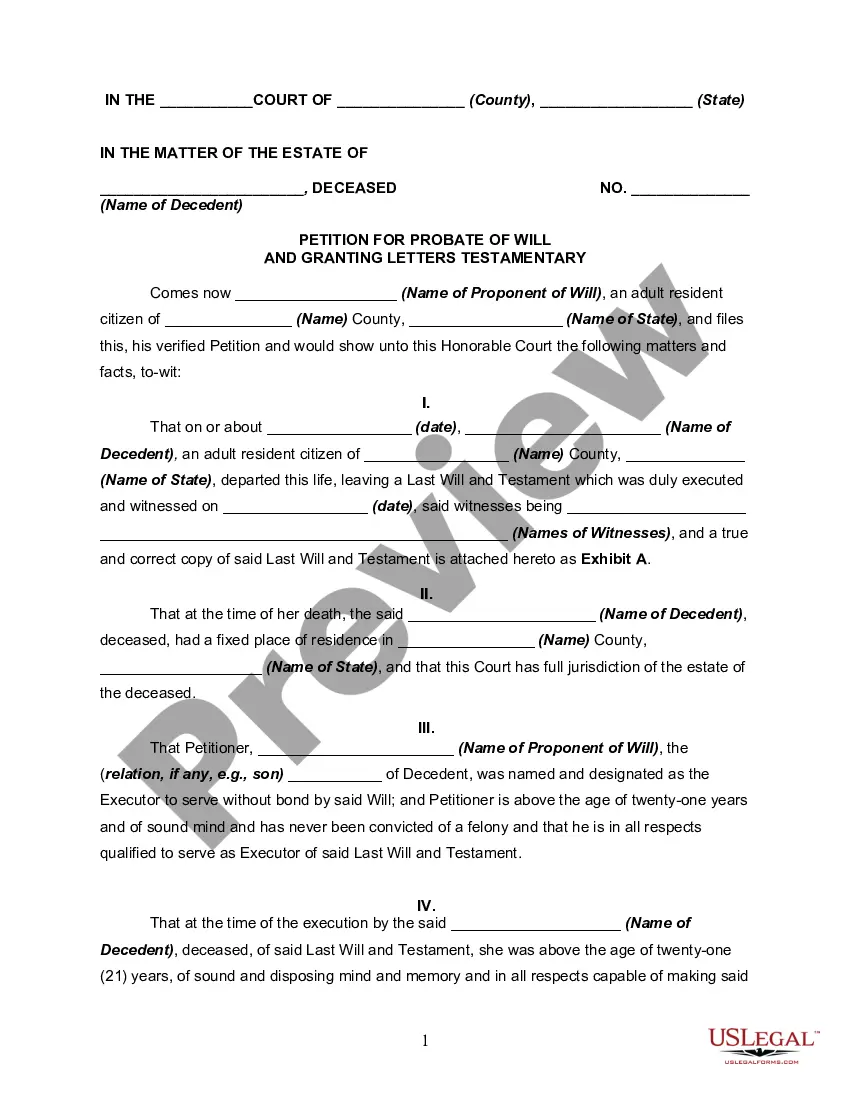
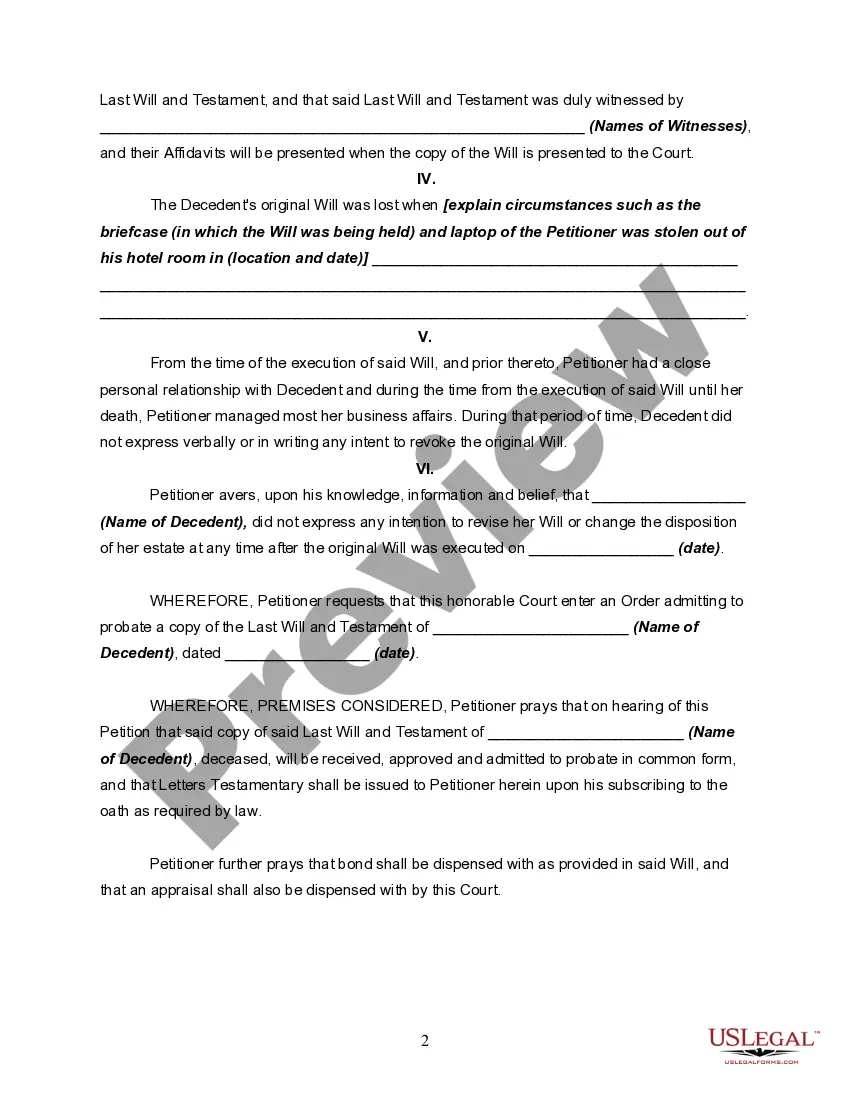
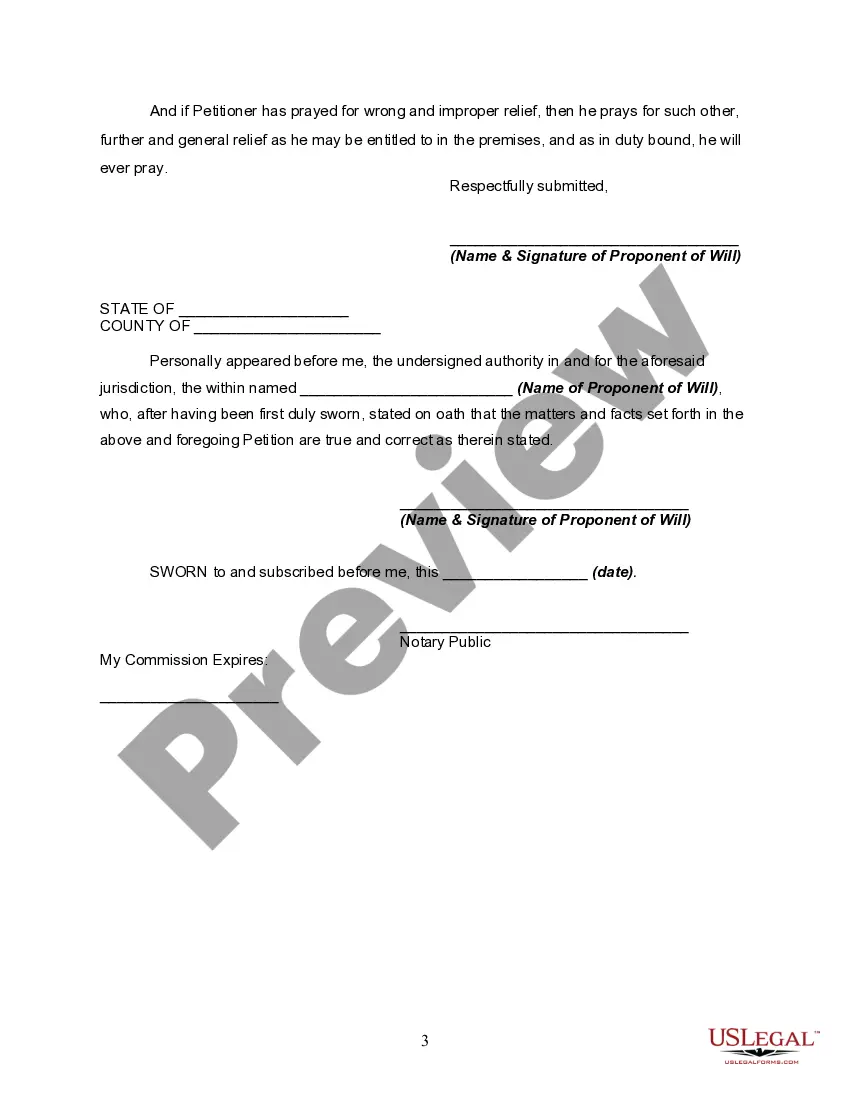
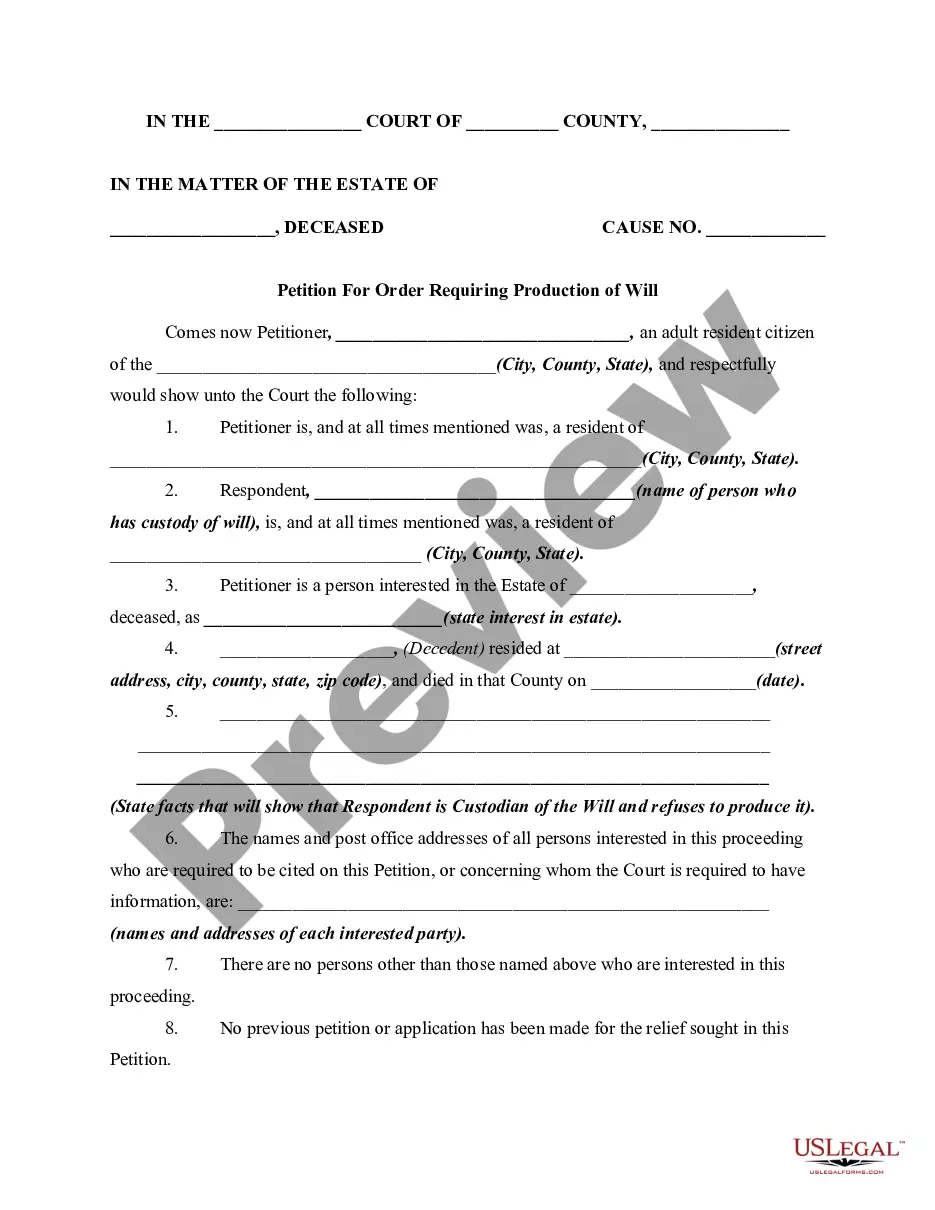
How to fill out Petition To Probate Lost Will?
- Log into your existing US Legal Forms account. Check the validity of your subscription; renew if necessary.
- Browse the available forms. Utilize the Preview mode to read the descriptions and ensure the template meets your specific needs and local requirements.
- If you don’t find the right form, use the Search feature to discover more templates that may suit your needs.
- Select the desired document and click 'Buy Now'. Choose a subscription plan that fits your requirements and create an account for access.
- Complete your purchase by entering your payment details, either through credit card or PayPal.
- Download your completed form and save it to your device. You can also access it anytime through the 'My Forms' section of your profile.
By following these straightforward steps, you’ll be able to successfully navigate US Legal Forms and obtain the legal documents you need. With a vast library of over 85,000 forms, you can ensure compliance with various local laws while saving time and effort.
Ready to take the first step? Visit US Legal Forms today and discover how easy it is to manage your legal documentation!
Form popularity
FAQ
To write a legal letter to court, start by addressing the letter to the correct court and including relevant case information. Clearly state your purpose for writing, and provide any supporting details as necessary. Make your requests specific, and always maintain a respectful and formal tone. For additional guidance on format and content, you can refer to examples available on US Legal Forms, which can enhance your understanding of petition law.
Writing a legal petition begins with researching the specific rules of the court where you will file. Create a structured outline that captures all necessary components, such as the introduction, statements of fact, and legal arguments related to your case under petition law. Make sure to use clear and concise language to convey your points effectively. Utilizing resources like US Legal Forms can simplify this process with ready-to-use templates.
Making a legal petition involves several steps. First, determine the type of petition required for your case, whether it’s a family law petition, a civil petition, or another category under petition law. Then, draft your petition by including relevant facts, legal arguments, and a clear request to the court. For assistance and templates to ensure compliance, consider using platforms like US Legal Forms.
To write a legal petition for court, start by clearly identifying the court you will submit your petition to. Provide a title that reflects the purpose of the petition and include your name, the name of the opposing party, and your case number. Organize your petition with a statement of facts, followed by the legal grounds for your request, and end with a conclusion that summarizes your ask. You can find helpful templates and guidance on petition law through resources like US Legal Forms.
A good sentence for a petition might read, 'I respectfully request that the court consider my appeal for a new trial based on the evidence presented herein.' This sentence clearly states the request and the purpose. Using intuitive language like this helps convey your intent effectively under petition law. Engaging resources like US Legal Forms can provide additional examples to refine your phrasing.
An example of a petition could be one requesting a public hearing on a proposed law, outlining key points for consideration. It typically starts with an introduction, followed by a statement of facts, and a conclusion with a specific request. Such examples are beneficial in understanding how to apply petition law effectively in real scenarios. For templates, consider checking US Legal Forms, which offers a variety of examples to assist you.
To write a proper petition, begin with a clear title that summarizes your request. Follow with a concise introduction that states your purpose, then lay out the facts supporting your case. Emphasizing the legal basis under petition law can strengthen your request. Finally, include a respectful closing statement that reflects your sincere request for action.
Filling out a petition involves gathering all necessary information about your case and the relief you seek. Start by reviewing the specific requirements of petition law in your jurisdiction to ensure compliance. You can use templates from US Legal Forms to streamline the process and ensure you include all essential elements. This approach reduces the chance of errors and enhances the chances of your petition being taken seriously.
In legal terms, a petition is a formal written request to a court or governmental body. It can seek a specific action, such as the change of a law or policy. Understanding the definition of petition within the context of law underscores its importance in civic engagement and the opportunities it provides for advocacy. For those looking to navigate this process, US Legal Forms offers valuable resources to guide you.
A petition works by gathering signatures to demonstrate support for a particular issue or request. Once enough signatures are collected, the petition is submitted to a relevant authority or organization. The purpose is to prompt those decision-makers to take action or change existing policies. This process is governed by petition law, which varies across different states and municipalities.