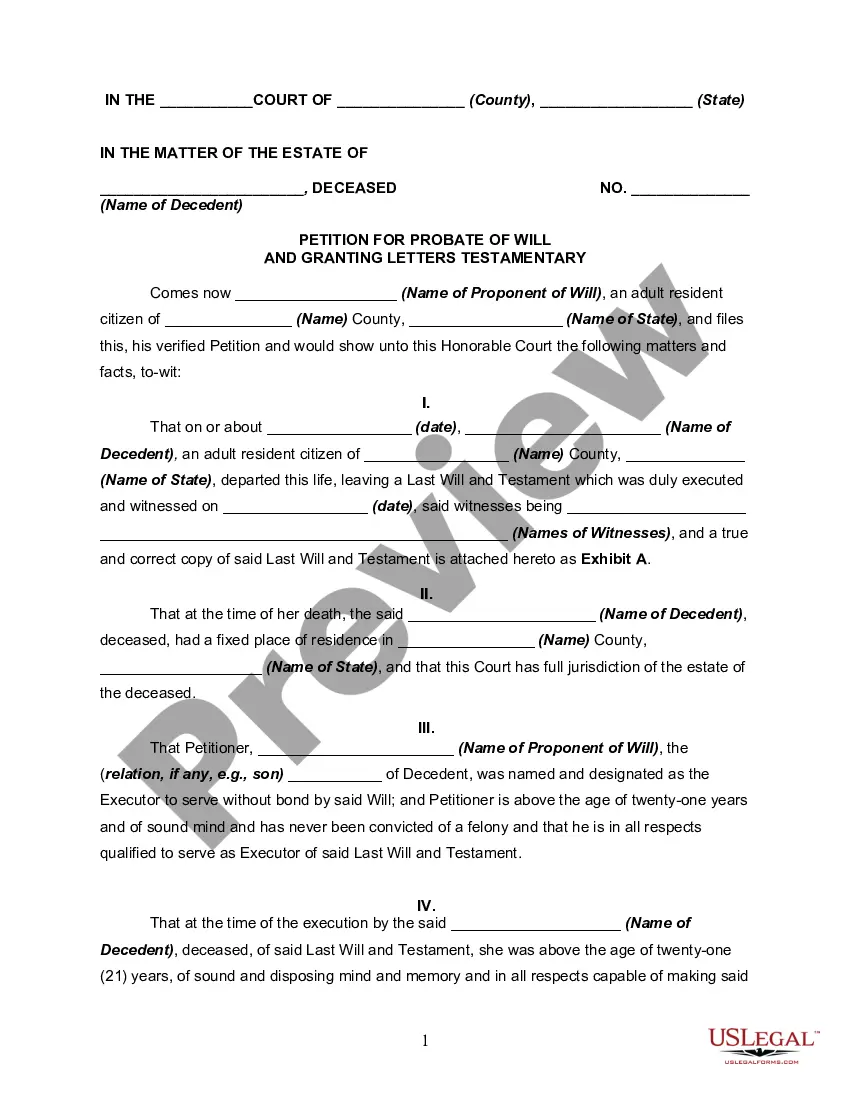
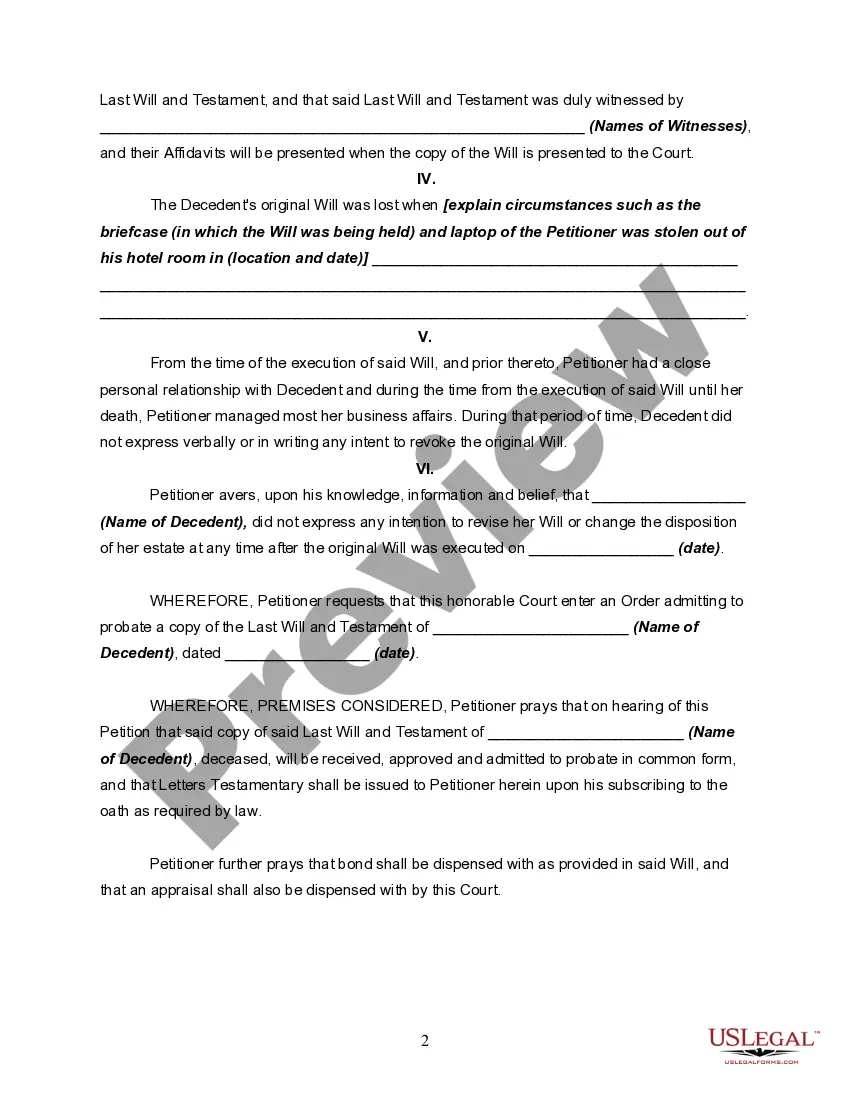
Petition For Probate Court Without A Will
Description
Get your form ready online
Our built-in tools help you complete, sign, share, and store your documents in one place.
Make edits, fill in missing information, and update formatting in US Legal Forms—just like you would in MS Word.
Download a copy, print it, send it by email, or mail it via USPS—whatever works best for your next step.
Sign and collect signatures with our SignNow integration. Send to multiple recipients, set reminders, and more. Go Premium to unlock E-Sign.
If this form requires notarization, complete it online through a secure video call—no need to meet a notary in person or wait for an appointment.
We protect your documents and personal data by following strict security and privacy standards.

Make edits, fill in missing information, and update formatting in US Legal Forms—just like you would in MS Word.

Download a copy, print it, send it by email, or mail it via USPS—whatever works best for your next step.

Sign and collect signatures with our SignNow integration. Send to multiple recipients, set reminders, and more. Go Premium to unlock E-Sign.

If this form requires notarization, complete it online through a secure video call—no need to meet a notary in person or wait for an appointment.

We protect your documents and personal data by following strict security and privacy standards.
Looking for another form?







How to fill out Petition To Probate Lost Will?
Whether for commercial uses or personal affairs, everyone must confront legal matters at some stage in their lives.
Filling out legal documents requires meticulous care, starting with selecting the right form template.
With a vast US Legal Forms library available, you don’t have to waste time searching for the right template online. Make use of the library’s straightforward navigation to find the suitable form for any situation.
- Locate the form you require using the search box or catalog browsing.
- Examine the form’s details to ensure it suits your circumstance, region, and county.
- Click on the form’s preview to review it.
- If it is the incorrect form, return to the search feature to find the Petition For Probate Court Without A Will template you need.
- Obtain the file when it meets your requirements.
- If you already have a US Legal Forms account, simply click Log in to access previously saved templates in My documents.
- In case you don’t have an account yet, you can acquire the form by clicking Buy now.
- Select the correct pricing option.
- Complete the account registration form.
- Choose your payment method: you can utilize a credit card or PayPal account.
- Select the file format you prefer and download the Petition For Probate Court Without A Will.
- After it is downloaded, you can fill out the form using editing software or print it and complete it manually.
Form popularity
FAQ
In general, probate must be filed within five years of the date of death in Alabama when there is no will. It is essential to act promptly in order to navigate the legal requirements and protect the estate's assets. By filing a petition for probate court without a will, you can initiate the process and ensure proper management of the estate in a timely manner.
If a Florida resident dies without a will, their property will pass to their closest relatives through the Florida intestate laws. Intestate laws set out a rigid formula for judges to distribute assets to family members to avoid a situation where the deceased person's assets end up with the state.
Typical Intestate Succession Rules Generally, a surviving spouse receives the largest share of a decedent's property, followed by the decedent's children. Children commonly include adopted children but not step-children or foster children.
When someone dies without a will in Florida, the court will identify all surviving family members to determine who will inherit the deceased's property. In some cases, this is an easy endeavor; however, that is not always the case.
If a person dies without a will they are considered intestate "without a will". Therefore that person's property and estate is distributed ing to the state that is their home state. Real property is handled ing to state law. The distribution of all property is by relationship to the deceased.
The first heirs in line to receive property are the surviving spouse and the deceased's children. If the deceased did not leave a surviving spouse or children, then the property next passes to the parents, siblings, aunts, uncles, nieces and nephews.