Qualified Trust Caps Fill With Tax Return
Description

Get your form ready online
Our built-in tools help you complete, sign, share, and store your documents in one place.
Make edits, fill in missing information, and update formatting in US Legal Forms—just like you would in MS Word.
Download a copy, print it, send it by email, or mail it via USPS—whatever works best for your next step.
Sign and collect signatures with our SignNow integration. Send to multiple recipients, set reminders, and more. Go Premium to unlock E-Sign.
If this form requires notarization, complete it online through a secure video call—no need to meet a notary in person or wait for an appointment.
We protect your documents and personal data by following strict security and privacy standards.

Make edits, fill in missing information, and update formatting in US Legal Forms—just like you would in MS Word.

Download a copy, print it, send it by email, or mail it via USPS—whatever works best for your next step.

Sign and collect signatures with our SignNow integration. Send to multiple recipients, set reminders, and more. Go Premium to unlock E-Sign.

If this form requires notarization, complete it online through a secure video call—no need to meet a notary in person or wait for an appointment.

We protect your documents and personal data by following strict security and privacy standards.
Looking for another form?










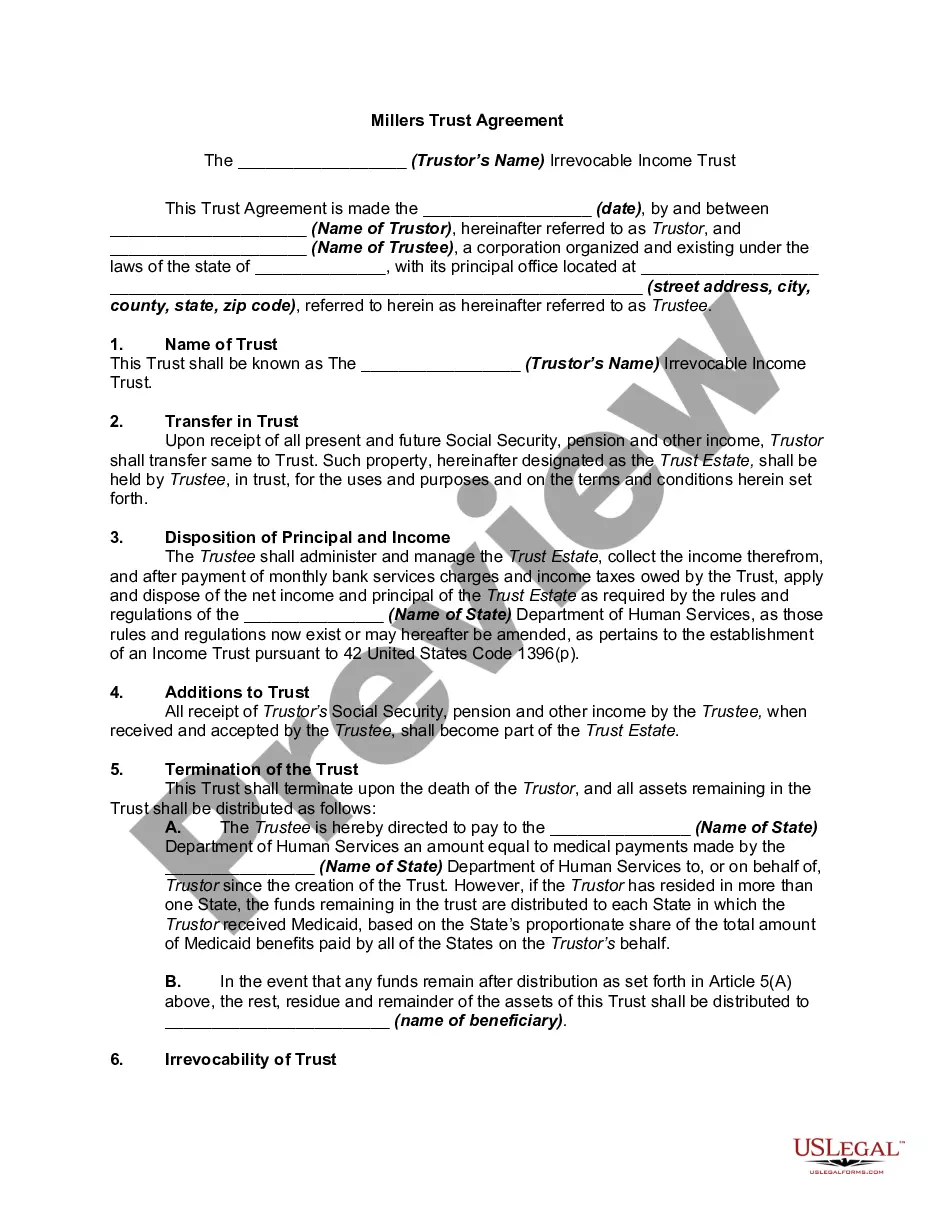
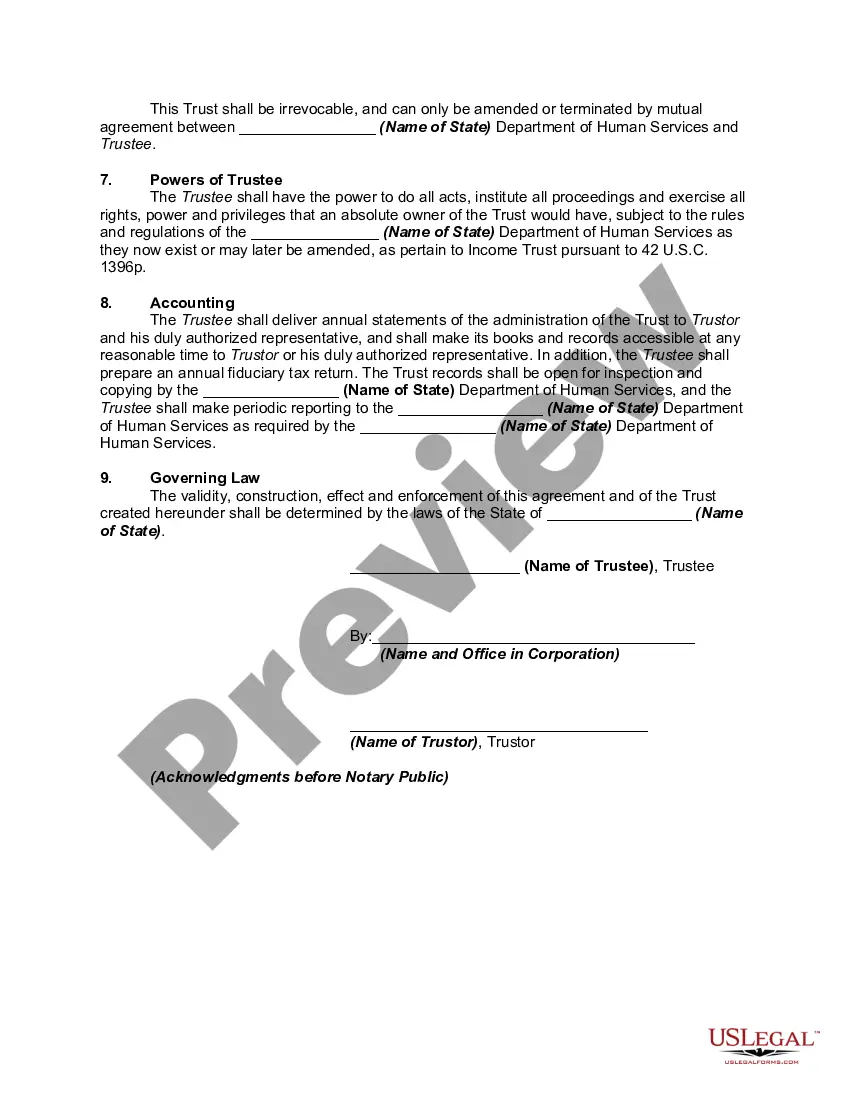
How to fill out Qualified Income Miller Trust?
- Log in to your US Legal Forms account if you're a returning user. Ensure your subscription is active to download the necessary form template.
- For first-time users, begin by previewing the form description. Confirm it aligns with your needs and meets local jurisdiction requirements.
- If the selected form doesn't meet your expectations, utilize the Search function to find alternative templates that suit your needs better.
- Select the appropriate document by clicking the Buy Now button and choose the subscription plan that fits your needs. Account registration will be required for full access.
- Complete your purchase securely by providing your payment details through credit card or PayPal.
- Finally, download your completed form and save it on your device. You can also access it later from the My Forms section in your profile.
In conclusion, US Legal Forms simplifies the document acquisition process, offering a robust library and expert assistance for users, ensuring that they can create precise legal documents efficiently.
Don’t wait any longer; start your legal journey today at US Legal Forms!
Form popularity
FAQ
Charitable Remainder Unitrusts (CRUTs) are generally required to file tax returns under specific circumstances. If a CRUT has income above certain thresholds, it must file Form 1041. It's crucial to understand how qualified trust caps fill with tax return processes apply to maintain compliance, particularly for those benefiting from charitable deductions.
Yes, a foreign grantor trust must file Form 1041 if it generates income effectively connected with a U.S. trade or business. This measure ensures compliance with U.S. tax obligations. Moreover, these trusts often face unique requirements, making it essential to know how qualified trust caps fill with tax return provisions apply. Consultation with a tax professional may be beneficial.
A QSST is generally not classified as a grantor type trust. Instead, a QSST permits the income to be taxed directly to the beneficiaries rather than the trust itself. This structure helps in maintaining compliance with the tax regulations while optimizing how qualified trust caps fill with tax return duties are handled. Therefore, understanding the differences can assist in making informed decisions.
Form 1041 must be filed by any trust that has taxable income, gross income of $600 or more, or has a beneficiary who is a nonresident alien. This filing requirement ensures that all income is reported accurately. Utilizing a service like US Legal Forms can simplify the process and help ensure everything aligns with the qualified trust caps fill with tax return requirements.
Trusts are taxed at different rates than individuals, which can become significantly higher. For the current tax year, trust income is subject to the highest tax rates once it exceeds a certain threshold. Understanding these tax brackets helps in planning for how qualified trust caps fill with tax return affect financial decisions. Monitoring these rates is crucial for maintaining compliance.
Yes, Qualified Subchapter S Trusts (QSST) do file tax returns. They must file Form 1041 to report income, deductions, and credits. Beneficiaries will report their share of the income on their tax returns, ensuring the trust income is properly taxed. This process aligns with the qualified trust caps fill with tax return guidelines.
Yes, if a trust generates income, you must report that income on a tax return. The IRS requires trusts to file Form 1041 if they have gross income of $600 or more. Trust beneficiaries also need to report their share of the trust income on their personal tax returns. This ensures that all income from a qualified trust caps fill with tax return is accounted for properly.
Yes, trust income needs to be reported on your tax returns. According to IRS regulations, you must disclose this income to maintain compliance. Not reporting trust income can lead to penalties, so it’s better to be thorough. Utilizing a qualified trust caps fill with tax return can assist you in properly documenting and reporting this income on your tax return.
Yes, you typically receive Form 1099 for trust income if you have earned interest or dividends. This form reports the income to both you and the IRS, ensuring transparency in your earnings. It's important to include this information when you prepare your tax return. Leveraging a qualified trust caps fill with tax return can help you accurately track and report this income.
The IRS requires you to use Form 1041 to report trust income. This form captures income generated by the trust and any distributions made to beneficiaries. It's essential to fill out the form carefully to ensure that you meet all requirements. Remember, a qualified trust caps fill with tax return will help streamline this process, making compliance easier.