Custodial Parent Under Foreign Child
Description
Get your form ready online
Our built-in tools help you complete, sign, share, and store your documents in one place.
Make edits, fill in missing information, and update formatting in US Legal Forms—just like you would in MS Word.
Download a copy, print it, send it by email, or mail it via USPS—whatever works best for your next step.
Sign and collect signatures with our SignNow integration. Send to multiple recipients, set reminders, and more. Go Premium to unlock E-Sign.
If this form requires notarization, complete it online through a secure video call—no need to meet a notary in person or wait for an appointment.
We protect your documents and personal data by following strict security and privacy standards.

Make edits, fill in missing information, and update formatting in US Legal Forms—just like you would in MS Word.

Download a copy, print it, send it by email, or mail it via USPS—whatever works best for your next step.

Sign and collect signatures with our SignNow integration. Send to multiple recipients, set reminders, and more. Go Premium to unlock E-Sign.

If this form requires notarization, complete it online through a secure video call—no need to meet a notary in person or wait for an appointment.

We protect your documents and personal data by following strict security and privacy standards.
Looking for another form?









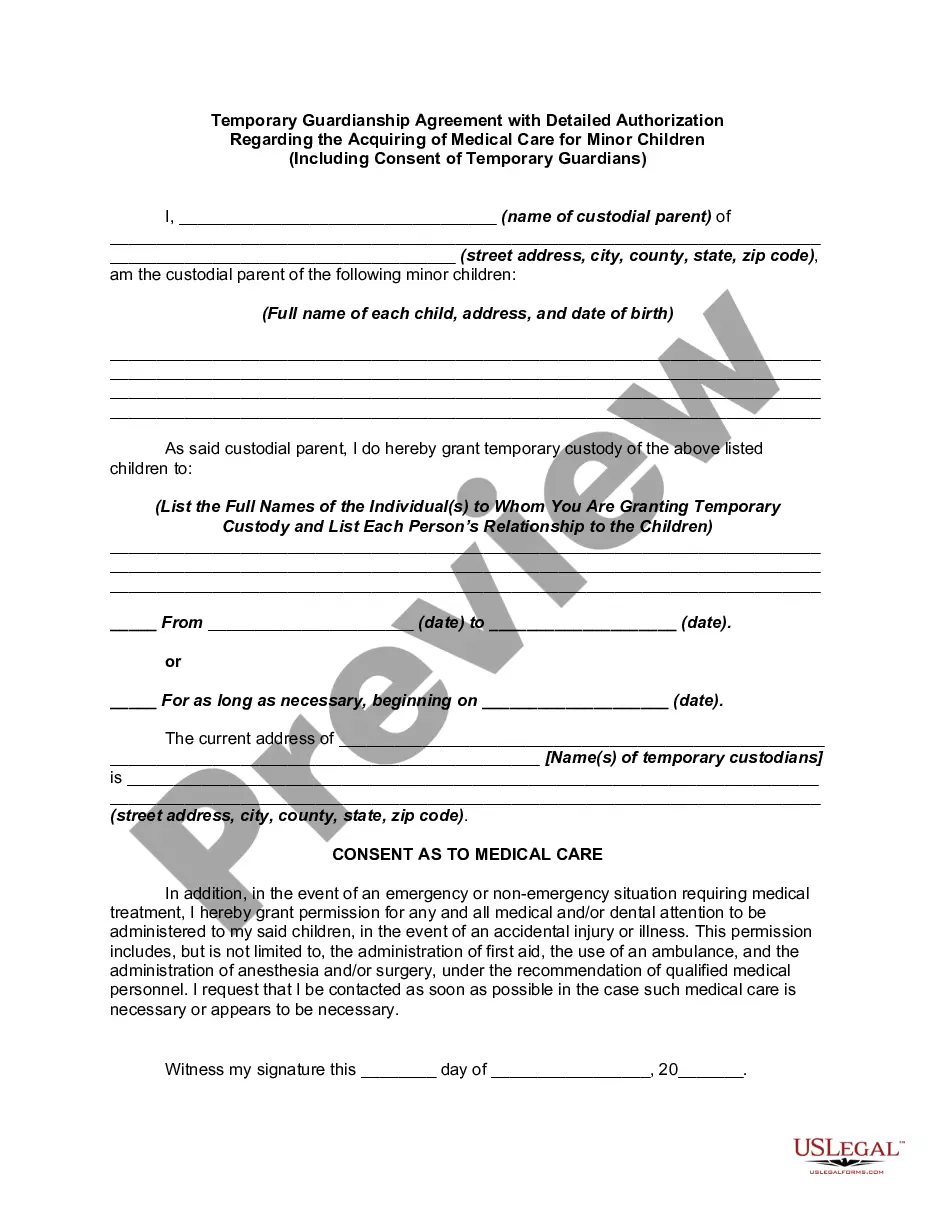
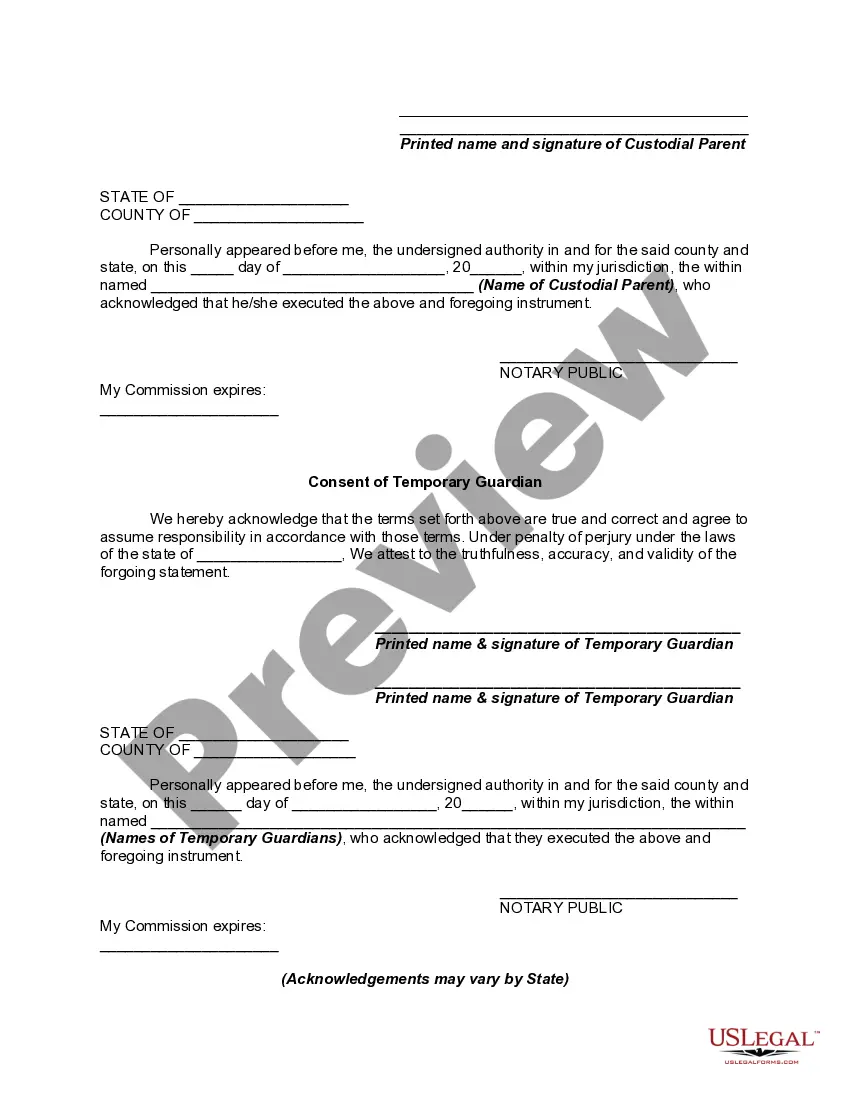
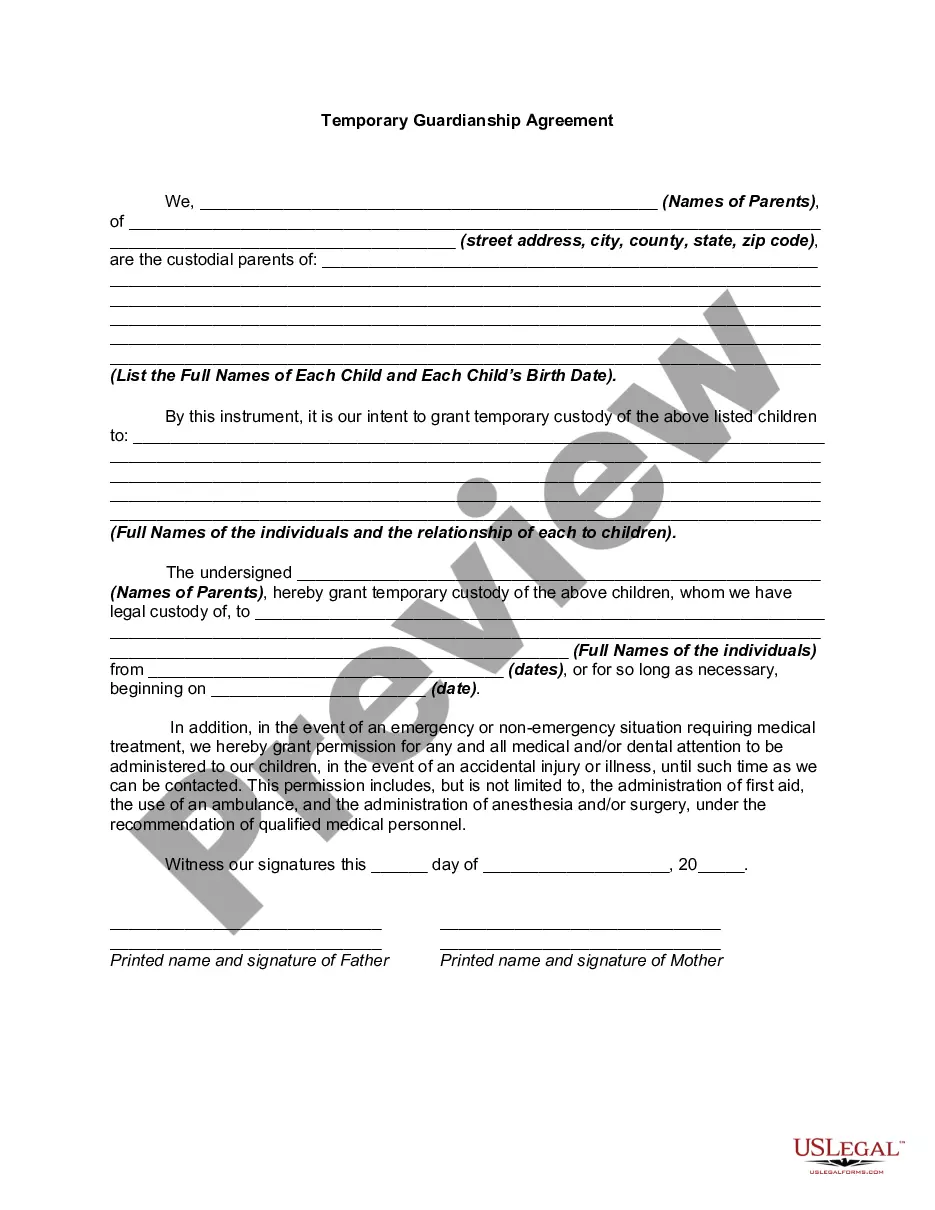
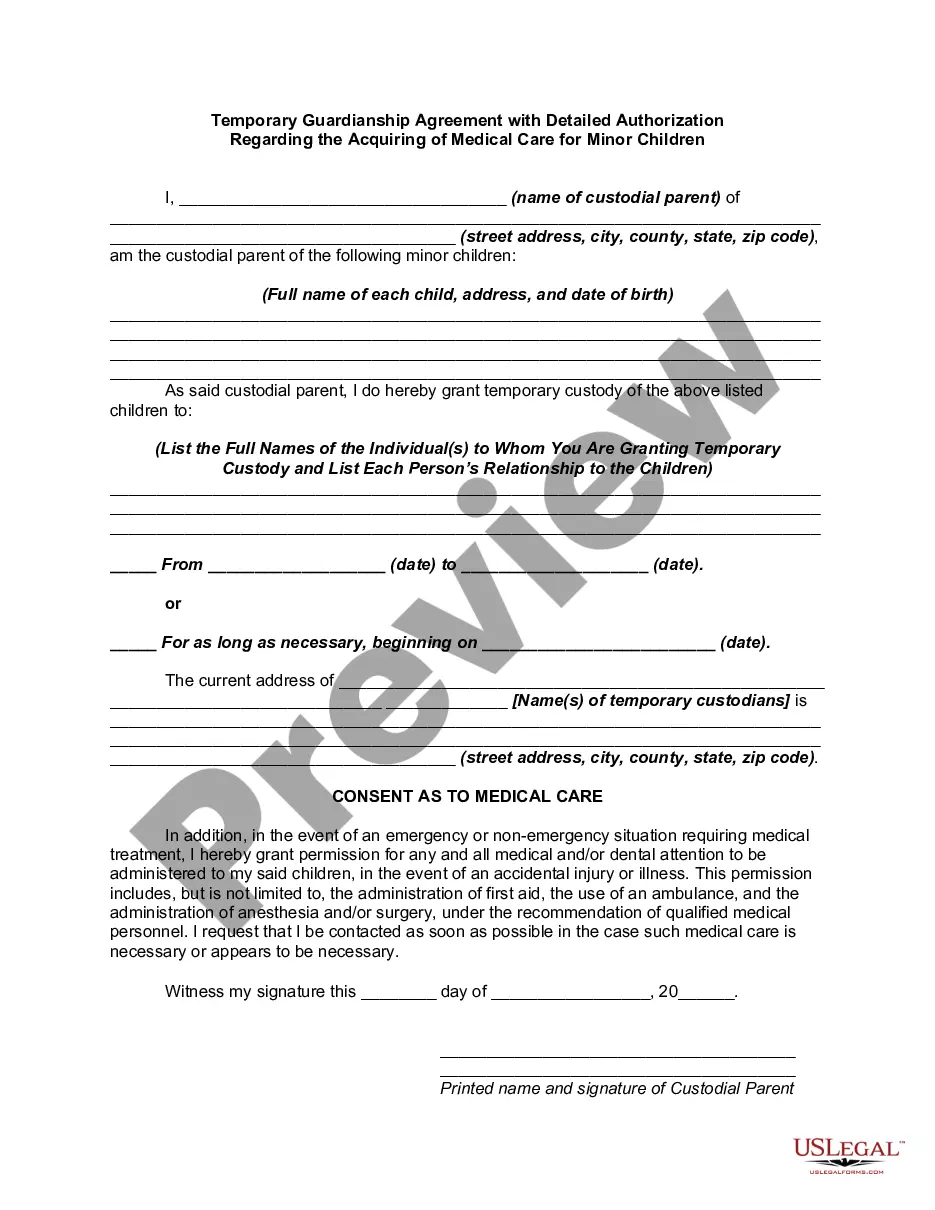
How to fill out Temporary Guardianship Agreement With Detailed Authorization Regarding The Acquiring Of Medical Care For Minor Children - Including Consent Of Temporary Guardians?
Whether for professional objectives or personal issues, everyone must deal with legal matters at some point in their lives.
Completing legal paperwork requires meticulous care, starting with selecting the appropriate form template.
With a comprehensive US Legal Forms catalog available, you don’t need to waste time searching for the suitable template online. Use the library’s easy navigation to find the correct form for any situation.
- For instance, if you select an incorrect version of a Custodial Parent Under Foreign Child, it will be rejected after you submit it.
- Therefore, it is vital to obtain a reliable source of legal documents like US Legal Forms.
- If you need to acquire a Custodial Parent Under Foreign Child template, follow these straightforward steps.
- Access the template you require by employing the search bar or catalog browsing.
- Review the form’s description to confirm it corresponds with your situation, state, and county.
- Click on the form’s preview to inspect it.
- If it is the wrong document, return to the search feature to locate the Custodial Parent Under Foreign Child template you need.
- Download the file when it meets your requirements.
- If you possess a US Legal Forms account, simply click Log in to access previously saved forms in My documents.
- If you do not have an account yet, you can acquire the form by clicking Buy now.
- Choose the appropriate pricing option.
- Complete the profile registration form.
- Select your payment method: use a credit card or PayPal account.
- Choose the document format you prefer and download the Custodial Parent Under Foreign Child.
- Once saved, you can fill out the form using editing software or print it out and complete it by hand.
Form popularity
FAQ
If one parent takes a child out of the country without the other parent's consent, it can lead to serious legal complications. This action may be considered international abduction, resulting in legal repercussions in both countries. It’s crucial for custodial parents under foreign child contexts to obtain mutual agreement or legal permission prior to international travel with their child. Consulting with legal professionals can help clarify rights and options in such scenarios.
The biggest mistake in a custody battle is failing to prioritize the child’s best interests. Losing sight of what truly matters can undermine your position and negatively affect your relationship with your child. Especially for a custodial parent under foreign child situations, demonstrating commitment and care is essential. Properly navigating this process with the right tools, such as uslegalforms, can help you avoid common pitfalls.
First, if parents live in different countries, it is essential to agree on where the child will reside. If parents cannot agree, it may be necessary to seek a court order from the child's country of residence. It is also essential to consider what kind of contact the child will have with each parent.
The custodial parent is the parent with whom the child lived for the longer period of time during the year. However, the child will be treated as the qualifying child of the noncustodial parent if the special rule for children of divorced or separated parents (or parents who live apart) applies.
The custodial parent is the parent with whom the child lived for the greater number of nights during the year. The other parent is the noncustodial parent. In most cases, because of the residency test, the custodial parent claims the child on their tax return.
If both parents are American, the baby is also American, no matter where he or she is born. However, if one parent is from a different country or has dual citizenship with the US, then the parents can apply for the baby to be declared a citizen of that country or be a dual citizen.
The U.S. Supreme Court has repeatedly held that a parent's citizenship or lack thereof should be largely irrelevant to the determination of child custody. This is important because it means that cases involving parents where only one is a U.S. citizen will be treated much the same as any other custody matter.