Tax And Accounting
Description
Get your form ready online
Our built-in tools help you complete, sign, share, and store your documents in one place.
Make edits, fill in missing information, and update formatting in US Legal Forms—just like you would in MS Word.
Download a copy, print it, send it by email, or mail it via USPS—whatever works best for your next step.
Sign and collect signatures with our SignNow integration. Send to multiple recipients, set reminders, and more. Go Premium to unlock E-Sign.
If this form requires notarization, complete it online through a secure video call—no need to meet a notary in person or wait for an appointment.
We protect your documents and personal data by following strict security and privacy standards.

Make edits, fill in missing information, and update formatting in US Legal Forms—just like you would in MS Word.

Download a copy, print it, send it by email, or mail it via USPS—whatever works best for your next step.

Sign and collect signatures with our SignNow integration. Send to multiple recipients, set reminders, and more. Go Premium to unlock E-Sign.

If this form requires notarization, complete it online through a secure video call—no need to meet a notary in person or wait for an appointment.

We protect your documents and personal data by following strict security and privacy standards.
Looking for another form?




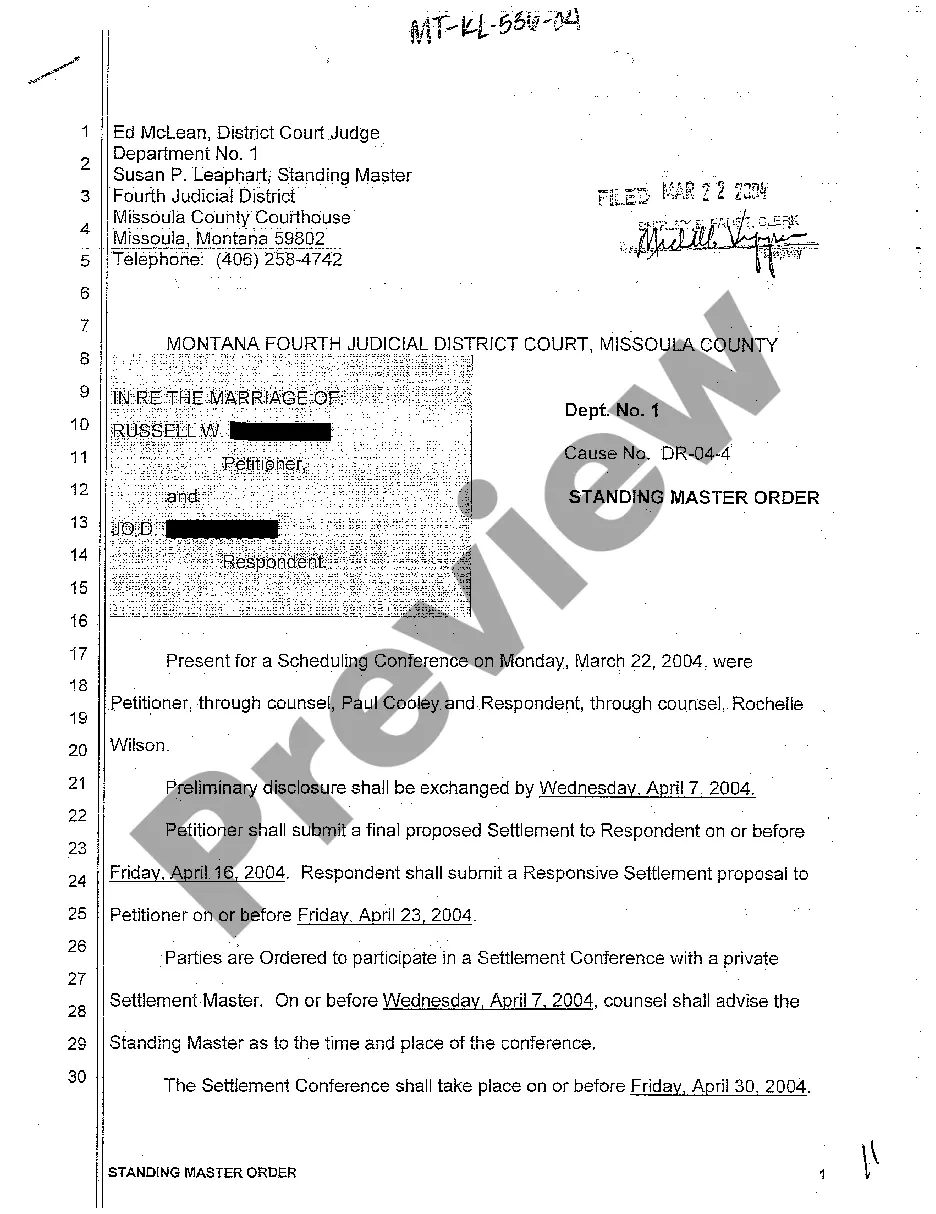



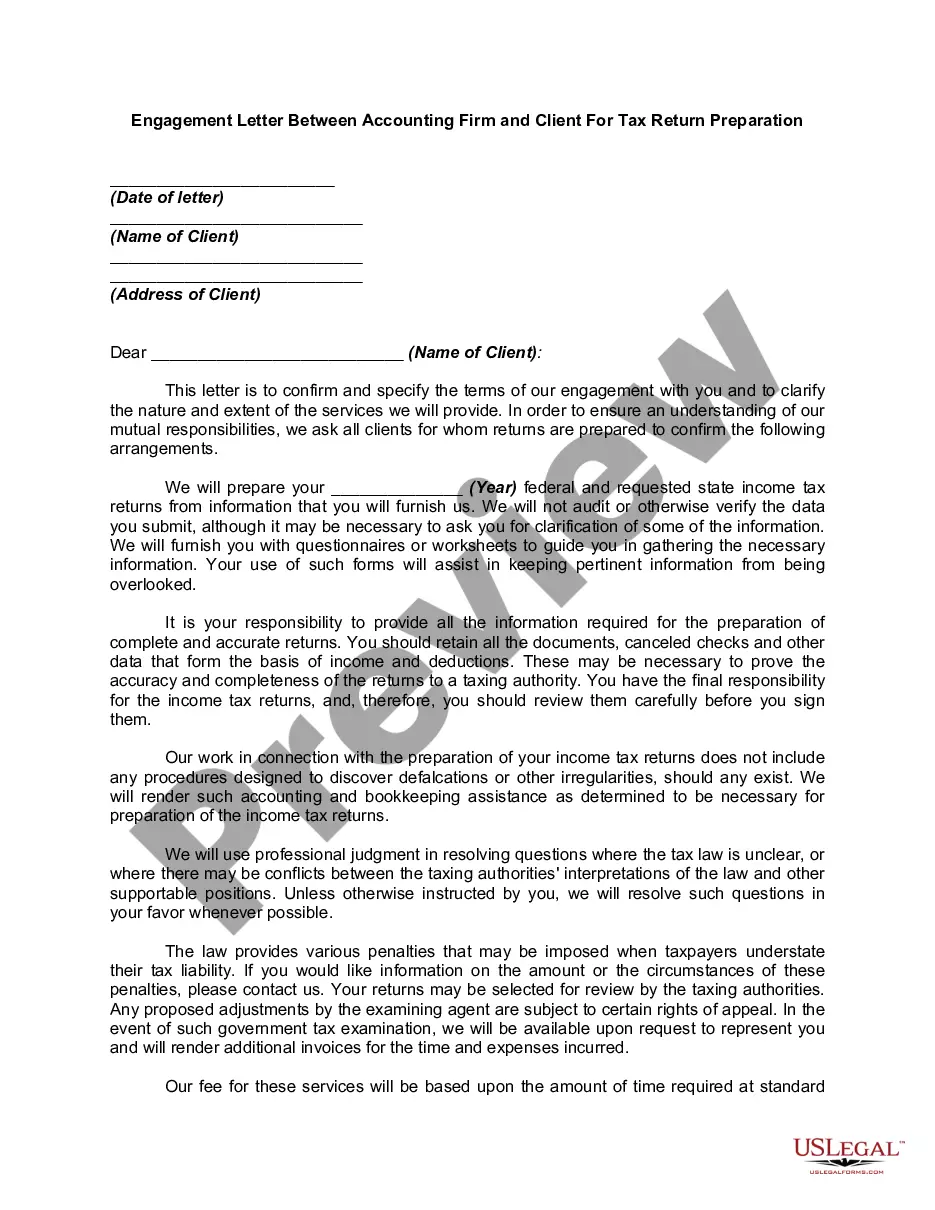
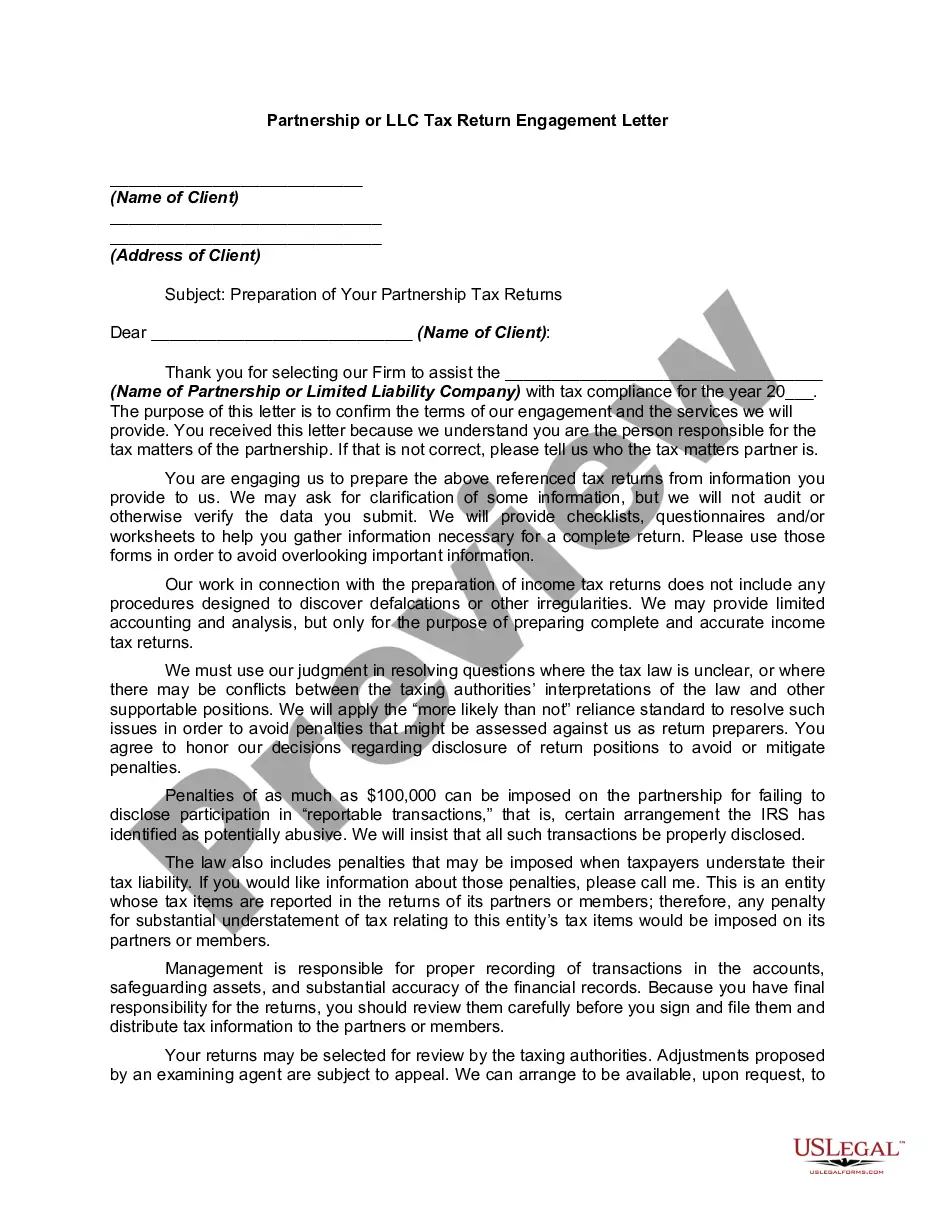
How to fill out Engagement Letter Between Accounting Firm And Client For Tax Return Preparation?
- If you're a returning user, log into your account and check your subscription status to ensure it's active. Then, download the needed form template by clicking the Download button.
- For new users, start by browsing our expansive form library. Use the Preview mode to scrutinize the form's description and confirm it meets your requirements and jurisdiction.
- If necessary, utilize the Search tab to explore additional templates. Adjust your search until you find the form that perfectly suits your needs.
- Select your desired document by clicking the Buy Now button and choose your preferred subscription plan. An account registration is required for access to our resource library.
- Complete the purchase process by providing your payment information via credit card or PayPal.
- Download the accessed form to your device and save it. You can revisit it anytime from the My Forms section of your account.
In conclusion, US Legal Forms simplifies the process of acquiring essential tax and accounting documents. Its extensive collection and expert support ensure you have access to legally sound forms tailored to your specific needs.
Ready to streamline your document management? Start your journey by exploring US Legal Forms today!
Form popularity
FAQ
While it's not mandatory to be a CPA to work as a tax accountant, having this certification can significantly enhance your credibility and expertise. A CPA brings a deep understanding of accounting principles and tax laws that can benefit clients seeking guidance on complex financial issues. If you're serious about a career in tax and accounting, pursuing CPA certification may open more doors and opportunities in the field.
GAAP, or Generally Accepted Accounting Principles, focuses on how businesses prepare their financial statements for investors and creditors, while tax accounting concentrates on complying with tax laws. GAAP emphasizes consistent reporting and transparency, while tax accounting prioritizes deductions and credits to minimize tax liabilities. Understanding these differences is essential for anyone involved in tax and accounting, ensuring compliance and effective financial management.
Deciding whether to use a CPA or a tax preparer depends on the complexity of your financial situation. If you have straightforward tax needs, a tax preparer may suffice. However, if you own a business or have complicated investments, engaging a CPA can provide you with a more strategic approach. Knowing your options will help you make an informed decision that aligns with your financial goals.
A CPA offers a wider array of services beyond basic tax preparation, including financial planning, auditing, and consulting. They also have the authority to represent clients in dealings with the IRS during audits and appeals. This expert guidance can be invaluable, especially when dealing with complex financial situations. For comprehensive support in tax and accounting, USLegalForms can provide resources to connect you with qualified professionals.
No, a tax accountant is not the same as a CPA. While all CPAs can perform tax accounting, not all tax accountants have the CPA designation. CPAs undergo rigorous education and pass a challenging exam, allowing them to provide a broader range of services. If your needs are primarily tax-related, a tax accountant may be sufficient, though a CPA brings additional expertise.
Accounting refers to the systematic process of recording, analyzing, and reporting financial transactions. Tax, on the other hand, focuses specifically on the preparation and filing of tax returns and compliance with tax laws. Both accounting and tax play crucial roles in ensuring that individuals and businesses manage their finances responsibly. Understanding the differences can help you make informed decisions when seeking professional guidance.
Tax accounting can be a rewarding career for those interested in finance, law, and helping others with their financial obligations. The demand for skilled tax accountants remains high, especially during tax season. Additionally, the field offers opportunities for certification and specialization, making it a promising option for those pursuing a long-term career. With platforms like USLegalForms, you can access resources that enhance your understanding and capabilities in tax and accounting.
Choosing between a CPA and an EA depends on your specific tax and accounting needs. A CPA, or Certified Public Accountant, has extensive training and can offer a wider range of services, including audits and financial consulting. EAs, or Enrolled Agents, specialize in tax matters and can represent clients before the IRS. Consider your needs and the complexity of your tax situation when making this choice.
As a beginner, the best way to do your taxes is to educate yourself on basic tax concepts and explore available resources. Use tax preparation software or consult online articles that break down the process into manageable steps. By understanding your options for tax and accounting, you can build confidence and tackle your tax responsibilities successfully.
Doing taxes for the first time may seem daunting, but it can be straightforward with the right approach. Start by collecting all your income documents and familiarizing yourself with tax forms, including the standard deduction options. Platforms like US Legal Forms provide guidance and templates that can make your first-time filing experience less stressful and more efficient.