Accounting For Insurance Proceeds Pwc
Description
Get your form ready online
Our built-in tools help you complete, sign, share, and store your documents in one place.
Make edits, fill in missing information, and update formatting in US Legal Forms—just like you would in MS Word.
Download a copy, print it, send it by email, or mail it via USPS—whatever works best for your next step.
Sign and collect signatures with our SignNow integration. Send to multiple recipients, set reminders, and more. Go Premium to unlock E-Sign.
If this form requires notarization, complete it online through a secure video call—no need to meet a notary in person or wait for an appointment.
We protect your documents and personal data by following strict security and privacy standards.

Make edits, fill in missing information, and update formatting in US Legal Forms—just like you would in MS Word.

Download a copy, print it, send it by email, or mail it via USPS—whatever works best for your next step.

Sign and collect signatures with our SignNow integration. Send to multiple recipients, set reminders, and more. Go Premium to unlock E-Sign.

If this form requires notarization, complete it online through a secure video call—no need to meet a notary in person or wait for an appointment.

We protect your documents and personal data by following strict security and privacy standards.
Looking for another form?










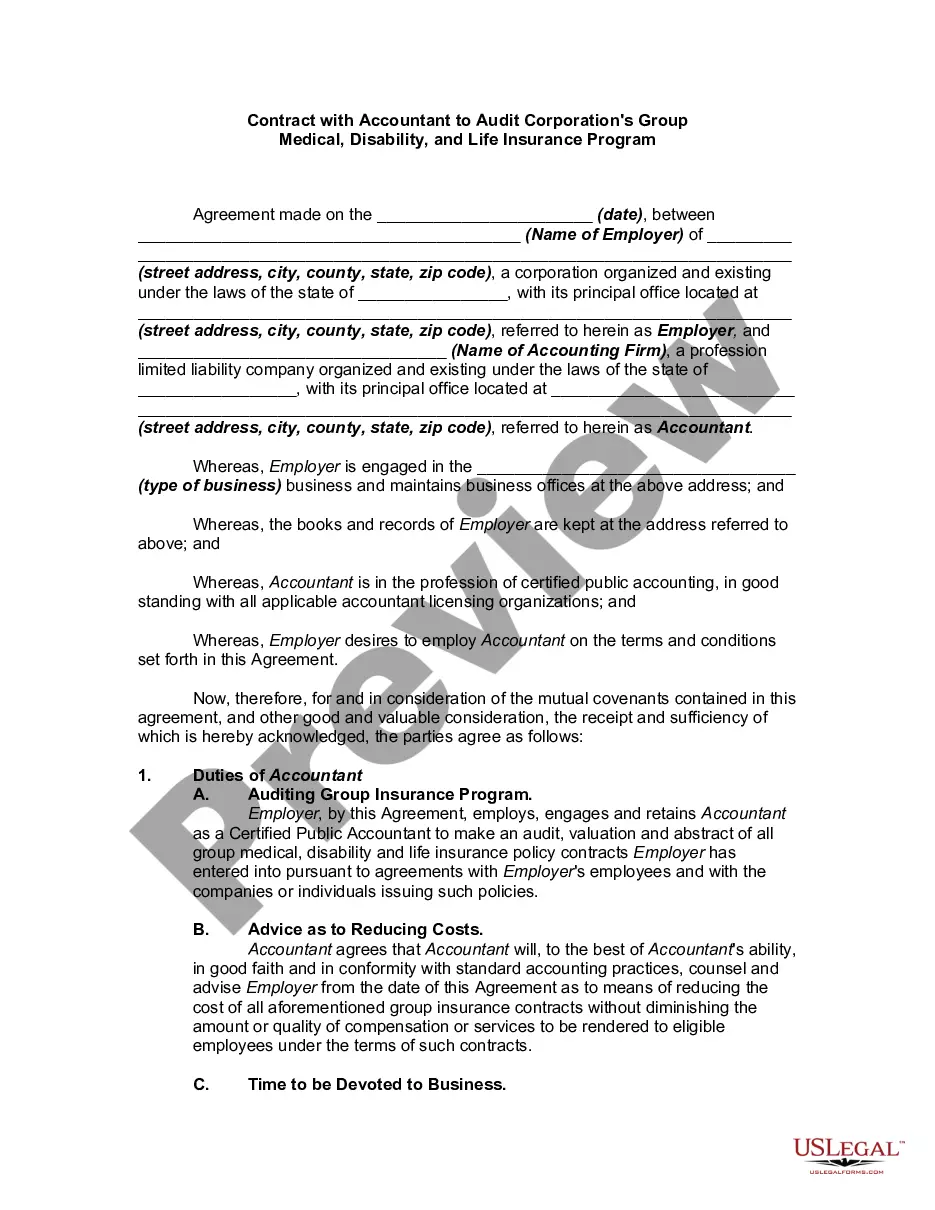
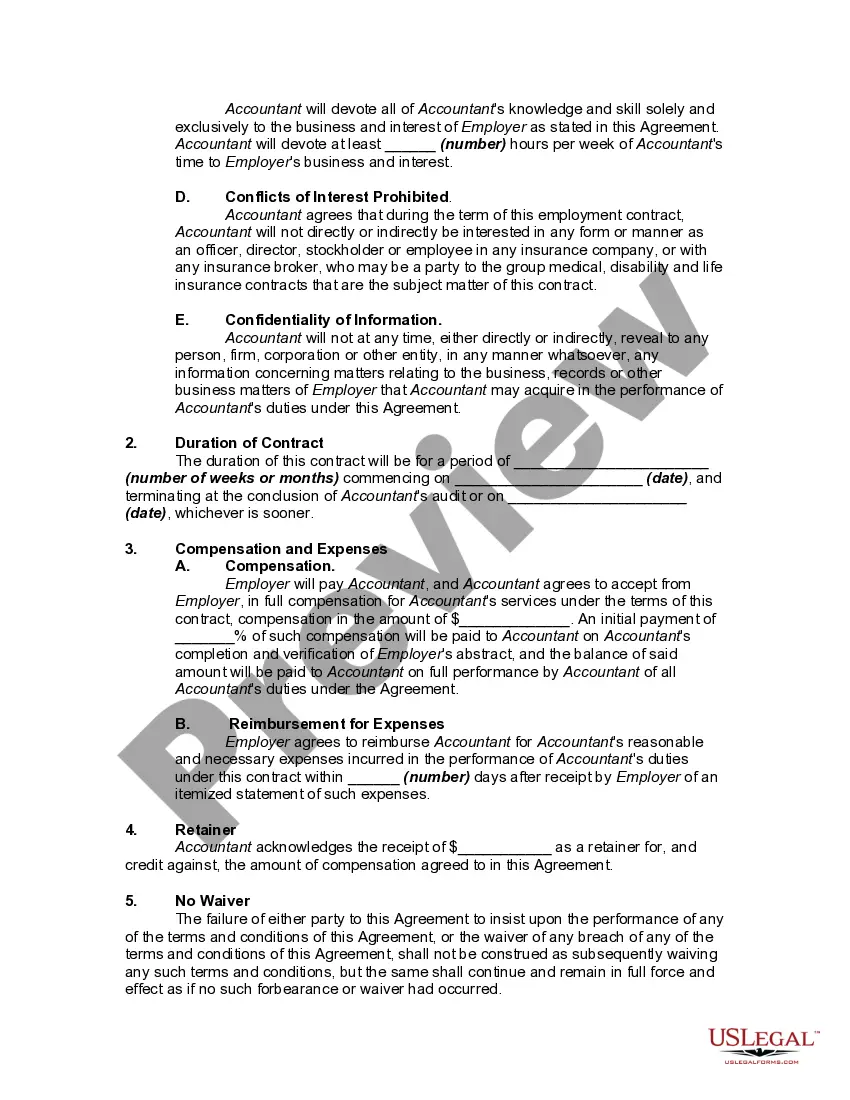
How to fill out Contract With Accountant To Audit Corporation's Group Medical, Disability, And Life Insurance Program?
Whether for commercial reasons or for personal matters, everyone must deal with legal circumstances at some time in their lives.
Filling out legal documentation requires meticulous care, beginning with selecting the correct form template.
Once it is saved, you can complete the form using editing software or print it out to finish manually. With an extensive US Legal Forms catalog available, you will never need to waste time searching for the right template online. Use the library’s user-friendly navigation to find the correct template for any occasion.
- For example, if you choose an incorrect version of an Accounting For Insurance Proceeds Pwc, it will be denied upon submission.
- Thus, it is crucial to have a reliable source of legal documents such as US Legal Forms.
- If you are looking to obtain a sample of Accounting For Insurance Proceeds Pwc, follow these simple steps.
- Utilize the search bar or browse the catalog to find the template you require.
- Review the form’s details to confirm it is appropriate for your circumstances, state, and county.
- Click on the form’s preview to examine it.
- If it turns out to be the incorrect form, return to the search feature to locate the Accounting For Insurance Proceeds Pwc sample you need.
- Download the file if it satisfies your requirements.
- If you possess a US Legal Forms profile, simply click Log in to access previously saved templates in My documents.
- If you have yet to create an account, you can get the form by clicking Buy now.
- Select the suitable pricing option.
- Fill out the profile registration form.
- Choose your payment method: use a credit card or PayPal account.
- Select the document format you prefer and download the Accounting For Insurance Proceeds Pwc.
Form popularity
FAQ
The payment made by the company is listed as an expense for the accounting period. If the insurance is used to cover production and operation, then the insurance expense can be listed in an overhead cost pool and divided into each unit produced during the period.
Reimbursement for a loss: If the insurance proceeds are intended to reimburse the company for a loss or damage (e.g., property damage, theft, or loss of inventory), the proceeds are typically recorded as a reduction of the related loss or expense.
The following journal entry can be used to record the insurance claim: Debit: Insurance Claim Receivable (Assets) - Increase in the amount of insurance claim receivable. Credit: Loss on Damaged Goods (Expenses) - Record the loss incurred due to damaged goods.
For example, if $10,000 of inventory is damaged in a fire and the proceeds are $7,000, the transaction should be recorded as a $7,000 debit to cash-fire damage reimbursement, a $3,000 debit to loss on insurance proceeds, and a $10,000 credit to inventory.
Insurance expense refers to the cost incurred by a business or an individual for obtaining insurance coverage. These costs are paid as premiums to an insurance company and are typically accounted for as expense items in the entity's financial statements.