Sample Custody Schedules
Description
Get your form ready online
Our built-in tools help you complete, sign, share, and store your documents in one place.
Make edits, fill in missing information, and update formatting in US Legal Forms—just like you would in MS Word.
Download a copy, print it, send it by email, or mail it via USPS—whatever works best for your next step.
Sign and collect signatures with our SignNow integration. Send to multiple recipients, set reminders, and more. Go Premium to unlock E-Sign.
If this form requires notarization, complete it online through a secure video call—no need to meet a notary in person or wait for an appointment.
We protect your documents and personal data by following strict security and privacy standards.

Make edits, fill in missing information, and update formatting in US Legal Forms—just like you would in MS Word.

Download a copy, print it, send it by email, or mail it via USPS—whatever works best for your next step.

Sign and collect signatures with our SignNow integration. Send to multiple recipients, set reminders, and more. Go Premium to unlock E-Sign.

If this form requires notarization, complete it online through a secure video call—no need to meet a notary in person or wait for an appointment.

We protect your documents and personal data by following strict security and privacy standards.
Looking for another form?

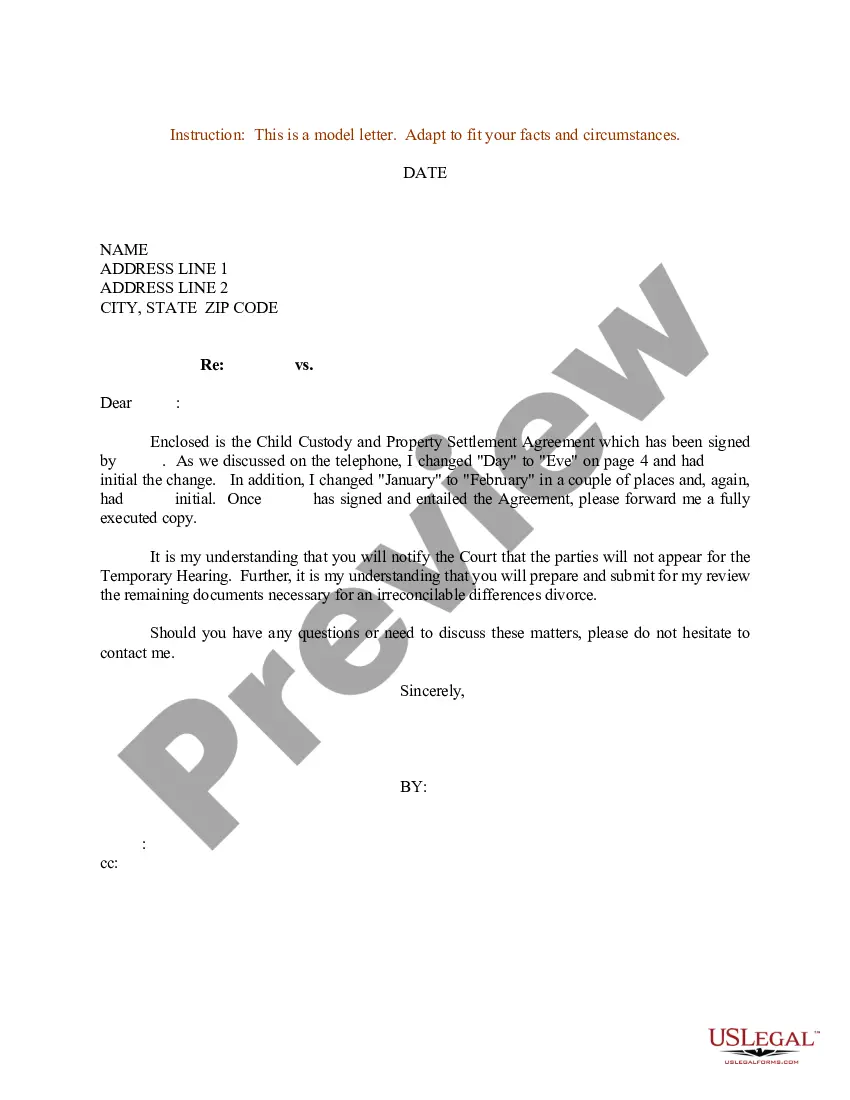
How to fill out Sample Letter Regarding Child Custody And Property Settlement Agreement?
The Sample Custody Schedules displayed on this page is a reusable formal template crafted by expert attorneys in alignment with federal and state laws and regulations.
For over 25 years, US Legal Forms has offered individuals, organizations, and legal practitioners with more than 85,000 validated, state-specific forms for any business and personal scenario. It’s the quickest, easiest, and most dependable method to acquire the documents you require, as the service ensures the utmost level of data security and anti-malware safeguards.
Register for US Legal Forms to have authentic legal templates for all of life’s situations at your fingertips.
- Search for the document you need and examine it. Browse through the sample you sought and view it or check the form description to confirm it meets your requirements. If it doesn’t, use the search bar to locate the suitable one.
- Register and Log In. Select the pricing option that fits you and create an account. Utilize PayPal or a credit card to make a swift payment. If you already possess an account, Log In and verify your subscription to continue.
- Obtain the fillable template. Choose the format you prefer for your Sample Custody Schedules (PDF, DOCX, RTF) and save the sample to your device.
- Complete and sign the documents. Print the template to fill it out manually. Alternatively, use an online multifunctional PDF editor to swiftly and accurately complete and sign your form with a legally-binding electronic signature.
- Download your documents once more. Utilize the same document again whenever required. Access the My documents tab in your profile to redownload any previously downloaded forms.
Form popularity
FAQ
As the name suggests, in the 2-2-3 schedule, the employees are divided into four groups and each set of employees work for two days, then get two consecutive days off, and then again work for three days. The following week, these employees get two days off, then work for 2 consecutive days and then get three days off.
Attorney Zeiderman lists 5-2-2-5 and alternating weeks as the two most popular schedules. "I would say that there are two plans that work," says Zeiderman. "5-2-2-5 is extremely popular, but it means lots of transitions for the child. Some children do very well with this plan, but other children dislike the transition.
4-3-3-4 schedule: As the title suggests, the 4-3-3-4 is the inverse of 3-4-4-3. Instead of the first parent in the rotation starting with three days, he/she starts with four. Then, the other parent gets the children for three days.
A 50/50 parenting schedule could be arranged in many ways, such as: Biweekly rotation - One week with one parent, and one week with the other parent. 2-2-5-5 rotation - Two days with one parent, and two days with the other parent. Then, five days back with the first parent, and five days with the other parent.
The most common co-parenting 50/50 plans include 2-2-3, 3-4-4-3, 2-2-5-5, and alternating weeks. However, some more uncommon arrangements also exist, like alternating custody every two weeks.