Trust Agreement Irrevocable With Spendthrift Provision
Description


Get your form ready online
Our built-in tools help you complete, sign, share, and store your documents in one place.
Make edits, fill in missing information, and update formatting in US Legal Forms—just like you would in MS Word.
Download a copy, print it, send it by email, or mail it via USPS—whatever works best for your next step.
Sign and collect signatures with our SignNow integration. Send to multiple recipients, set reminders, and more. Go Premium to unlock E-Sign.
If this form requires notarization, complete it online through a secure video call—no need to meet a notary in person or wait for an appointment.
We protect your documents and personal data by following strict security and privacy standards.

Make edits, fill in missing information, and update formatting in US Legal Forms—just like you would in MS Word.

Download a copy, print it, send it by email, or mail it via USPS—whatever works best for your next step.

Sign and collect signatures with our SignNow integration. Send to multiple recipients, set reminders, and more. Go Premium to unlock E-Sign.

If this form requires notarization, complete it online through a secure video call—no need to meet a notary in person or wait for an appointment.

We protect your documents and personal data by following strict security and privacy standards.
Looking for another form?

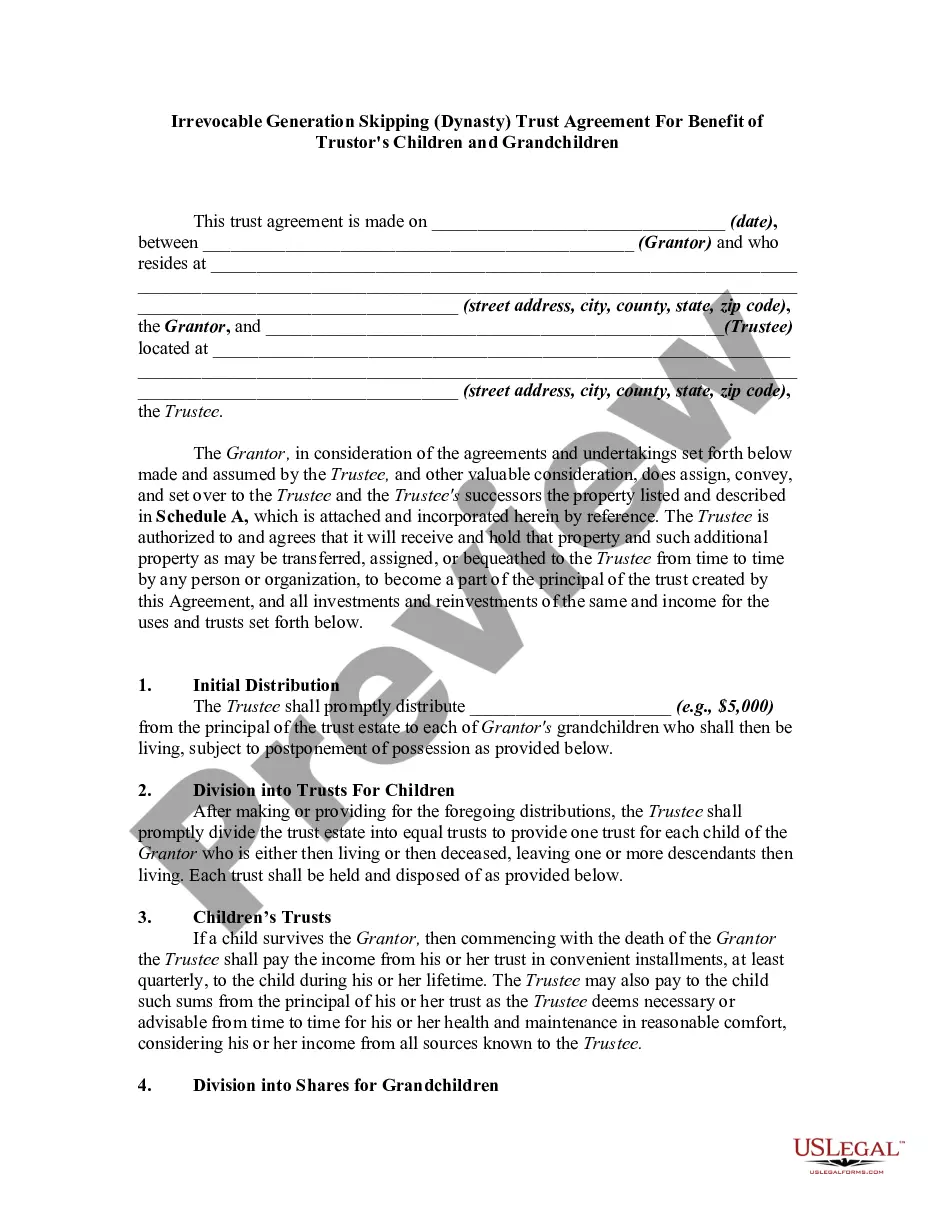
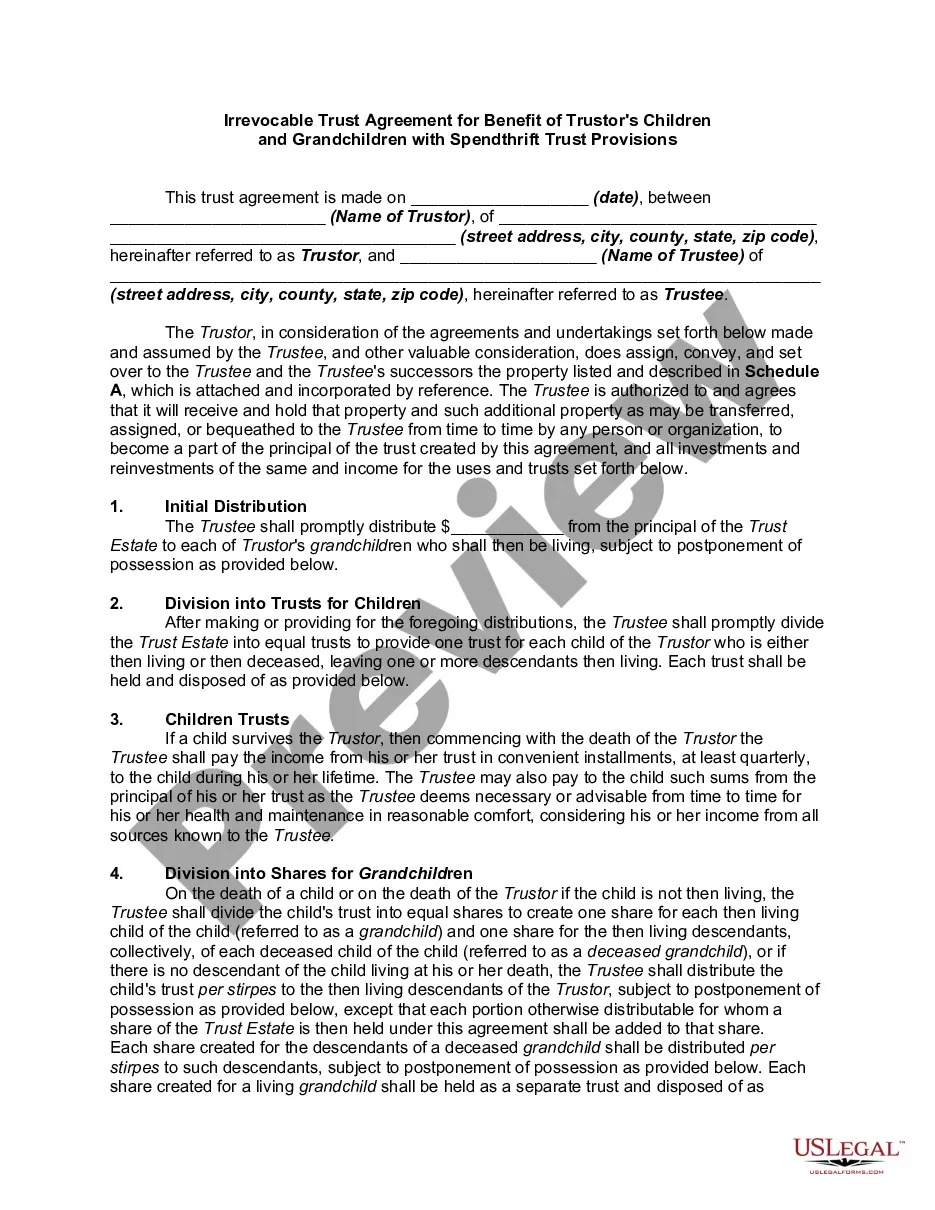
How to fill out Irrevocable Trust Agreement For Benefit Of Trustor's Children And Grandchildren?
Creating legal documents from scratch can frequently be overwhelming.
Certain situations may require extensive research and significant financial investment.
If you are looking for an easier and more cost-effective method of drafting a Trust Agreement Irrevocable With Spendthrift Provision or any other documentation without unnecessary complications, US Legal Forms is readily available.
Our online library of over 85,000 current legal forms covers nearly every facet of your financial, legal, and personal needs. With just a few clicks, you can swiftly find state- and county-specific templates carefully assembled for you by our legal experts.
US Legal Forms has a strong reputation and over 25 years of experience. Join us today and simplify the document completion process!
- Utilize our website whenever you require dependable and trustworthy services to effortlessly locate and download the Trust Agreement Irrevocable With Spendthrift Provision.
- If you are familiar with our services and have created an account previously, simply Log In to your account, find the template, and download it or re-download it later through the My documents section.
- Not an account holder? No problem. It takes minimal time to register and browse the catalog.
- Before you proceed to download the Trust Agreement Irrevocable With Spendthrift Provision, keep these suggestions in mind.
- Examine the document preview and descriptions to verify that you have found the correct document.
Form popularity
FAQ
Creditors generally cannot pursue assets held in a spendthrift trust. This is an essential feature of a trust agreement irrevocable with spendthrift provision. The purpose of a spendthrift trust is to protect assets from beneficiaries’ creditors, ensuring the trust assets remain preserved for their intended use. However, there are exceptions, which may vary by state, so consulting a legal expert is advisable for tailored guidance.
One disadvantage of a spendthrift trust is that beneficiaries have limited control over trust assets, which might lead to frustration. Additionally, the irrevocable nature of a trust agreement irrevocable with spendthrift provision means you cannot make changes once established. This might limit flexibility should your circumstances change. However, these drawbacks often balance out with the financial protection and security provided.
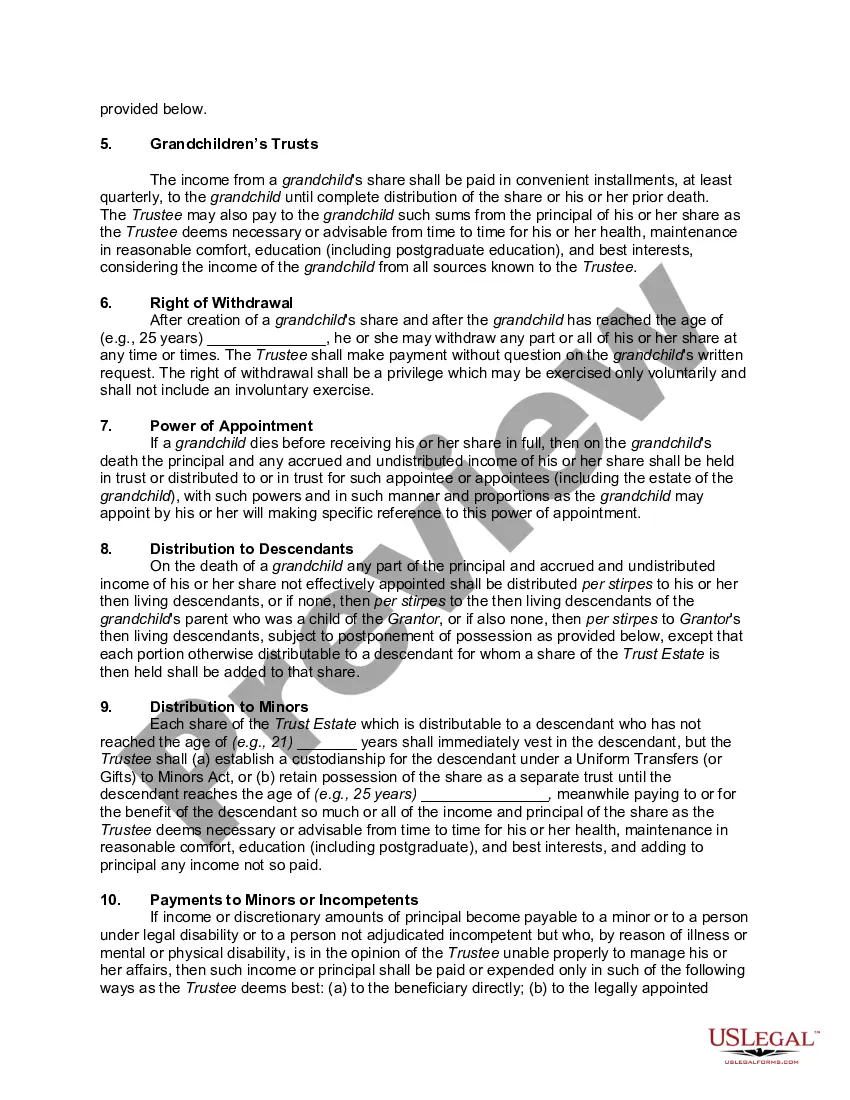
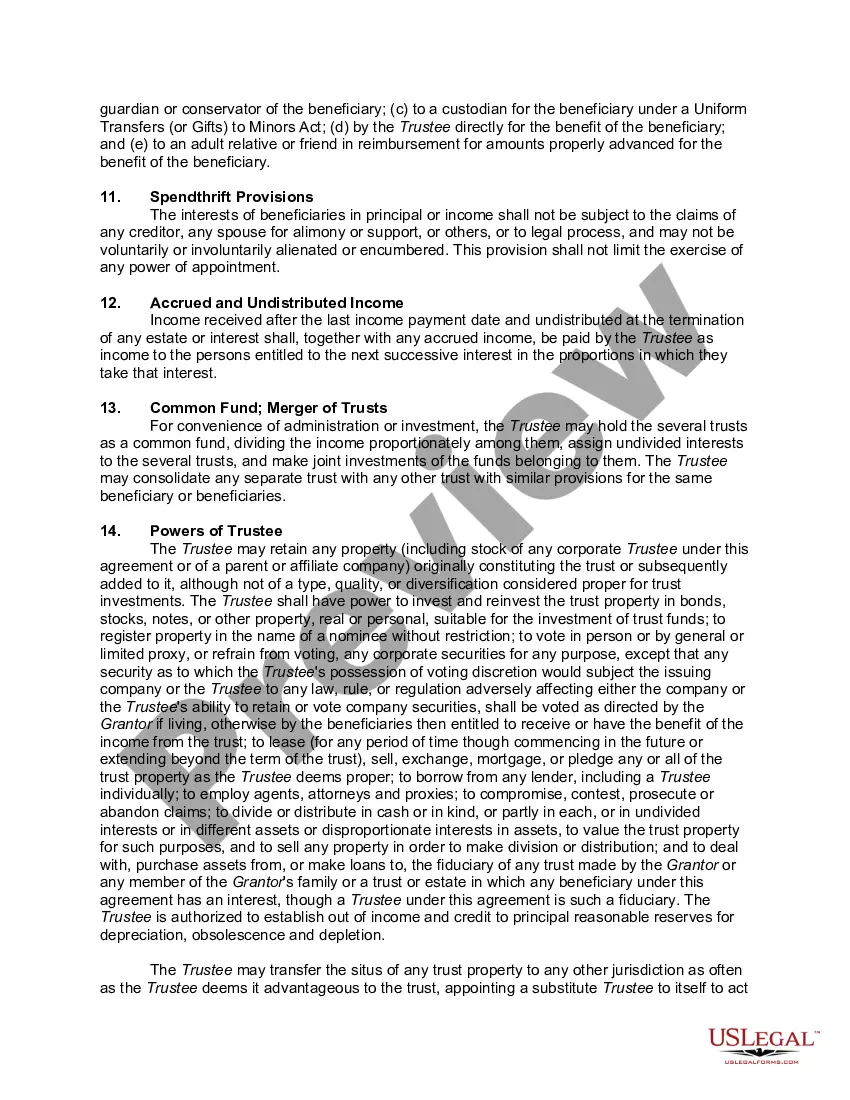
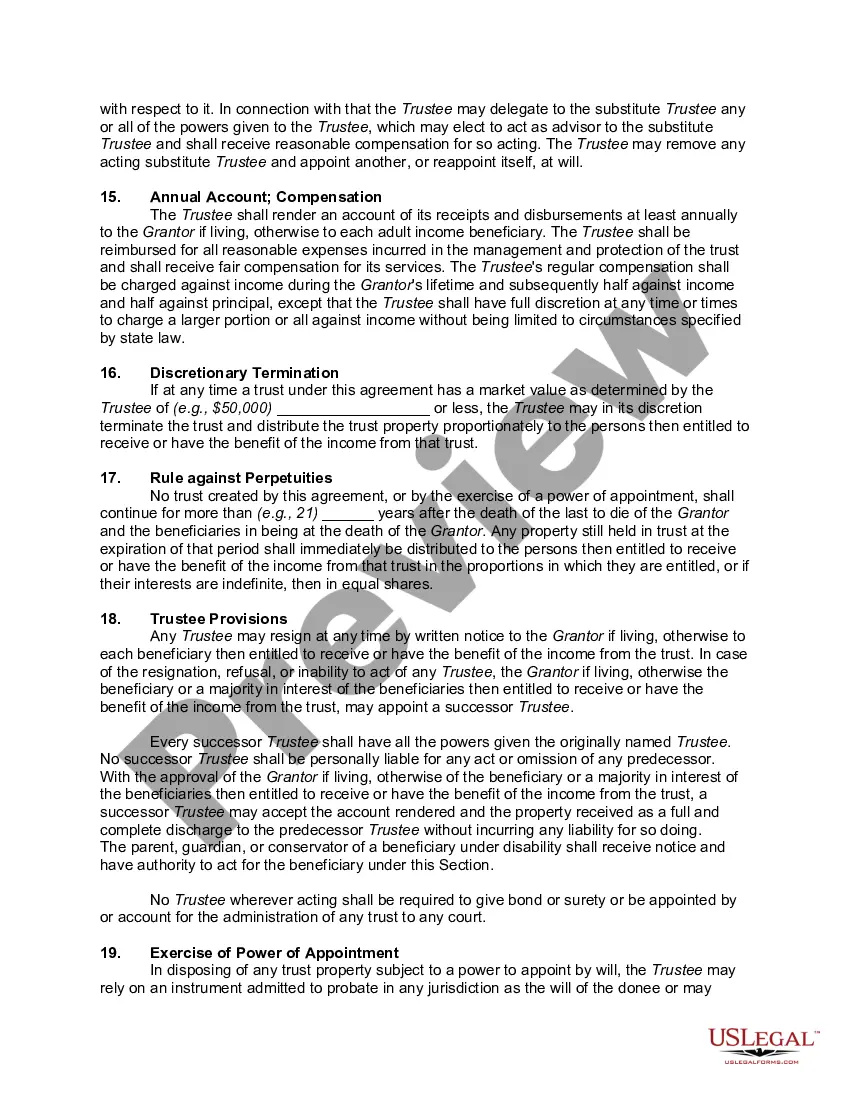
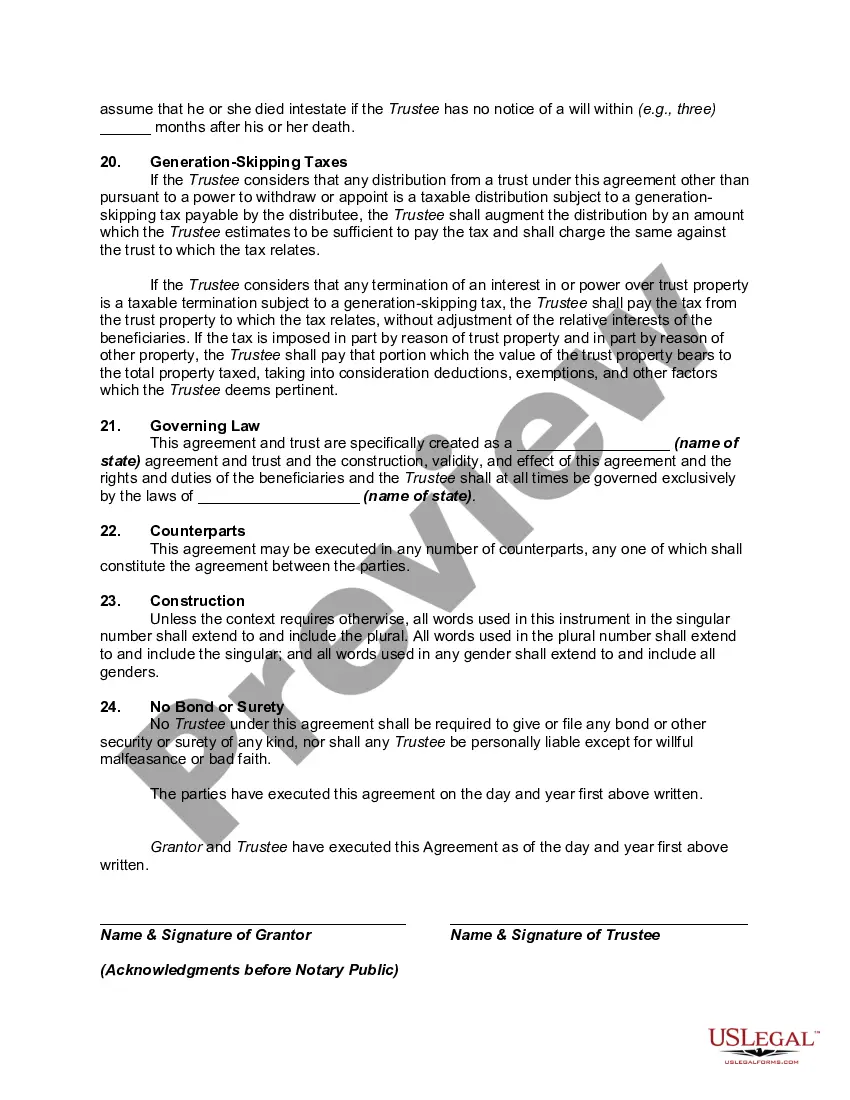
A spendthrift provision in a trust is a clause that limits a beneficiary's access to trust assets, preventing them from squandering or mismanaging the funds. This provision is particularly useful in a trust agreement irrevocable with spendthrift provision, as it secures the trust from external creditors and ensures the assets are used wisely. Such provisions create a safety net, promoting financial stability for the beneficiaries.
An example of a spendthrift provision would be a clause that states a beneficiary cannot sell or assign their interest in the trust assets. It limits their ability to access funds until certain conditions are met, providing protection from creditors. This feature is essential in a trust agreement irrevocable with spendthrift provision, as it ensures assets are preserved for future generations. It promotes responsible financial management among beneficiaries.
The three types of irrevocable trust typically include irrevocable life insurance trusts, irrevocable charitable trusts, and irrevocable spendthrift trusts. Each serves a unique purpose in managing assets and providing benefits to beneficiaries. A trust agreement irrevocable with spendthrift provision is specifically designed to protect the trust assets from beneficiaries’ creditors. Choosing the right type depends on your financial goals and family needs.
Yes, a spendthrift trust can be irrevocable. When you create a trust agreement irrevocable with spendthrift provision, it prevents beneficiaries from withdrawing funds or selling their interest. This structure protects the assets from creditors and ensures that the trust's resources are used for the intended purpose. Trusts like these offer long-term security and stability for your beneficiaries.
While a spendthrift clause provides substantial protection, there are exceptions that may allow creditors to access certain funds. These may include obligations like child support and federal tax liens, which typically cannot be shielded by a spendthrift provision. Awareness of these exceptions is vital when setting up a trust agreement irrevocable with spendthrift provision, as they can affect overall asset protection.
Consider a trust agreement irrevocable with spendthrift provision that specifies, 'No beneficiary shall have the right to encumber, transfer, or pledge their interest in this trust, and creditors shall not have the right to attach or seize any distributions.' This example clearly delineates the limitations placed on beneficiaries concerning their interest in the trust, reinforcing the protective aspect of the spendthrift clause.
A spendthrift clause lump sum refers to a situation where a beneficiary receives a single, large distribution from the trust rather than periodic payments. This can occur when a trust agreement irrevocable with spendthrift provision allows for specific circumstances under which lump sums are appropriate. It is essential to structure these distributions carefully to maintain the protective intent of the spendthrift provision.
Not all assets are suitable for inclusion in a trust agreement irrevocable with spendthrift provision. Assets that may benefit from more flexible management, such as real estate that you require for living, should generally be kept outside the trust. Additionally, personal assets that are difficult to value or that you may want control over later should also be excluded.