Clean Up Property Notice With React
Description
Get your form ready online
Our built-in tools help you complete, sign, share, and store your documents in one place.
Make edits, fill in missing information, and update formatting in US Legal Forms—just like you would in MS Word.
Download a copy, print it, send it by email, or mail it via USPS—whatever works best for your next step.
Sign and collect signatures with our SignNow integration. Send to multiple recipients, set reminders, and more. Go Premium to unlock E-Sign.
If this form requires notarization, complete it online through a secure video call—no need to meet a notary in person or wait for an appointment.
We protect your documents and personal data by following strict security and privacy standards.

Make edits, fill in missing information, and update formatting in US Legal Forms—just like you would in MS Word.

Download a copy, print it, send it by email, or mail it via USPS—whatever works best for your next step.

Sign and collect signatures with our SignNow integration. Send to multiple recipients, set reminders, and more. Go Premium to unlock E-Sign.

If this form requires notarization, complete it online through a secure video call—no need to meet a notary in person or wait for an appointment.

We protect your documents and personal data by following strict security and privacy standards.
Looking for another form?







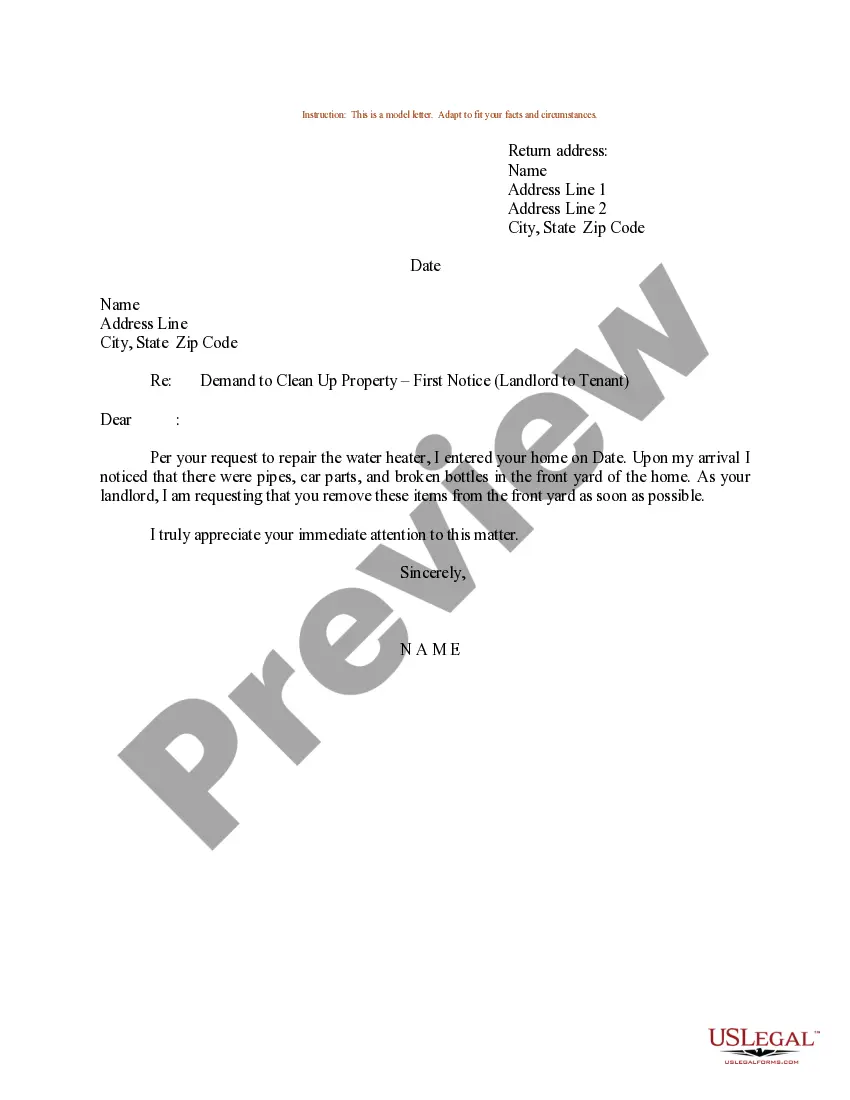
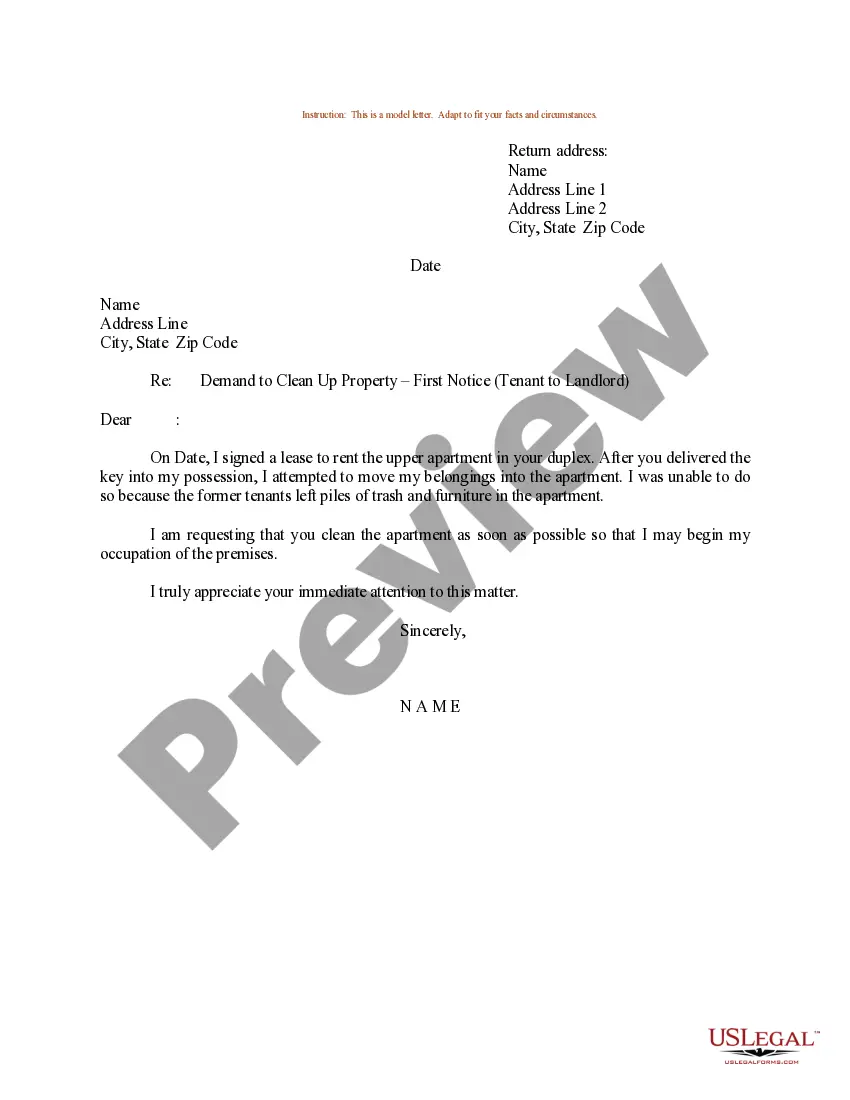
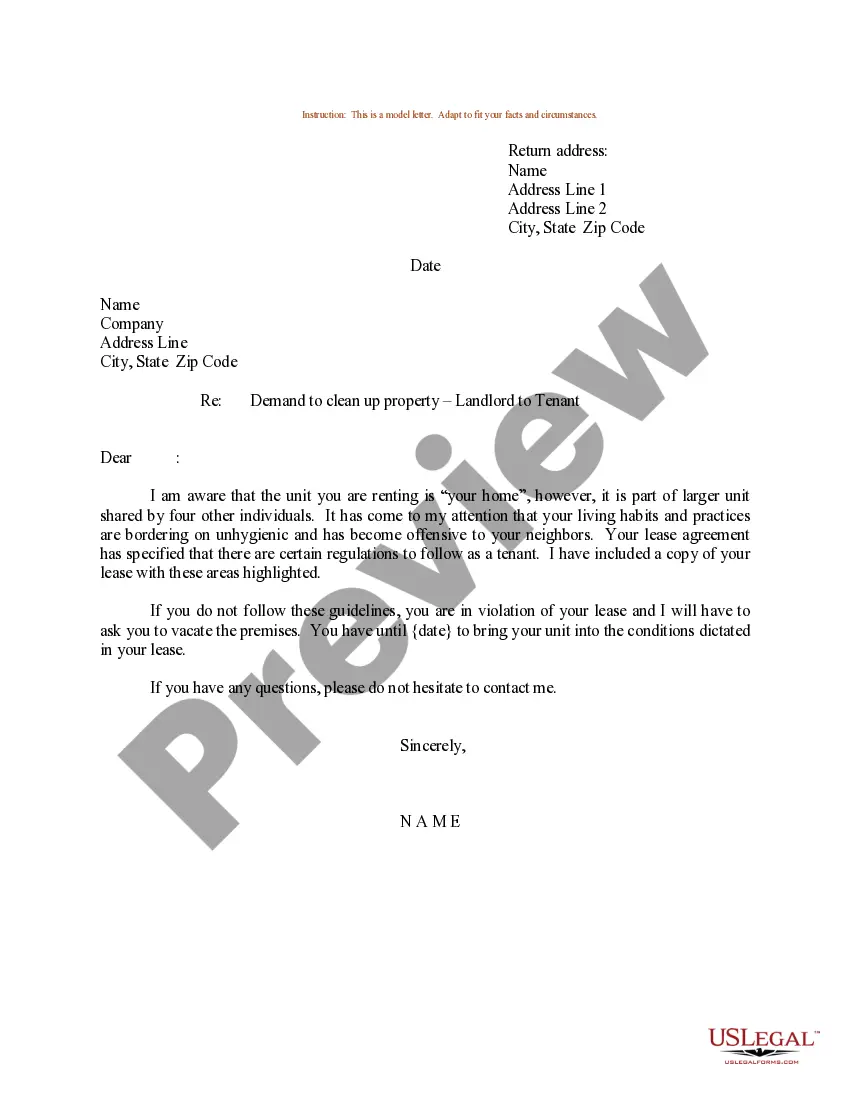
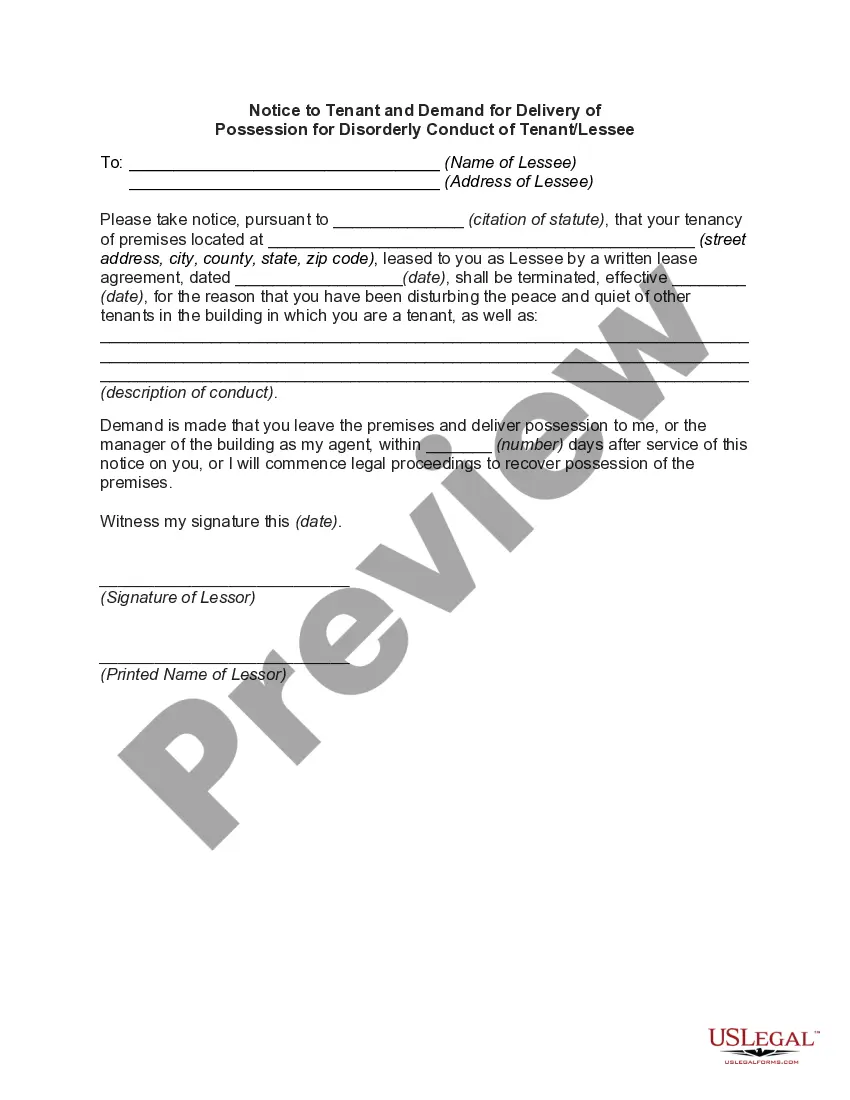
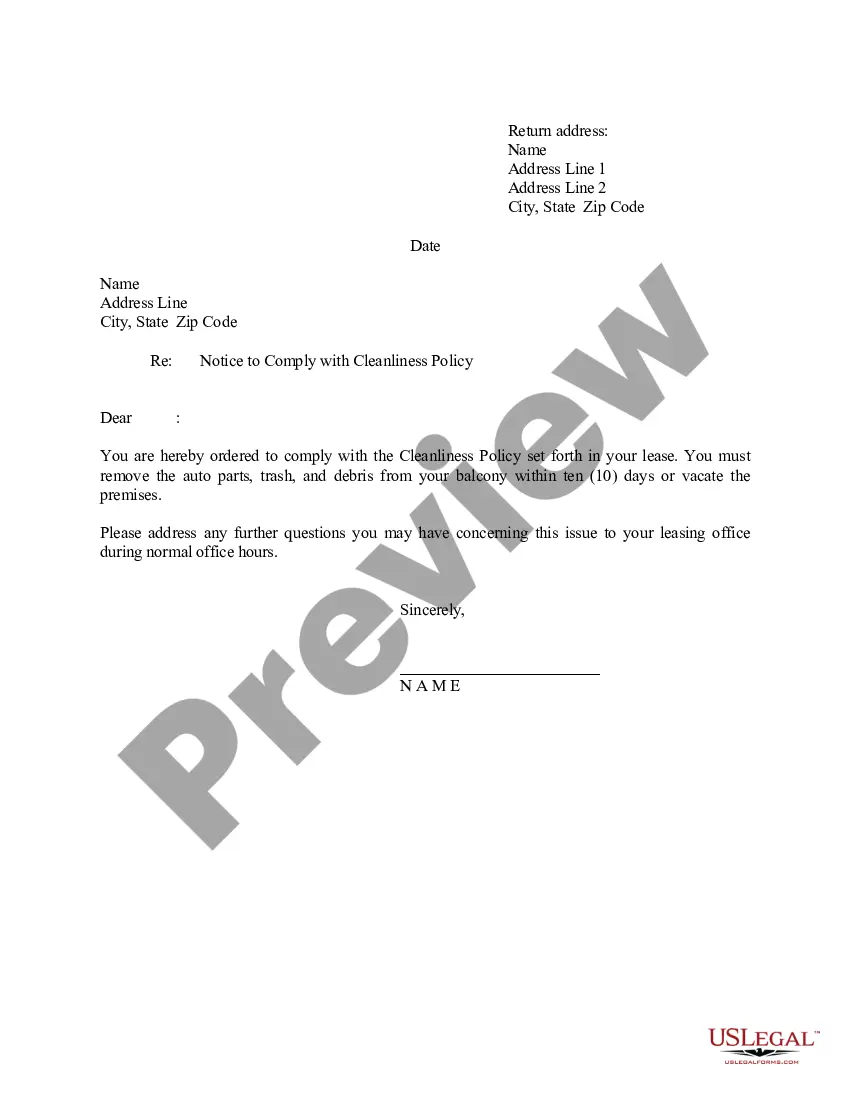
How to fill out Sample Letter Regarding Demand To Clean Up Property - First Notice From Landlord To Tenant?
The Clean Up Property Notice With React displayed on this page is a versatile legal template crafted by experienced attorneys following federal and local statutes.
For over 25 years, US Legal Forms has offered individuals, businesses, and legal experts over 85,000 verified, state-specific forms for any commercial and personal circumstances. It’s the fastest, simplest, and most reliable method to acquire the documentation you require, as the service ensures bank-level data protection and anti-malware safeguards.
Fill out and sign the form. Print the template to complete it manually. Alternatively, use an online multi-functional PDF editor to quickly and accurately fill out and sign your document electronically.
Retrieve your documents again.
You can use the same document whenever required. Access the My documents section in your profile to redownload any previously downloaded forms. Sign up for US Legal Forms to have verified legal templates for all of life’s scenarios at your fingertips.
- Search for the document you need and review it.
- Browse through the sample you sought and preview it or evaluate the form details to ensure it meets your needs. If it doesn’t, use the search feature to locate the correct one. Click Buy Now once you find the template you need.
- Register and Log In.
- Choose the subscription plan that suits you and create an account. Use PayPal or a credit card to make a swift payment. If you already have an account, Log In and verify your subscription to continue.
- Obtain the editable template.
- Select the format you prefer for your Clean Up Property Notice With React (PDF, Word, RTF) and save the document on your device.
Form popularity
FAQ
In this version of the UserProfile component, the useEffect cleanup function cancels the ongoing API request by calling the abort method on the AbortController instance. This ensures that the request is stopped when the component is unmounted, helping to prevent unnecessary network traffic and data inconsistencies.
The cleanup function can be used for a variety of purposes. One of the most common is to avoid race conditions in async requests. By using the cleanup function to cancel an active request, you can ensure that your application behaves correctly, even when requests return out of order.
To use the setTimeout function we use the useEffect hook in React to prevent the creation of multiple timeouts during re-renders. We use a cleanup function to clear the previously created timeout before running the side effects; to do so, we use the clearTimeout function.
How to write clean React code? Use meaningful component names. Give component names that reflect their functionality. ... Break down components. ... Use destructuring. ... Keep components small. ... Use prop-types. ... Use functional components. ... Avoid using inline styles. ... Use arrow functions.
To use the setTimeout function we use the useEffect hook in React to prevent the creation of multiple timeouts during re-renders. We use a cleanup function to clear the previously created timeout before running the side effects; to do so, we use the clearTimeout function.