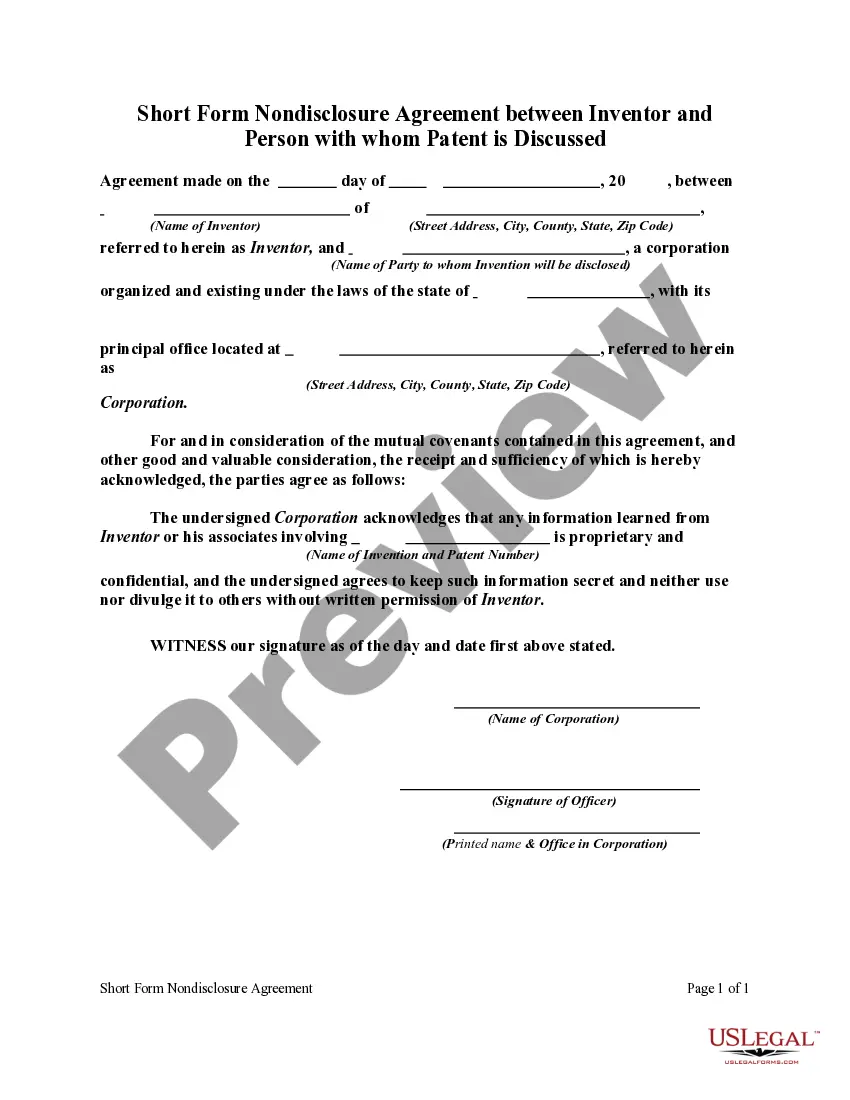
Alternatives To Patents
Description
Get your form ready online
Our built-in tools help you complete, sign, share, and store your documents in one place.
Make edits, fill in missing information, and update formatting in US Legal Forms—just like you would in MS Word.
Download a copy, print it, send it by email, or mail it via USPS—whatever works best for your next step.
Sign and collect signatures with our SignNow integration. Send to multiple recipients, set reminders, and more. Go Premium to unlock E-Sign.
If this form requires notarization, complete it online through a secure video call—no need to meet a notary in person or wait for an appointment.
We protect your documents and personal data by following strict security and privacy standards.

Make edits, fill in missing information, and update formatting in US Legal Forms—just like you would in MS Word.

Download a copy, print it, send it by email, or mail it via USPS—whatever works best for your next step.

Sign and collect signatures with our SignNow integration. Send to multiple recipients, set reminders, and more. Go Premium to unlock E-Sign.

If this form requires notarization, complete it online through a secure video call—no need to meet a notary in person or wait for an appointment.

We protect your documents and personal data by following strict security and privacy standards.
Looking for another form?







How to fill out Short Form Nondisclosure Agreement Between Inventor And Person With Whom Patent Is Discussed?
Whether for professional reasons or personal affairs, everyone must deal with legal issues at some point during their lives.
Filling out legal forms necessitates meticulous care, beginning with selecting the right form template.
With an extensive US Legal Forms catalog available, you need not waste time searching for the correct template online. Utilize the library's straightforward navigation to find the appropriate template for any circumstance.
- Locate the template you require by utilizing the search field or browsing the catalog.
- Examine the form's overview to verify it suits your circumstances, state, and locality.
- Click on the form's preview to inspect it.
- If it is the incorrect form, return to the search feature to find the Alternatives To Patents example you need.
- Obtain the template when it satisfies your criteria.
- If you have a US Legal Forms account, click Log in to access previously saved templates in My documents.
- If you do not have an account yet, you can acquire the form by clicking Buy now.
- Select the appropriate pricing option.
- Complete the account registration form.
- Choose your payment method: you can use a credit card or PayPal account.
- Select the file format you prefer and download the Alternatives To Patents.
- Once it is downloaded, you can fill out the form using editing software or print it and finish it by hand.
Form popularity
FAQ
A 'poor man's patent' is often achieved by mailing yourself a detailed description of your invention. This timestamp can serve as a record proving your idea's originality should a dispute arise. However, understand this approach has its limitations and does not offer the same legal protections as formal patents. Exploring alternatives to patents can be a more effective way to secure your intellectual property.
Protecting your idea from theft involves a combination of legal measures and careful sharing practices. Start by keeping details confidential, and only share them with trusted parties under non-disclosure agreements. Additionally, having a solid record of development can support your claim if disputes arise. Remember, using alternatives to patents can provide a robust shield for your innovative ideas.
To protect your invention without a patent, consider using legal agreements, such as non-compete and non-disclosure agreements, to safeguard your idea. You might also explore trademarks, which can protect the brand identity of your invention. By leveraging these alternatives to patents, you create barriers that limit others from copying your idea. Utilizing platforms like uslegalforms can help you find the right legal documents to secure your invention.
You can protect an invention without a patent by using several strategies, such as trade secrets, non-disclosure agreements, and copyrights. Trade secrets help keep your invention confidential while non-disclosure agreements ensure that anyone you share your idea with also keeps it a secret. Additionally, you can document your invention's development, which can help establish your ownership. Remember, alternatives to patents exist and can be very effective.
To pitch your idea without it being stolen, start by using non-disclosure agreements to safeguard your information front and center. Clearly define the aspects of your idea that you're sharing and ensure that everyone involved is aware of their confidentiality obligations. Building relationships with trustworthy partners or investors can also help secure your idea's safety during discussions. Ultimately, knowing your alternatives to patents will empower you to confidently share your vision.
A poor man's patent involves mailing yourself a detailed description of your invention, including sketches or drawings, and keeping the sealed envelope as proof of your concept's development timeline. While this method does not offer legal protection, it can serve as a record of your idea's originality. However, relying solely on this method may not be sufficient; consider exploring legal alternatives to patents for more robust protection.
The four main types of intellectual property include copyrights, trademarks, patents, and trade secrets. Each serves a unique purpose in protecting different forms of creative work and innovation. Copyrights protect original works like books and art, trademarks safeguard brand names and logos, patents cover inventions, and trade secrets keep confidential business information safe. Understanding these alternatives to patents allows you to choose the right strategy for your needs.
Yes, you can sell your invention idea without a patent, but doing so requires careful preparation. Creating a strong business plan and identifying potential buyers are crucial steps in this process. It's also wise to use confidentiality agreements to ensure that your idea remains protected during discussions. Considering alternatives to patents can help you navigate this journey with greater confidence.
To legally protect your idea, you should consider various strategies such as copyrighting written materials or registering trademarks for brand names and logos. These methods provide legal backing for your creative work while allowing you flexibility without relying on patents. Moreover, keeping thorough records of your idea's evolution can further solidify your claim. It's essential to explore alternatives to patents to create a comprehensive protection plan.
You can protect your idea without a patent by using legal agreements like non-disclosure agreements (NDAs) to prevent others from sharing your idea. Additionally, you can rely on trade secrets to keep your concept confidential. By documenting your idea and its development, you establish a foundation to assert your rights when discussing it with potential partners or investors. Exploring alternatives to patents is vital for safeguarding your innovation.