Service Rate Formula In Queuing Theory
Description
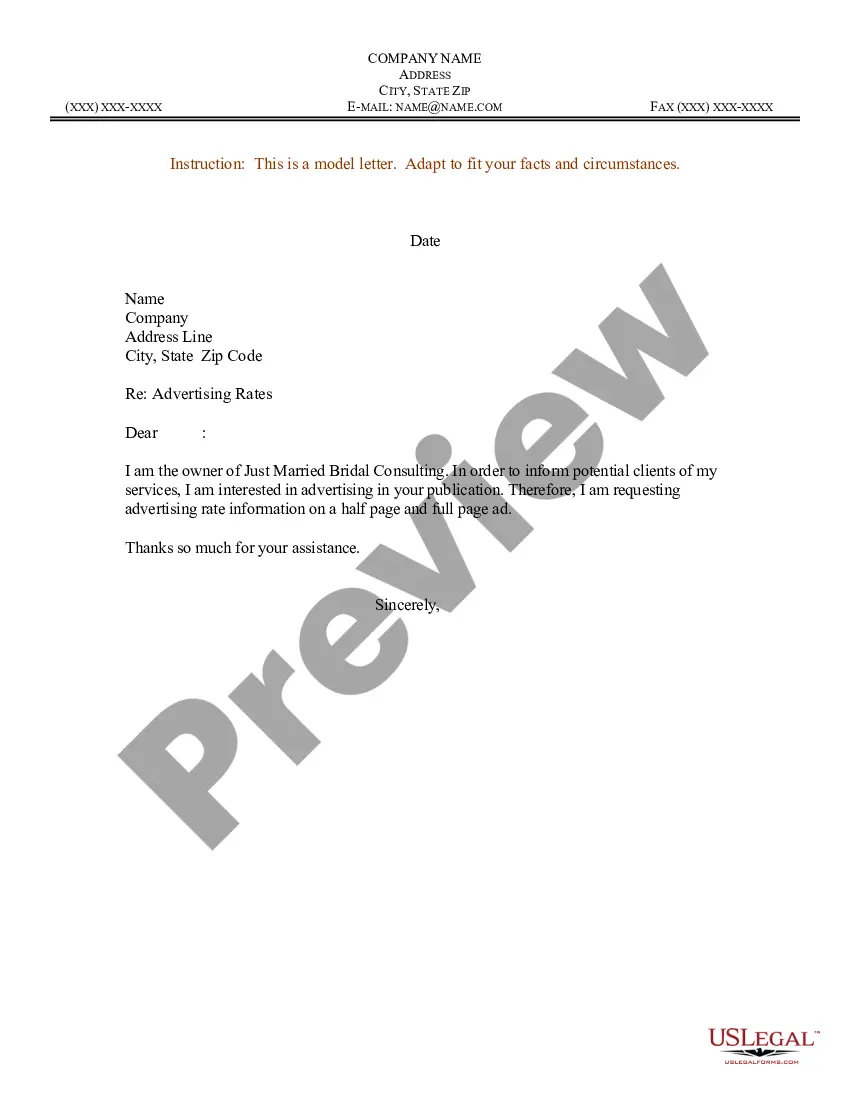

How to fill out Sample Letter For Service Rate Increase?
It’s well-known that you cannot instantly become a legal authority, nor can you quickly understand how to prepare the Service Rate Formula In Queuing Theory without possessing a specialized skill set.
Drafting legal documents is a lengthy process that demands specific education and expertise. So why not entrust the creation of the Service Rate Formula In Queuing Theory to the experts.
With US Legal Forms, one of the most extensive legal document repositories, you can locate anything from court filings to templates for office communication.
If you need a different template, start your search again.
Create a free account and select a subscription plan to purchase the template. Click Buy now. Once the payment is completed, you can access the Service Rate Formula In Queuing Theory, fill it out, print it, and send or mail it to the relevant parties. You can revisit your documents from the My documents tab anytime. If you’re an existing client, simply Log In, and find and download the template from the same tab. Regardless of the intent behind your forms—whether financial, legal, or personal—our website has everything you need. Experience US Legal Forms today!
- We recognize the importance of compliance with federal and state laws and regulations.
- All forms on our website are tailored to your location and are current.
- To get started with our site and obtain the form you need within minutes.
- Utilize the search bar located at the top of the page to find the document you require.
- If available, preview it and read the accompanying description to determine if Service Rate Formula In Queuing Theory is what you seek.
Form popularity
FAQ
Hear this out loud PauseOne way to estimate mean service rate would be to count the number of customers exiting (after service) per unit time while there is a continuous line (always someone waiting). Another way would be to record when each customer starts and ends service, take the difference to get their time in service, and average that.
The following formulas are used in queuing theory for the case of random arrival, deterministic service, and only one service channel. A Q L = ( 2 p ? p 2 ) / 2 ? ( 1 ? p ) AQL = (2p-p^2)/2 * (1-p) AQL=(2p?p2)/2?(1?p) A T T = 2 ? p / 2 ? u ? ( 1 ? p ) ATT = 2-p/2*u*(1-p) ATT=2?p/2?u?(1?p)
Hear this out loud PauseHence, Wq can be obtained as follows: Wq = Lq/?. denotes the waiting time in the queue for the A/B/c queue. The above works well for M/G/c queues, but does not always work well when the inter-arrival time is not exponentially distributed.
Hear this out loud PauseAverage queue length is given by E(m) = ?2/(1-?). m= n-1, being the number of customers in the queue excluding the customer in service.
Hear this out loud PauseThe service rate is the number of customers per hour that the server can process, assuming there are always more customers waiting. It doesn't depend on the arrival rate.