Compensation Meaning For Nepali
Description
Get your form ready online
Our built-in tools help you complete, sign, share, and store your documents in one place.
Make edits, fill in missing information, and update formatting in US Legal Forms—just like you would in MS Word.
Download a copy, print it, send it by email, or mail it via USPS—whatever works best for your next step.
Sign and collect signatures with our SignNow integration. Send to multiple recipients, set reminders, and more. Go Premium to unlock E-Sign.
If this form requires notarization, complete it online through a secure video call—no need to meet a notary in person or wait for an appointment.
We protect your documents and personal data by following strict security and privacy standards.

Make edits, fill in missing information, and update formatting in US Legal Forms—just like you would in MS Word.

Download a copy, print it, send it by email, or mail it via USPS—whatever works best for your next step.

Sign and collect signatures with our SignNow integration. Send to multiple recipients, set reminders, and more. Go Premium to unlock E-Sign.

If this form requires notarization, complete it online through a secure video call—no need to meet a notary in person or wait for an appointment.

We protect your documents and personal data by following strict security and privacy standards.
Looking for another form?








How to fill out General Form Of An Indemnity Agreement?
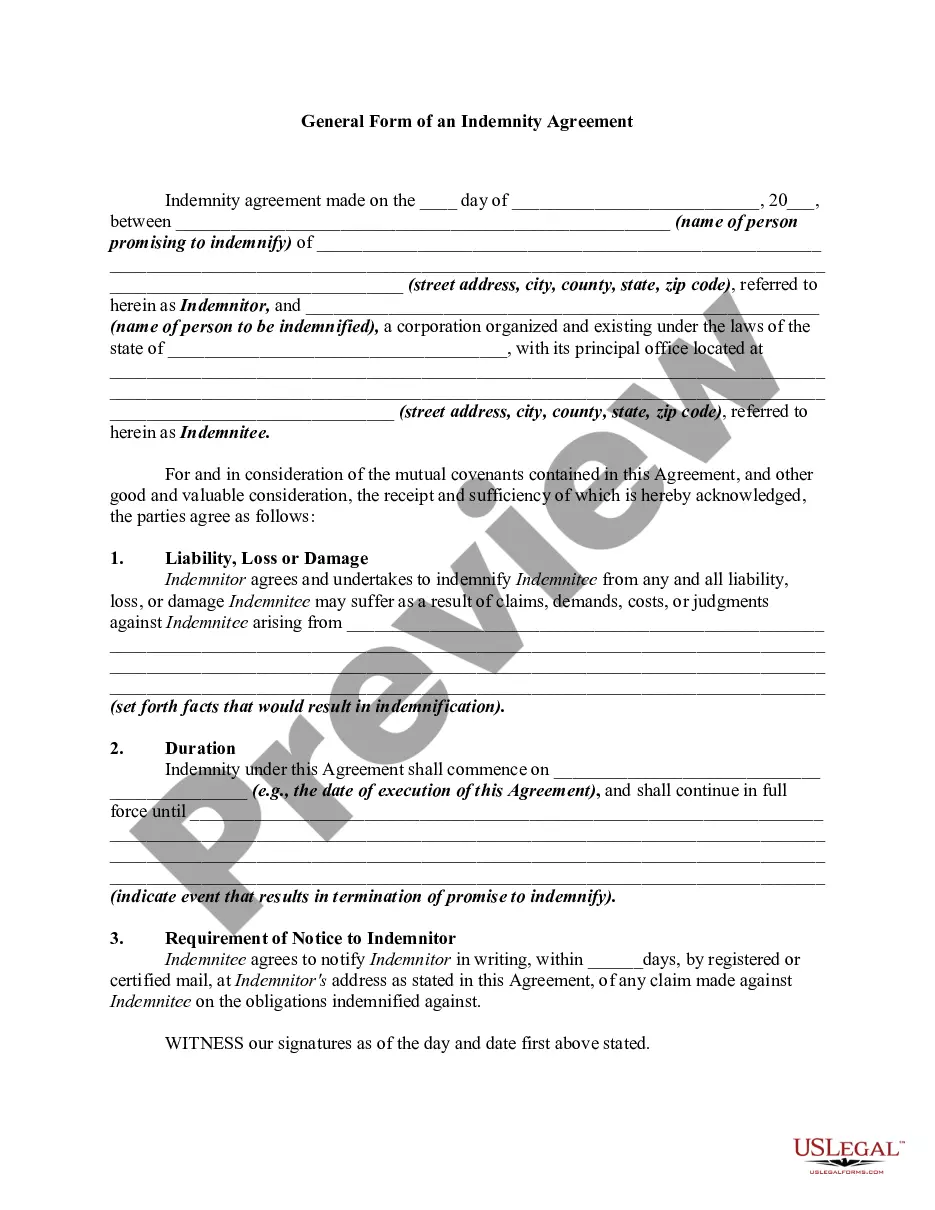
The Compensation Definition For Nepali you see on this site is a versatile official template crafted by expert attorneys in line with federal and state regulations.
For over 25 years, US Legal Forms has supplied individuals, companies, and legal professionals with more than 85,000 confirmed, state-specific documents for any business and personal situation. It’s the fastest, easiest, and most reliable method to obtain the necessary paperwork, as the service ensures bank-level data security and anti-malware safeguards.
Pick the format you prefer for your Compensation Definition For Nepali (PDF, DOCX, RTF) and store the sample on your device. Complete and sign the document. Print the template to fill it out manually. Alternatively, utilize an online multi-functional PDF editor to swiftly and accurately complete and sign your form with an electronic signature. Download your paperwork again when necessary. Use the same document again whenever required. Access the My documents tab in your profile to redownload any previously acquired documents.
- Search for the document you require and review it.
- Examine the file you looked for and preview it or assess the document description to confirm it meets your requirements. If it does not, utilize the search bar to find the appropriate one. Click Buy Now when you have found the template you require.
- Enroll and Log In.
- Select the pricing option that best fits your needs and create an account. Use PayPal or a credit card to process a quick payment. If you already possess an account, Log In and review your subscription to continue.
- Access the editable template.
Form popularity
FAQ
Muji in Nepali slang is often used to refer to someone in a derogatory way, similar to calling someone a jerk. While slang enriches communication, it's important to be mindful of its impact. Understanding terms like muji can help you navigate social landscapes more effectively. If you are looking for more detailed explanations or translations, consider referencing legal and language guides.
To define the meaning of a Nepali word, one must consider the context in which it is used. Words can carry multiple meanings based on cultural nuances, and exploring these can deepen your understanding of the language. For those navigating legal matters, knowing precise meanings is crucial, making resources like US Legal invaluable.
Jatha in Nepali slang generally refers to a group or a gang, often associated with close friends or compatriots. The term carries an informal tone and is widely used in casual conversations. If you are interested in colorful local vernacular, understanding jatha can be an engaging way to connect. Look into comprehensive language resources for more details.
In Nepali, you say 'Ma timīlā'ī māyā garchu' to express 'I love you.' Building connections through language often requires understanding these phrases, which resonate emotionally. Knowing such expressions can be beneficial in personal relationships. US Legal’s resources may guide you to further explore language tools.
Nepali slang varies widely, enriching the language with playful expressions. Some common examples include 'pasi', which refers to a fool, and 'chillax', a mix of chill and relax. Familiarizing yourself with these terms can provide insight into day-to-day interactions. If you seek a deeper understanding of Nepali language, consider using platforms that enhance your learning experience.
Boka in Nepali slang refers to a foolish person. This term is often used in a light-hearted manner among friends, but context matters. Understanding local slang like this can enhance your experience if you are learning about language and culture. For those looking to grasp the broader nuances, exploring resources like US Legal can be helpful.
In English, 'compensation' translates to payment or reward given in exchange for loss, injury, or service. When discussing Compensation meaning for Nepali, grasping this concept is crucial for fair negotiations and agreements. Understanding the translation helps in navigating various legal and professional contexts effectively.
The translation of 'compensation' refers to the payment or reward given to someone to make up for a loss, injury, or service. In the context of Compensation meaning for Nepali, it conveys the importance of recognizing and addressing an individual's needs. This understanding can help in various fields, including legal and financial discussions.
The Latin word 'compensatio' is the root of 'compensation.' It refers to the act of repaying or balancing something. In the context of Compensation meaning for Nepali, it emphasizes the idea of making up for losses or damages. Understanding this origin can deepen your insights into its usage today.