What Is A Contractors Lien
Description
Get your form ready online
Our built-in tools help you complete, sign, share, and store your documents in one place.
Make edits, fill in missing information, and update formatting in US Legal Forms—just like you would in MS Word.
Download a copy, print it, send it by email, or mail it via USPS—whatever works best for your next step.
Sign and collect signatures with our SignNow integration. Send to multiple recipients, set reminders, and more. Go Premium to unlock E-Sign.
If this form requires notarization, complete it online through a secure video call—no need to meet a notary in person or wait for an appointment.
We protect your documents and personal data by following strict security and privacy standards.

Make edits, fill in missing information, and update formatting in US Legal Forms—just like you would in MS Word.

Download a copy, print it, send it by email, or mail it via USPS—whatever works best for your next step.

Sign and collect signatures with our SignNow integration. Send to multiple recipients, set reminders, and more. Go Premium to unlock E-Sign.

If this form requires notarization, complete it online through a secure video call—no need to meet a notary in person or wait for an appointment.

We protect your documents and personal data by following strict security and privacy standards.
Looking for another form?







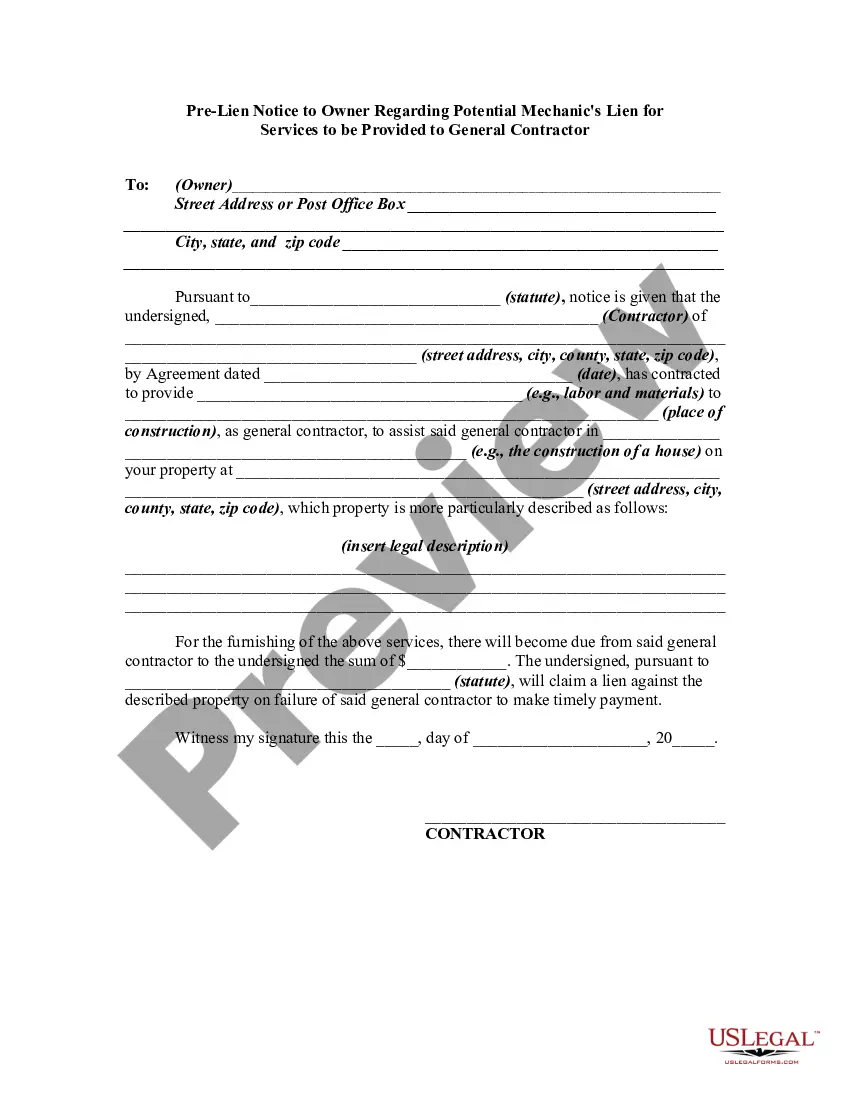
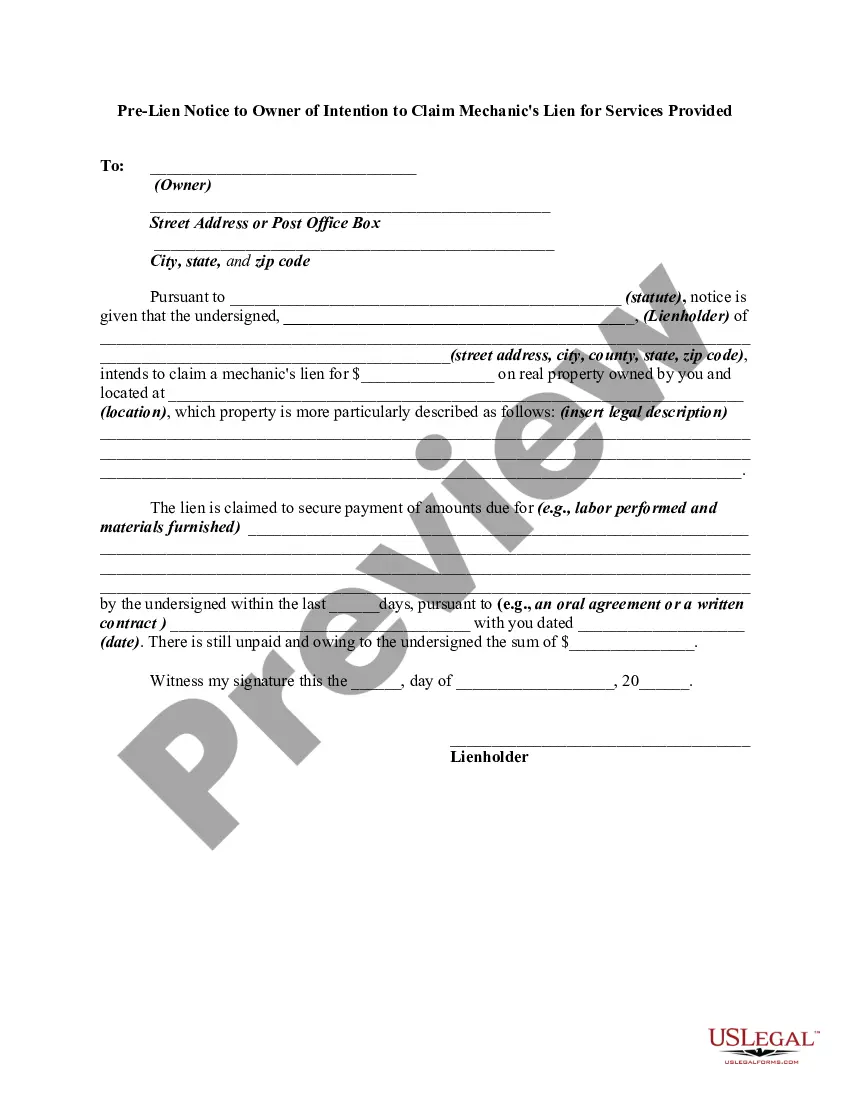
How to fill out Pre-Lien Notice To Owner Regarding Potential Mechanic's Lien For Services To Be Provided To General Contractor?
- Visit the US Legal Forms website and log in to your account if you are a returning user. Make sure your subscription is current to access all resources.
- For first-time users, start by checking the Preview mode and form descriptions to find the contractor's lien template suitable for your state.
- If you need another template, utilize the Search feature to find the specific legal form matching your requirements.
- Once you've identified the appropriate document, click on the Buy Now button to choose your subscription plan and register for an account.
- Complete your purchase by entering your payment information, either through credit card details or PayPal.
- Finally, download the form to your device. You can access it anytime from the My Forms section in your account.
By utilizing US Legal Forms, individuals and attorneys can swiftly create and manage legal documents. Our extensive library of over 85,000 fillable forms ensures you have the necessary resources at your fingertips, making the process efficient and effective.
Start protecting your legal rights by leveraging our reliable service today. Visit US Legal Forms to explore our vast collection and support your legal documentation needs.
Form popularity
FAQ
In Minnesota, specific rules govern how contractor liens are filed and enforced. Contractors must file a lien within 120 days of the last service provided to claim their rights. Proper notices must also be provided to the property owner. Knowing these rules can help both parties manage liens effectively, and using resources like USLegalForms ensures compliance with Minnesota’s requirements.
For a lien to be valid, certain conditions must typically be met. The contractor must have provided valuable services or materials and should have a written contract or agreement. Additionally, the contractor must file the lien within the specified timeframe, which varies by state. Developing a clear understanding of these conditions can help avoid future issues with contractor liens.
Yes, a lien can sometimes be placed on property without the owner's notification. However, laws regarding notification can vary by state. Once a contractor files a lien, the property owner may be formally notified through public records, but initial filing might happen without direct communication. Awareness of how contractor liens operate is essential for property owners.
To place a contractor lien on your business, follow legal requirements relevant to your state. Typically, you must file a claim that details the unpaid amount and the services rendered. Your documentation should include contracts and invoices as evidence. Utilizing platforms like USLegalForms can streamline this process and ensure compliance with the law.
Filling out a construction lien waiver is a straightforward process. Start by specifying the project details, including the names of parties involved and the property address. Clearly state the amount waived and ensure that both the contractor and property owner sign the document. This helps prevent disputes and clarifies that a contractor's lien will not be placed on your property.
In Georgia, a contractor's lien generally lasts for one year from the date of filing. However, it can be renewed if the lienholder takes specific action before it expires. This time frame is critical for both homeowners and contractors, as it informs decisions related to payment and property transactions. If you need help managing or understanding liens, US Legal Forms offers resources to clarify your rights and responsibilities.
Yes, it is possible for someone to place a lien on your property without your immediate knowledge. A contractor or creditor can file a lien if you have unpaid debts for services or materials provided. They typically do this through the local court or county office, which may not notify you right away. To protect yourself, it's wise to regularly check property records, especially if you believe a lien may be forthcoming.
To file a lien in Georgia, you need to prepare a written document that includes specific details about the debt. This document should have information such as the property description, the amount owed, and the names of the involved parties. It's essential to file the lien in the county where the property is located. You can use US Legal Forms to access templates and guidance, making this process smoother and ensuring compliance with local laws.
Yes, a property lien can affect your credit score negatively. When a lien is filed and you fail to settle the associated debts, it can be reported to credit agencies. Understanding what a contractors lien represents can help you manage your financial obligations and avoid lasting impacts on your credit. Keeping up with your payments is essential to maintain a strong credit profile.
In Nebraska, a construction lien is generally valid for four months after it is filed. This timeframe is crucial for contractors wishing to secure their payments. It emphasizes the importance of understanding what a contractors lien is to avoid missing deadlines for enforcement. If a lien is not enforced within this period, it could be automatically released.