Identity Law In Logic
Description
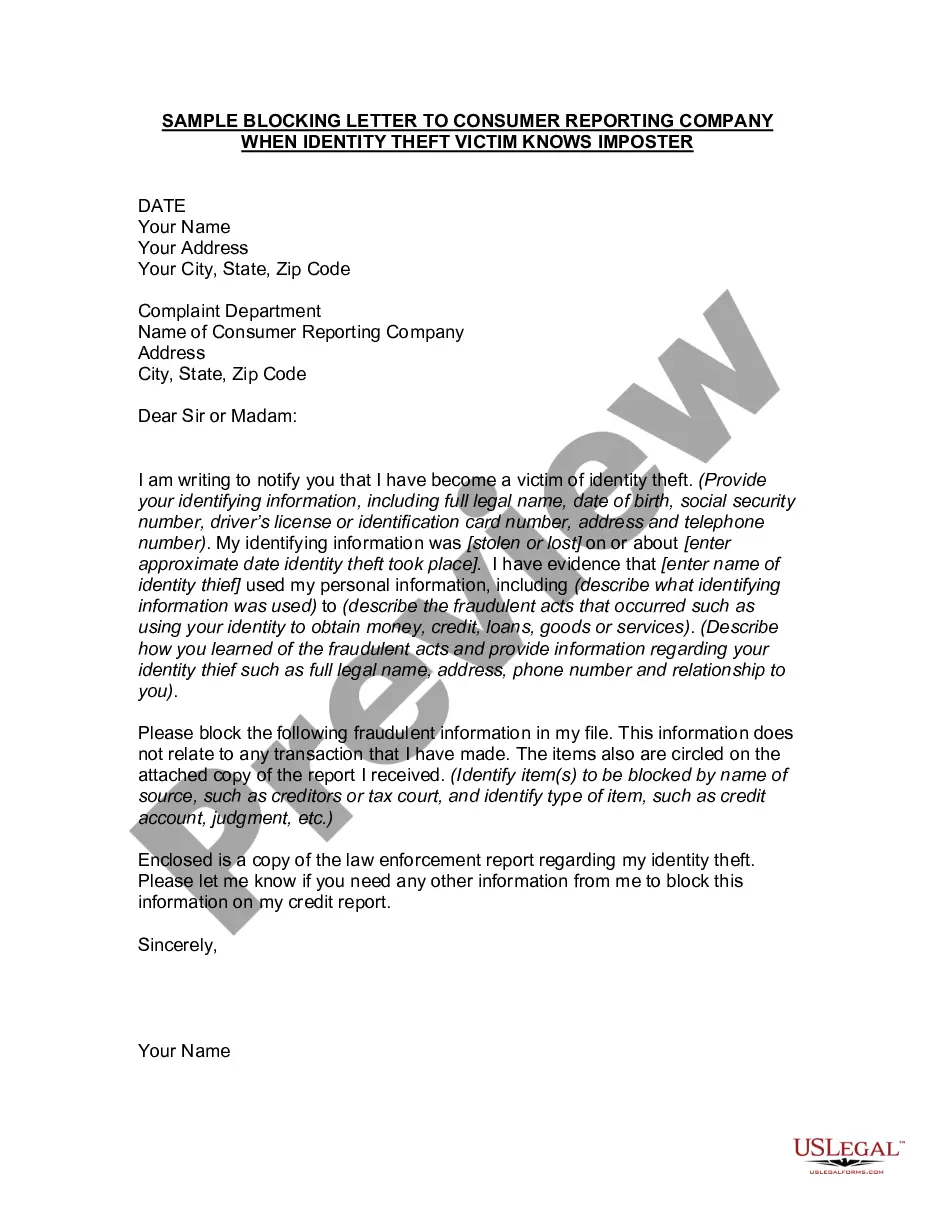




How to fill out Letter To Law Enforcement To Report Identity Theft By Known Imposter?
Legal administration can be perplexing, even for the most seasoned professionals.
When you are looking for an Identity Law In Logic and lack the time to spend searching for the suitable and current version, the processes can be anxiety-inducing.
US Legal Forms caters to any needs you may have, from personal to corporate paperwork, all in one location.
Utilize sophisticated resources to complete and oversee your Identity Law In Logic.
Here are the steps to follow after downloading the form you want: Verify it is the correct form by previewing it and reviewing its description. Ensure that the template is accepted in your state or county. Click Buy Now when you are ready. Choose a monthly subscription plan. Select the file format you desire, and Download, complete, eSign, print, and send your document. Enjoy the US Legal Forms online library, backed by 25 years of experience and reliability. Transform your daily document management into a simple and user-friendly process today.
- Access a pool of articles, tutorials, and guides relevant to your situation and requirements.
- Conserve time and effort searching for the documents you need, and use US Legal Forms’ advanced search and Preview feature to locate Identity Law In Logic and download it.
- If you possess a subscription, Log In to your US Legal Forms account, search for the form, and download it.
- Check the My documents tab to view the documents you have previously downloaded and manage your folders as you see fit.
- If this is your first time with US Legal Forms, create an account and gain unrestricted access to all the benefits of the library.
- A robust online form repository can be a game-changer for those who wish to navigate these circumstances effectively.
- US Legal Forms is an industry leader in online legal documentation, with over 85,000 state-specific legal forms accessible at any moment.
- With US Legal Forms, you can gain entry to state- or county-specific legal and business documents.
Form popularity
FAQ
So the identity law, p?T?p, means that the conjunction of any sentence p with an arbitrary tautology T will always have the same truth value as p (i.e., will be logically equivalent with p).
In logic, the law of identity states that each thing is identical with itself. It is the first of the historical three laws of thought, along with the law of noncontradiction, and the law of excluded middle.
Legal identity is defined as the basic characteristics of an individual's identity. e.g. name, sex, place and date of birth conferred through registration and the issuance of a certificate by an authorized civil registration authority following the occurrence of birth.
Discrete Math - 2.2.3 Proving Set Identities - YouTube YouTube Start of suggested clip End of suggested clip Ways. So as I said there are essentially three ways to prove. Set identities one is to prove eachMoreWays. So as I said there are essentially three ways to prove. Set identities one is to prove each set in the identity is a subset of the other. So again we had said if a is equal to B.
Note: The Law of Identity is one of the Boolean Laws; it includes two terms: 1 AND A = A means a product of 1 and any number or variable is the same number and variable and 0 OR A = A means a sum of 0 and any number or variable is the same number or variable.