Identity Law In Boolean Algebra
Description


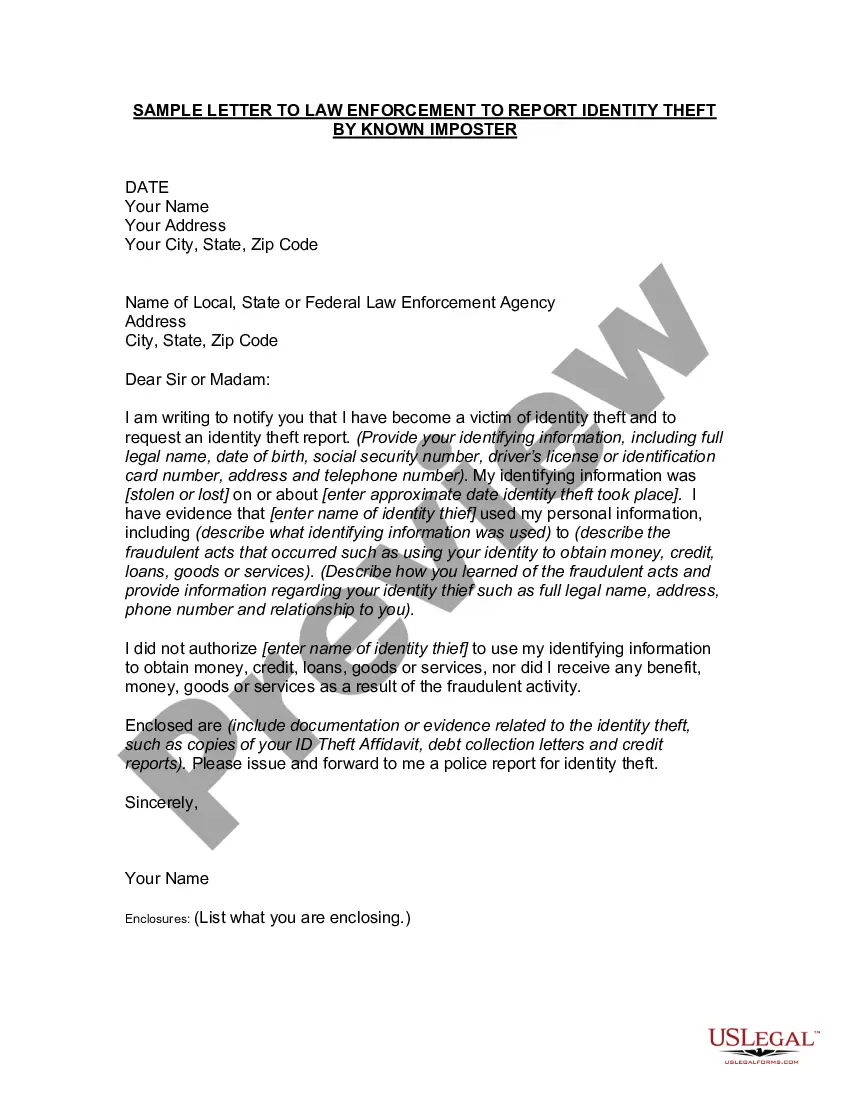
How to fill out Letter To Law Enforcement To Report Identity Theft By Known Imposter?
Creating legal documents from the ground up can frequently be somewhat daunting.
Certain situations may require extensive research and significant financial investment.
If you’re seeking a simpler and more economical method of drafting Identity Law In Boolean Algebra or any additional documents without unnecessary hurdles, US Legal Forms is readily available.
Our online collection of over 85,000 current legal documents covers nearly every facet of your financial, legal, and personal affairs.
Examine the document preview and descriptions to ensure you are selecting the correct form. Verify that the form you choose adheres to the laws and regulations of your state and county. Select the most suitable subscription plan to purchase the Identity Law In Boolean Algebra. Download the document, then complete, sign, and print it. US Legal Forms has a flawless reputation and over 25 years of experience. Join us today and make document completion an effortless and efficient process!
- With just a few clicks, you can promptly access state- and county-specific forms meticulously prepared by our legal professionals.
- Utilize our platform whenever you need dependable and trustworthy services through which you can swiftly locate and download the Identity Law In Boolean Algebra.
- If you’re familiar with our website and have set up an account previously, simply Log In to your account, find the template, and download it or re-download it later in the My documents section.
- Not registered yet? No worries. Setting up an account and browsing the catalog only takes a few minutes.
- However, before proceeding directly to download Identity Law In Boolean Algebra, consider these suggestions.
Form popularity
FAQ
So the identity law, p?T?p, means that the conjunction of any sentence p with an arbitrary tautology T will always have the same truth value as p (i.e., will be logically equivalent with p).
An "identity" is merely a relationship that is always true, regardless of the values that any variables involved might take on; similar to laws or properties. Many of these can be analogous to normal multiplication and addition, particularly when the symbols {0,1} are used for {FALSE, TRUE}.
Laws and Theorems of Boolean Algebra 4a.X ? X = 0Complement Law5.X = XDouble Negation Law6a.X ? Y = Y ? XCommutative Law7a.X (Y Z) = (X Y) Z = (X Z) Y = X Y ZAssociative Law7b.X + (Y + Z) = (X + Y) + Z = (X + Z) + Y = X + Y + ZAssociative Law14 more rows
Note: The Law of Identity is one of the Boolean Laws; it includes two terms: 1 AND A = A means a product of 1 and any number or variable is the same number and variable and 0 OR A = A means a sum of 0 and any number or variable is the same number or variable.
In logic, the law of identity states that each thing is identical with itself. It is the first of the historical three laws of thought, along with the law of noncontradiction, and the law of excluded middle.