Sole Proprietorship For Dummies
Description
Get your form ready online
Our built-in tools help you complete, sign, share, and store your documents in one place.
Make edits, fill in missing information, and update formatting in US Legal Forms—just like you would in MS Word.
Download a copy, print it, send it by email, or mail it via USPS—whatever works best for your next step.
Sign and collect signatures with our SignNow integration. Send to multiple recipients, set reminders, and more. Go Premium to unlock E-Sign.
If this form requires notarization, complete it online through a secure video call—no need to meet a notary in person or wait for an appointment.
We protect your documents and personal data by following strict security and privacy standards.

Make edits, fill in missing information, and update formatting in US Legal Forms—just like you would in MS Word.

Download a copy, print it, send it by email, or mail it via USPS—whatever works best for your next step.

Sign and collect signatures with our SignNow integration. Send to multiple recipients, set reminders, and more. Go Premium to unlock E-Sign.

If this form requires notarization, complete it online through a secure video call—no need to meet a notary in person or wait for an appointment.

We protect your documents and personal data by following strict security and privacy standards.
Looking for another form?



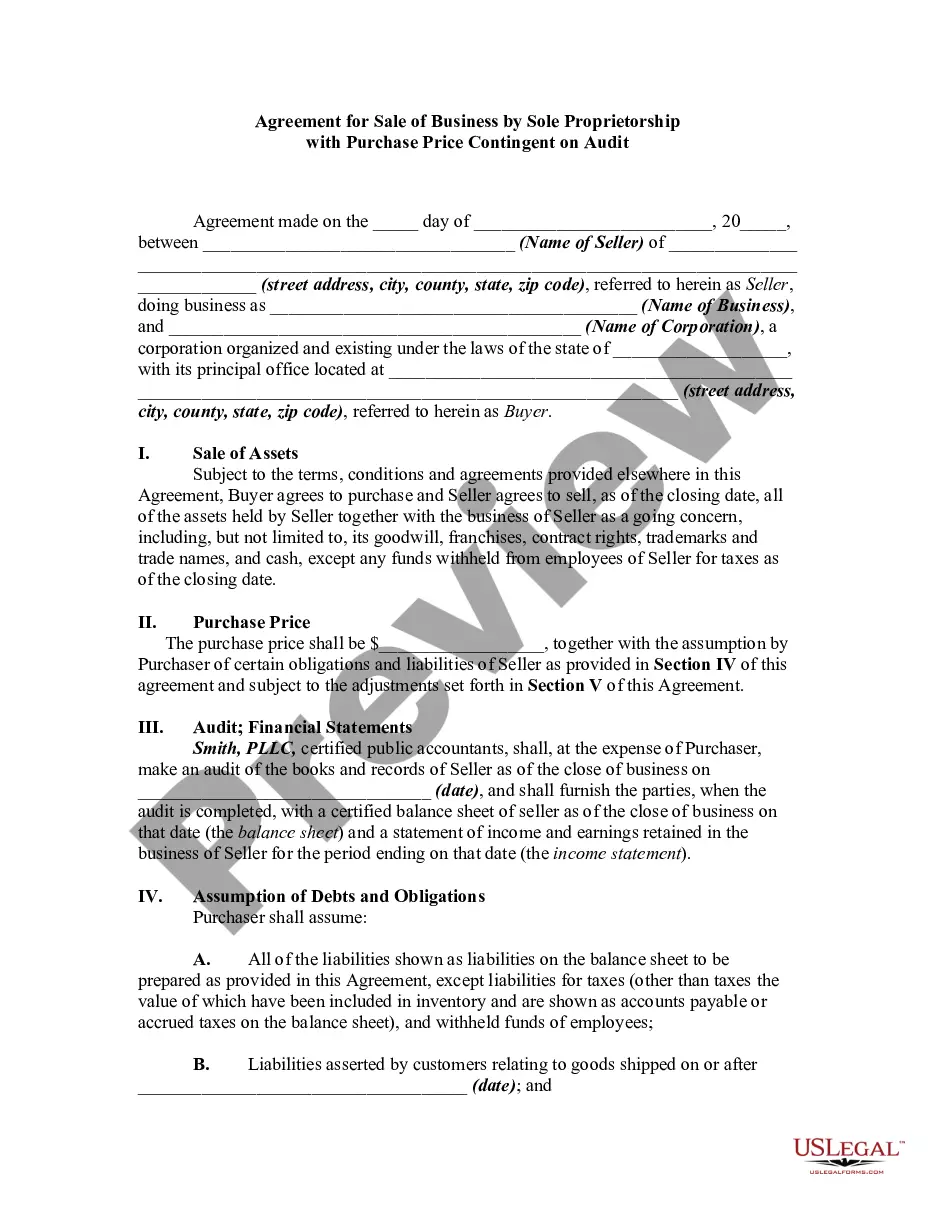
How to fill out Agreement For Sale Of Business By Sole Proprietorship With Purchase Price Contingent On Audit?
- If you're returning, log in to your account to access your previously obtained templates.
- Verify your subscription status to ensure access to needed documents. If expired, renew according to your plan.
- Browse the library to find the form suited to your needs. Use the Preview mode to confirm it meets local jurisdiction requirements.
- If the form doesn't meet your needs, utilize the Search tab to find more templates that may fit better.
- Select the desired document and click 'Buy Now' to choose your subscription plan and create an account if you haven't already.
- Enter your payment details, either via credit card or PayPal, to complete your purchase.
- Download the obtained form and save it to your device for later use. You can find it anytime in the My Forms section of your account.
Following these steps ensures you have the right legal documents at your fingertips. US Legal Forms stands out with its collection of over 85,000 fillable templates, ensuring you access more forms for less.
Ready to create your sole proprietorship? Start with US Legal Forms today for easy access to essential legal documents!
Form popularity
FAQ
Choosing between LLC and sole proprietorship depends on your business needs. A sole proprietorship is simpler and involves less paperwork, which suits many single-owner businesses. However, an LLC offers legal protection for your personal assets, shielding you from business liabilities. If you want to start off easily, explore the sole proprietorship for dummies concept, and then consider transitioning to an LLC later, potentially utilizing resources from UsLegalForms to make the switch smoother.
To set yourself up as a sole proprietor, choose a business name and check for its availability. Next, apply for any necessary licenses or permits in your area, depending on your business type. You should also maintain separate financial accounts to keep personal and business expenses distinct. Using UsLegalForms can help streamline this setup, making it easier for anyone, including those looking for sole proprietorship for dummies guidance.
The easiest sole proprietorship to set up typically involves starting a service-based business, such as freelancing or consulting. These types of businesses require minimal startup costs and no formal registration, making them ideal for new entrepreneurs. Furthermore, using platforms like UsLegalForms can provide you with easy templates and forms to help you get started on your journey, simplifying the sole proprietorship for dummies process.
To establish yourself as a sole proprietorship, start by deciding on your business name and checking its availability. Next, obtain any necessary licenses and permits based on your local regulations. You should also open a separate business bank account to keep your finances organized. Simplifying this process is easy, especially with resources like UsLegalForms, which guide you through each step, making sole proprietorship for dummies much clearer.
As a sole proprietor, you can write off various business expenses to reduce your taxable income. This includes costs such as supplies, business travel, and a portion of your home if you work from there. Keeping detailed records will help you maximize your deductions and understand the financial benefits of your sole proprietorship.
Sole proprietors can indeed receive tax refunds depending on their tax situation. If your business deductions exceed your income, you may end up with a refund from overpaid taxes. Staying organized with your income and expenses can help clarify potential returns during tax season.
A sole proprietorship for dummies refers to a simple business structure ideal for individuals starting out. It allows you to run a business without forming a separate legal entity, keeping things uncomplicated. This means you have the freedom to manage your business while benefiting from easy tax filing options.
The main disadvantage of being a sole proprietor is the personal liability it carries. This means any debts or legal actions against your business affect your personal assets. Understanding this risk is crucial, as it distinguishes a sole proprietorship from more complex business structures.
To file your taxes as a sole proprietor, you'll need to complete IRS Form 1040 along with Schedule C. This includes detailing your business income and expenses. Once compiled, you submit these forms to the IRS, allowing you to report your business activity alongside your personal income.
In simple words, a sole proprietorship is a business owned and operated by one person. This individual is responsible for all business activities, including profits and debts. It's a straightforward way to start a business, making it accessible for many entrepreneurs who want to go solo.