Well Agreements For The World
Description
Get your form ready online
Our built-in tools help you complete, sign, share, and store your documents in one place.
Make edits, fill in missing information, and update formatting in US Legal Forms—just like you would in MS Word.
Download a copy, print it, send it by email, or mail it via USPS—whatever works best for your next step.
Sign and collect signatures with our SignNow integration. Send to multiple recipients, set reminders, and more. Go Premium to unlock E-Sign.
If this form requires notarization, complete it online through a secure video call—no need to meet a notary in person or wait for an appointment.
We protect your documents and personal data by following strict security and privacy standards.

Make edits, fill in missing information, and update formatting in US Legal Forms—just like you would in MS Word.

Download a copy, print it, send it by email, or mail it via USPS—whatever works best for your next step.

Sign and collect signatures with our SignNow integration. Send to multiple recipients, set reminders, and more. Go Premium to unlock E-Sign.

If this form requires notarization, complete it online through a secure video call—no need to meet a notary in person or wait for an appointment.

We protect your documents and personal data by following strict security and privacy standards.
Looking for another form?




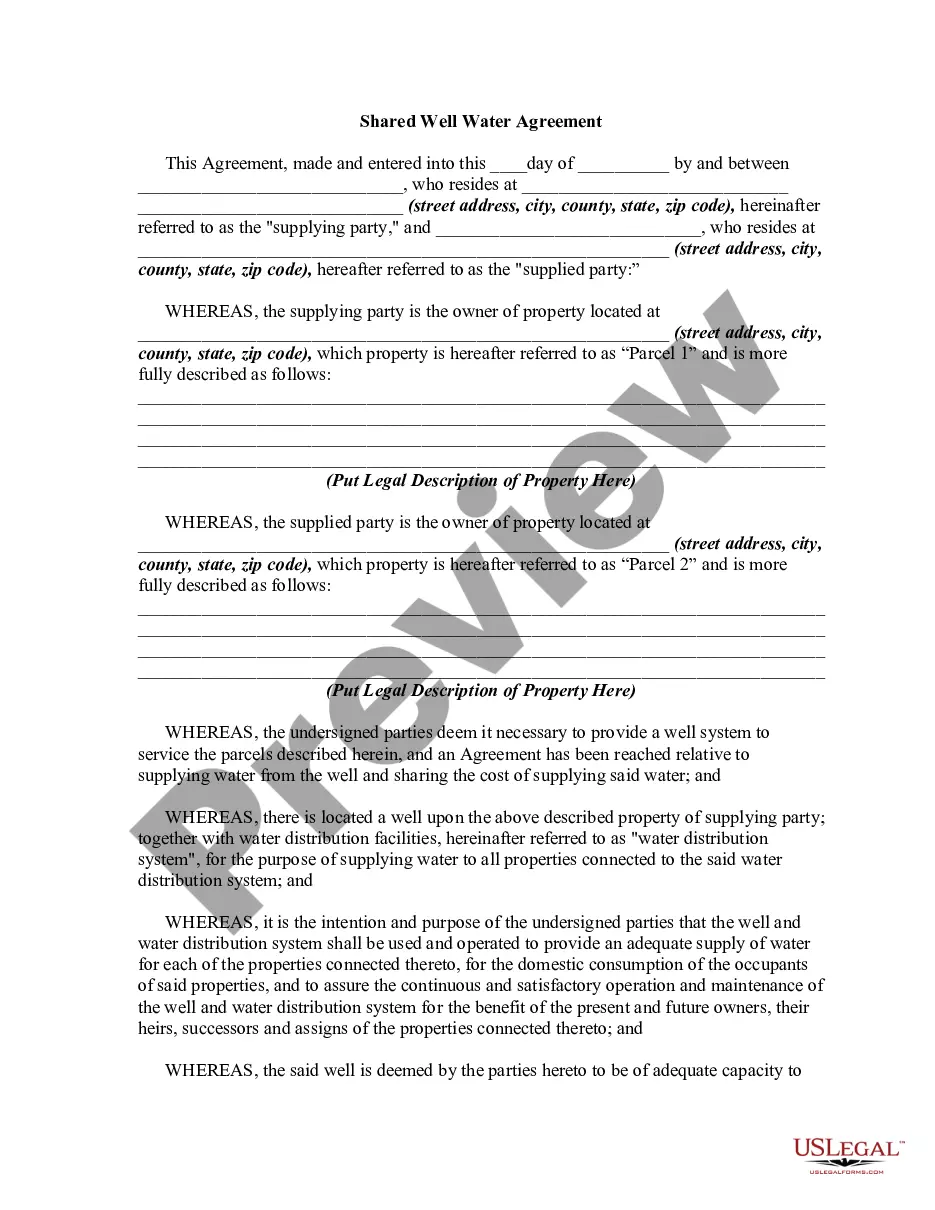
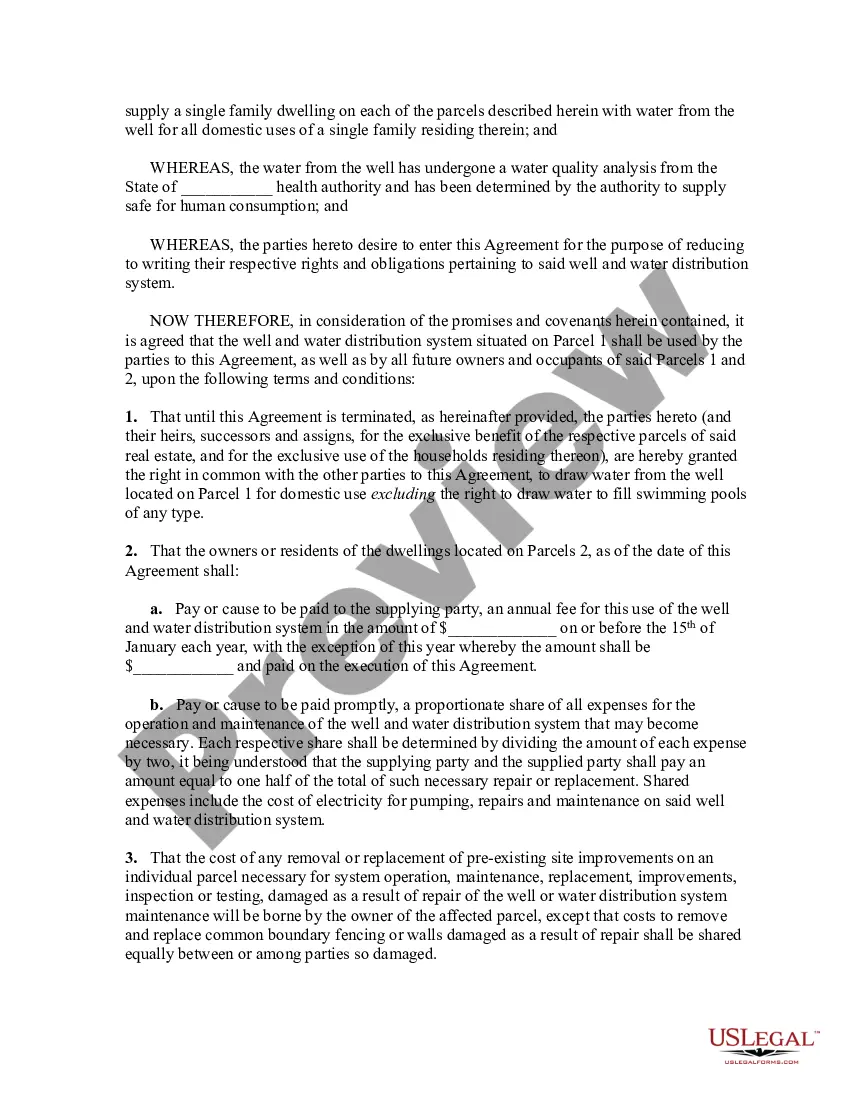
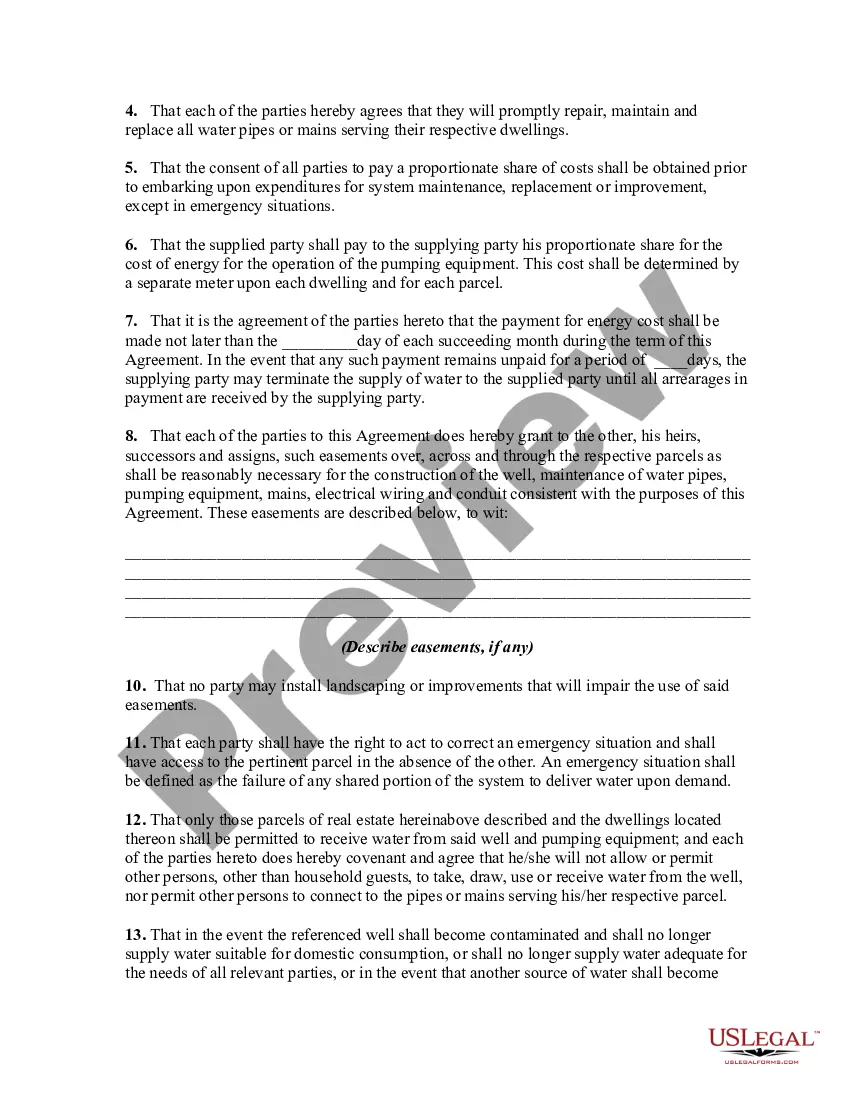
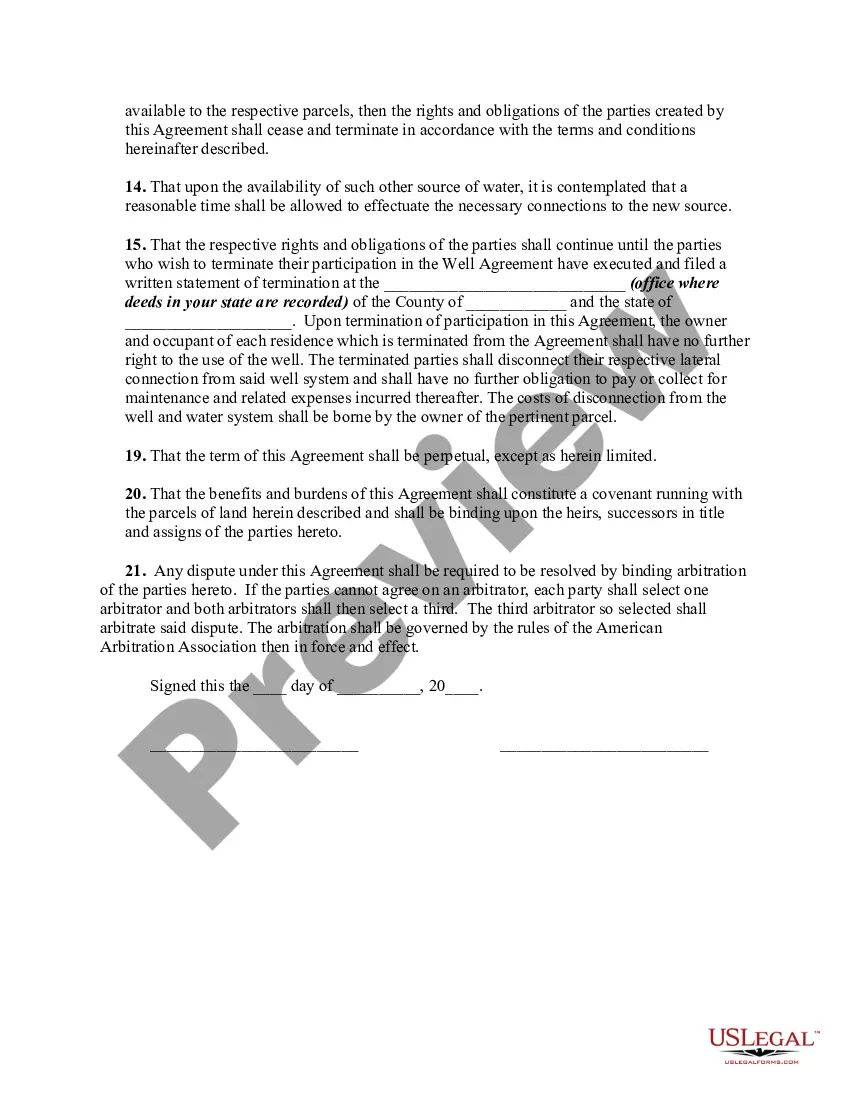
How to fill out Shared Well Water Agreement?
- If you're a returning user, log in to your account and check your subscription status. Download the necessary form template directly to your device by clicking the Download button.
- For first-time users, begin by reviewing the Preview mode and form description. Ensure the selected template aligns with your needs and meets local jurisdiction requirements.
- If the form doesn't meet your criteria, utilize the Search tab at the top to locate an appropriate template.
- After finding the suitable document, click the Buy Now button and select your desired subscription plan. Register for an account to unlock more resources.
- Complete your purchase by entering your credit card details or using your PayPal account for payment.
- Once the purchase is finalized, download the form to your device and access it anytime through the My Forms menu in your profile.
US Legal Forms empowers individuals and attorneys alike to swiftly execute legal documents through a vast collection of over 85,000 fillable and editable forms. This service not only offers more forms than competitors but also provides access to premium experts for guidance, ensuring your documents are both precise and legally sound.
Whether you’re familiar with legal paperwork or not, US Legal Forms simplifies your experience. Start today and take advantage of our extensive resources to create your well-crafted legal agreements.
Form popularity
FAQ
You can run two houses off of one well, provided that the well has the capacity to meet the water needs of both residences. It's crucial to establish a clear agreement among the homeowners defining usage limits and responsibilities. Using a well agreement for the world helps ensure that both parties are treated fairly and that water supply remains adequate.
Yes, multiple houses can certainly share a well, but it requires a well-structured agreement to prevent conflicts. This arrangement can benefit all parties, as it often reduces individual costs. A well agreement for the world ensures that every homeowner understands their rights and responsibilities regarding the shared well.
The number of homes that can effectively utilize a shared well varies based on its water production capacity and local regulations. Typically, homeowners should consult with local authorities to determine what is permissible. Incorporating a well agreement for the world will clearly delineate how many homes can be served and under what conditions.
Enforcing a well agreement requires clear communication and a mutual understanding of responsibilities. It is beneficial to outline specific consequences for breaches within the agreement. Should disputes arise, having a well agreement for the world in place can guide legal action and ensure all parties remain accountable.
The number of houses that can connect to a well is influenced by the well's production capacity and regional regulations. Local authorities often impose limits to ensure sustainable water use. Establishing a well agreement for the world is essential, as it helps define these limits and protects everyone's interests.
Shared wells come with several potential downsides, such as disputes over water usage and maintenance responsibilities. If one household uses more water than others, it could lead to shortages or conflicts. A well agreement for the world can help mitigate these issues by clearly defining each party's rights and responsibilities regarding water usage.
The number of houses that can share a well typically depends on local regulations and the well's capacity. A well agreement for the world should explicitly outline how many connections can be made, based on water needs and legal restrictions. It's crucial to consult local authorities to ensure compliance and to create a fair arrangement among all users.
Agreements between countries to support each other are known as mutual defense agreements or alliances. These agreements stipulate that countries will assist one another in times of need, reinforcing security and collaboration. They are crucial for maintaining peace and stability in the world. As you explore the effectiveness of well agreements for the world, consider how these alliances contribute to global cooperation.
When countries support each other, it is often referred to as mutual aid or cooperative support. This support can manifest in various forms, such as economic assistance, resource sharing, or political backing. These cooperative efforts help foster global stability and peace. Such collaborations embody the essence of well agreements for the world, as they emphasize partnership and shared objectives.
The term for an agreement between countries is a treaty. Treaties are formal documents that outline each party's commitments and obligations. They serve as essential tools for countries to manage their relationships and address mutual concerns. This highlights the importance of well agreements for the world in establishing international standards.