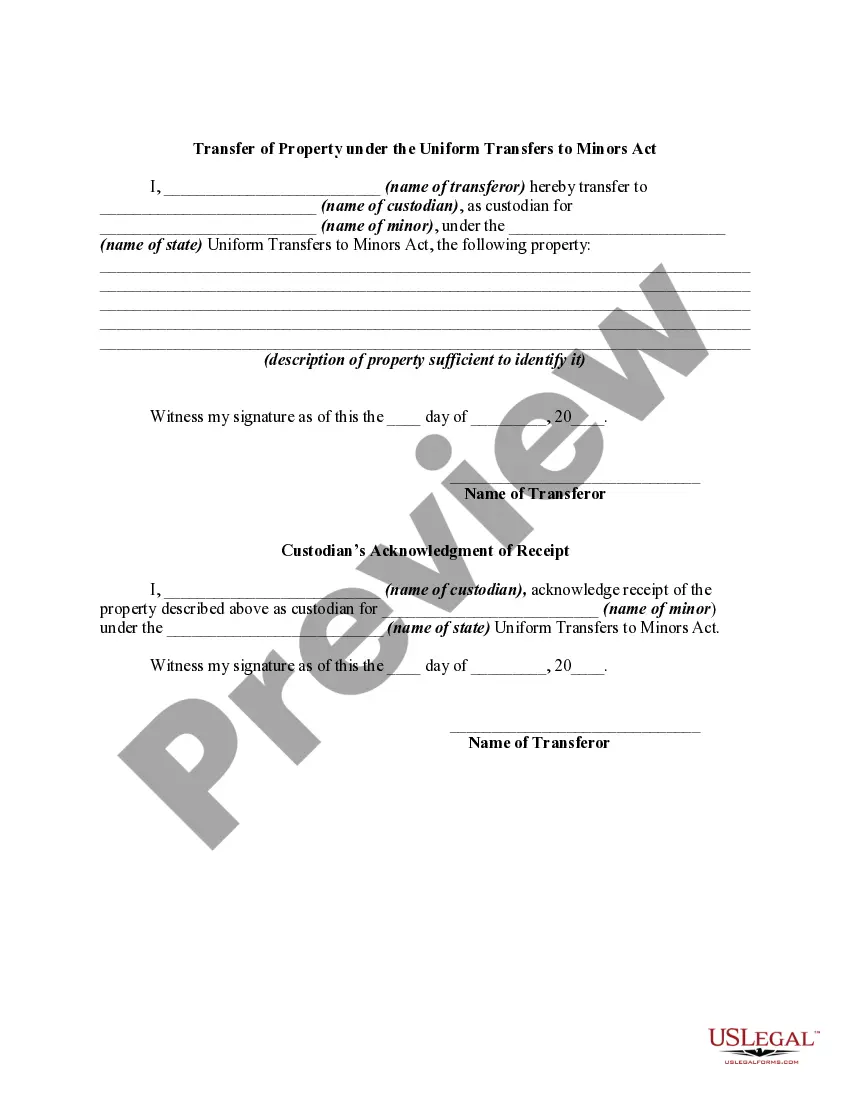
Uniform Transfers To Minors Act
Description
Get your form ready online
Our built-in tools help you complete, sign, share, and store your documents in one place.
Make edits, fill in missing information, and update formatting in US Legal Forms—just like you would in MS Word.
Download a copy, print it, send it by email, or mail it via USPS—whatever works best for your next step.
Sign and collect signatures with our SignNow integration. Send to multiple recipients, set reminders, and more. Go Premium to unlock E-Sign.
If this form requires notarization, complete it online through a secure video call—no need to meet a notary in person or wait for an appointment.
We protect your documents and personal data by following strict security and privacy standards.

Make edits, fill in missing information, and update formatting in US Legal Forms—just like you would in MS Word.

Download a copy, print it, send it by email, or mail it via USPS—whatever works best for your next step.

Sign and collect signatures with our SignNow integration. Send to multiple recipients, set reminders, and more. Go Premium to unlock E-Sign.

If this form requires notarization, complete it online through a secure video call—no need to meet a notary in person or wait for an appointment.

We protect your documents and personal data by following strict security and privacy standards.
Looking for another form?
How to fill out Transfer Of Property Under The Uniform Transfers To Minors Act?
Whether for commercial reasons or personal affairs, everyone eventually encounters legal circumstances in their lifetime.
Completing legal documents requires meticulous attention, starting with selecting the appropriate form template. For instance, if you choose an incorrect version of a Uniform Transfers To Minors Act, it will be declined upon submission. Therefore, it is crucial to have a trustworthy source of legal documents like US Legal Forms.
With a comprehensive US Legal Forms catalog available, you don’t need to waste time searching for the appropriate template online. Take advantage of the library’s user-friendly navigation to find the correct form for any scenario.
- Locate the template you require using the search bar or catalog navigation.
- Review the form’s description to ensure it corresponds with your situation, state, and county.
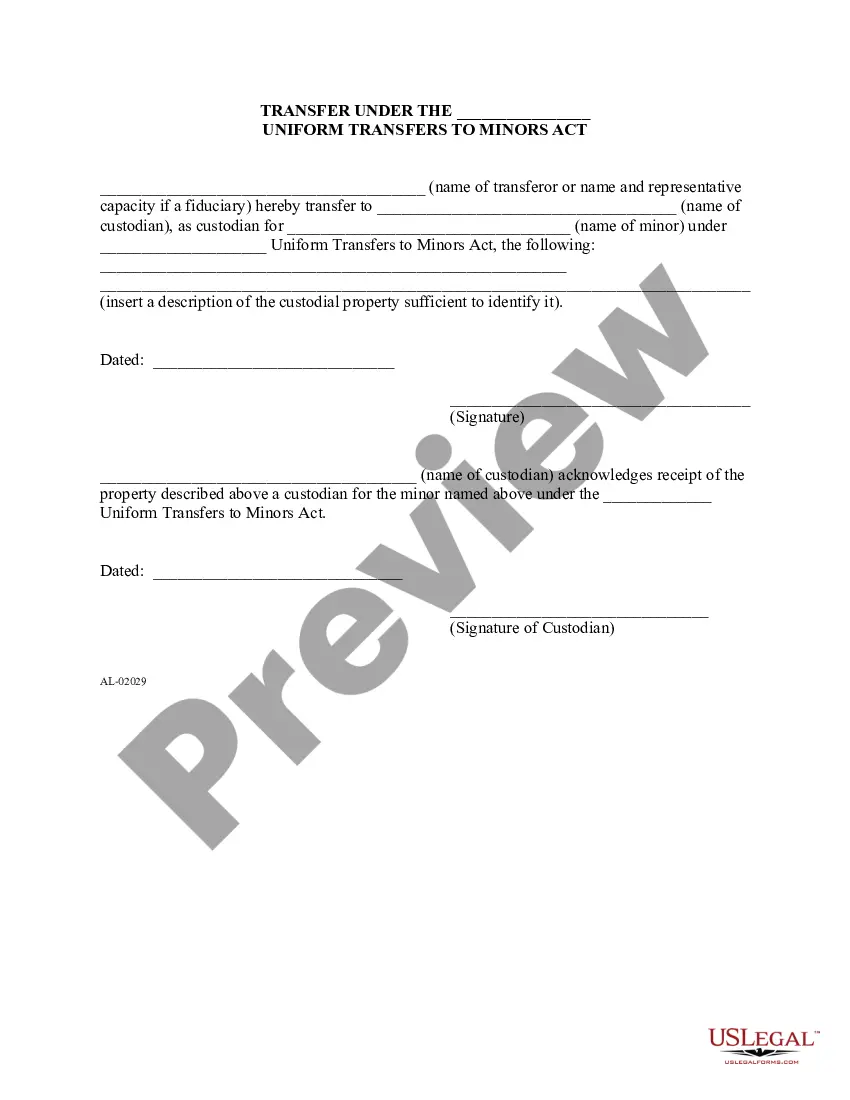
- Click on the form’s preview to examine it.
- If it is the incorrect document, return to the search feature to find the Uniform Transfers To Minors Act template you need.
- Obtain the template when it satisfies your requirements.
- If you possess a US Legal Forms profile, click Log in to access previously saved documents in My documents.
- If you don’t have an account yet, you can download the form by clicking Buy now.
- Select the suitable pricing option.
- Fill out the profile registration form.
- Choose your payment method: you can utilize a credit card or PayPal account.
- Select the document format you desire and download the Uniform Transfers To Minors Act.
- Once downloaded, you can complete the form using editing software or print it and finish it manually.
Form popularity
FAQ
UTMA allows the property to be gifted to a minor without establishing a formal trust. The donor or a custodian manages the property for the minor's benefit until the minor reaches a certain age. Once the child reaches a specified age set by the state, the child will have full control over the property.
UGMA/UTMA account assets can be transferred into a new account established by the now adult beneficiary as a sole or joint owner.
B or 1099DIV should be received at the end of the tax year from the financial institution handling the UGMA/UTMA account to report any interest or earnings on the account.
Transferring a UTMA account to a child is simple. You can do so with most financial or investment institutions. You can also consult a tax or business lawyer to help you set up the legal structure, although most financial institutions can do this for you.
Because money placed in an UGMA/UTMA account is owned by the child, earnings are generally taxed at the child's?usually lower?tax rate, rather than the parent's rate. For some families, this savings can be significant. Up to $1,050 in earnings tax-free. The next $1,050 is taxable at the child's tax rate.