Confidentiality Agreements Employee Agreement With Canada
Description

Get your form ready online
Our built-in tools help you complete, sign, share, and store your documents in one place.
Make edits, fill in missing information, and update formatting in US Legal Forms—just like you would in MS Word.
Download a copy, print it, send it by email, or mail it via USPS—whatever works best for your next step.
Sign and collect signatures with our SignNow integration. Send to multiple recipients, set reminders, and more. Go Premium to unlock E-Sign.
If this form requires notarization, complete it online through a secure video call—no need to meet a notary in person or wait for an appointment.
We protect your documents and personal data by following strict security and privacy standards.

Make edits, fill in missing information, and update formatting in US Legal Forms—just like you would in MS Word.

Download a copy, print it, send it by email, or mail it via USPS—whatever works best for your next step.

Sign and collect signatures with our SignNow integration. Send to multiple recipients, set reminders, and more. Go Premium to unlock E-Sign.

If this form requires notarization, complete it online through a secure video call—no need to meet a notary in person or wait for an appointment.

We protect your documents and personal data by following strict security and privacy standards.
Looking for another form?




How to fill out Confidentiality Agreements - Noncompetition In Employment?
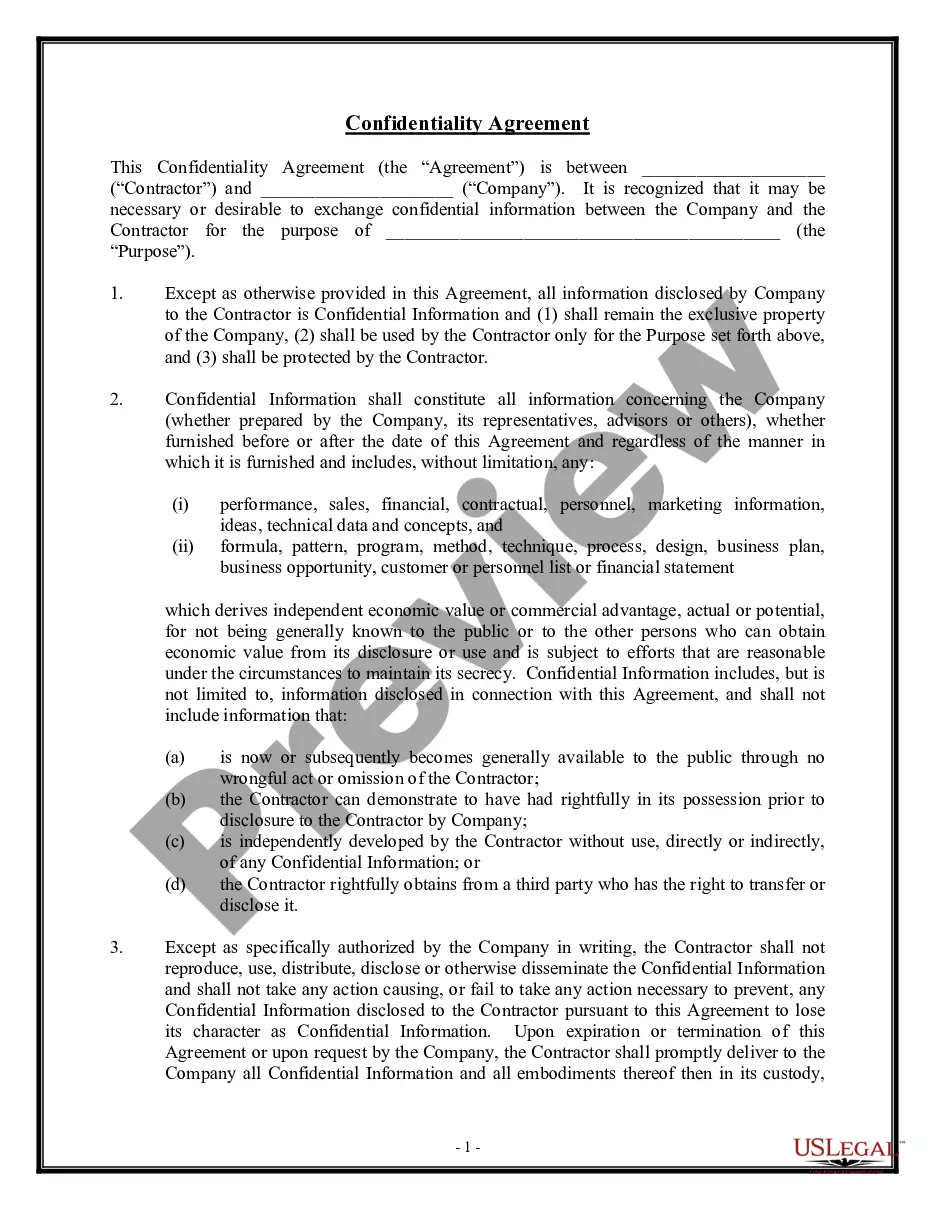
Whether for professional reasons or for personal concerns, everyone must confront legal circumstances at some point in their lives.
Completing legal documents necessitates meticulous attention, beginning with choosing the appropriate form template.
With an extensive US Legal Forms library at your disposal, you no longer need to waste time searching for the right template across the internet. Take advantage of the library’s straightforward navigation to find the correct template for any circumstance.
- Locate the template you need by utilizing the search bar or browsing the catalog.
- Review the form’s details to ensure it aligns with your circumstances, state, and county.
- Click on the form’s preview to inspect it.
- If it is the incorrect form, return to the search function to find the Confidentiality Agreements Employee Agreement With Canada template that you require.
- Acquire the template if it meets your specifications.
- If you possess a US Legal Forms account, simply click Log in to access previously stored documents in My documents.
- If you do not have an account yet, you can obtain the form by clicking Buy now.
- Choose the appropriate pricing option.
- Complete the profile registration form.
- Select your payment method: you can use a credit card or PayPal account.
- Choose the file format you desire and download the Confidentiality Agreements Employee Agreement With Canada.
- Once downloaded, you can fill out the form using editing software or print it and complete it manually.
Form popularity
FAQ
In Canada, you generally do not have to disclose medical information to your employer unless it directly impacts your ability to perform your job. The law protects your medical privacy, but some situations may require limited disclosure, particularly for workplace accommodations. Understanding your rights is essential, and resources like US Legal forms can help you navigate the complexities of employee agreements and confidentiality.
Yes, employee confidentiality agreements are generally enforceable in Canada if they meet specific legal requirements. These agreements aim to protect sensitive company information and trade secrets. Involving clearly defined terms, mutual consent, and a reasonable scope can help ensure their validity. By using US Legal forms, you can create tailored confidentiality agreements to suit your needs.
Filling out a confidentiality agreement requires careful attention to detail and understanding of the contract's terms. Begin by clearly identifying the parties involved and define the confidential information that needs protection. Then, specify the duration of the agreement and any exceptions that may apply. Utilizing resources like US Legal Forms can guide you through the process, especially when handling confidentiality agreements in the employee agreement with Canada, ensuring that you cover all necessary aspects legally and effectively.
In Canada, new employees typically need to fill out several key forms to ensure compliance with payroll and taxation regulations. These usually include a tax form, such as the TD1, an employee information form, and any required confidentiality agreements. Specifically, for confidentiality agreements in the employee agreement with Canada, it's essential to ensure that employees understand their obligations regarding sensitive information. Using platforms like US Legal Forms can simplify this process by providing templates that ensure all necessary documents are complete and legally binding.
Yes, you can sue someone for disclosing personal information in Canada, especially if the disclosure breaches privacy laws or contractual agreements. Privacy regulations, such as the Personal Information Protection and Electronic Documents Act (PIPEDA), protect individuals against unauthorized disclosures. Having a strong confidentiality agreements employee agreement with Canada in place can bolster legal actions in such scenarios by clearly defining what constitutes a breach.
Disclosure Agreement (NDA) primarily focuses on preventing the disclosure of confidential information, while a Confidentiality Agreement (CDA) can cover broader issues, including data protection and the management of sensitive materials. Both serve to protect interests but may differ in context and detail. Understanding these distinctions can enhance a confidentiality agreements employee agreement with Canada and better safeguard against information leaks.
The enforceability of NDAs internationally can vary based on jurisdiction and specific laws governing confidentiality. While many countries recognize the validity of NDAs, it’s crucial to ascertain the legal standards in each relevant location. For businesses engaged in cross-border operations, a well-crafted confidentiality agreements employee agreement with Canada can provide a framework for protecting sensitive information across borders.
Yes, confidentiality agreements are enforceable in Canada if they are properly structured and detailed. They must specify the nature of the confidential information and the obligations of the parties involved. By ensuring clarity and mutual consent, these agreements can provide legal protections that help maintain trust in business environments, underscoring the importance of a solid confidentiality agreements employee agreement with Canada.
Non-Disclosure Agreements (NDAs) are legally binding in Canada when they are drafted appropriately and meet the criteria for enforceability. These agreements serve to protect confidential information from unauthorized disclosure. By creating a clear understanding of what information is confidential, NDAs can safeguard both parties involved in a transaction or employment relationship, reinforcing the importance of a strong confidentiality agreements employee agreement with Canada.
Yes, employment contracts are legally binding in Canada, provided they are entered into voluntarily and include key elements such as offer, acceptance, and consideration. It is essential for both employers and employees to understand and agree to the terms outlined in the contract. If a dispute arises, a well-drafted confidentiality agreements employee agreement with Canada can help clarify expectations and protect both parties' interests.