Executor With No Key
Description

Get your form ready online
Our built-in tools help you complete, sign, share, and store your documents in one place.
Make edits, fill in missing information, and update formatting in US Legal Forms—just like you would in MS Word.
Download a copy, print it, send it by email, or mail it via USPS—whatever works best for your next step.
Sign and collect signatures with our SignNow integration. Send to multiple recipients, set reminders, and more. Go Premium to unlock E-Sign.
If this form requires notarization, complete it online through a secure video call—no need to meet a notary in person or wait for an appointment.
We protect your documents and personal data by following strict security and privacy standards.

Make edits, fill in missing information, and update formatting in US Legal Forms—just like you would in MS Word.

Download a copy, print it, send it by email, or mail it via USPS—whatever works best for your next step.

Sign and collect signatures with our SignNow integration. Send to multiple recipients, set reminders, and more. Go Premium to unlock E-Sign.

If this form requires notarization, complete it online through a secure video call—no need to meet a notary in person or wait for an appointment.

We protect your documents and personal data by following strict security and privacy standards.
Looking for another form?
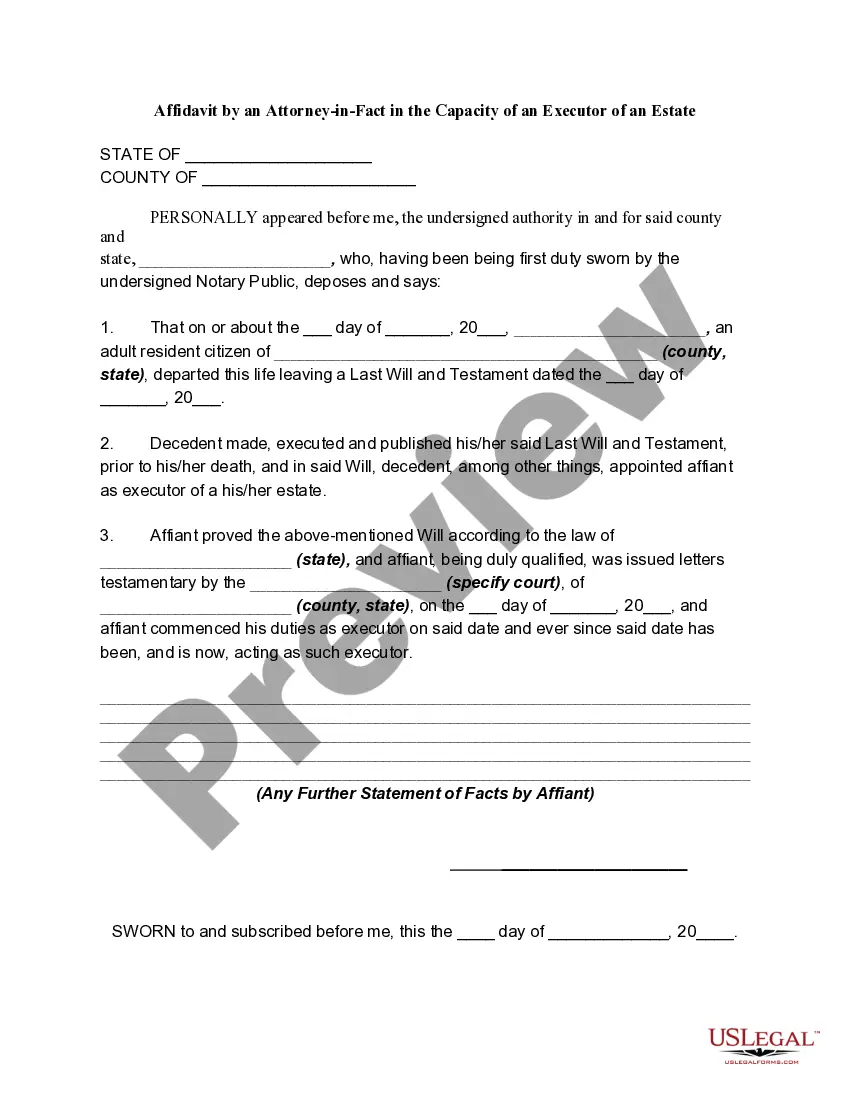
How to fill out Affidavit By An Attorney-in-Fact In The Capacity Of An Executor Of An Estate?
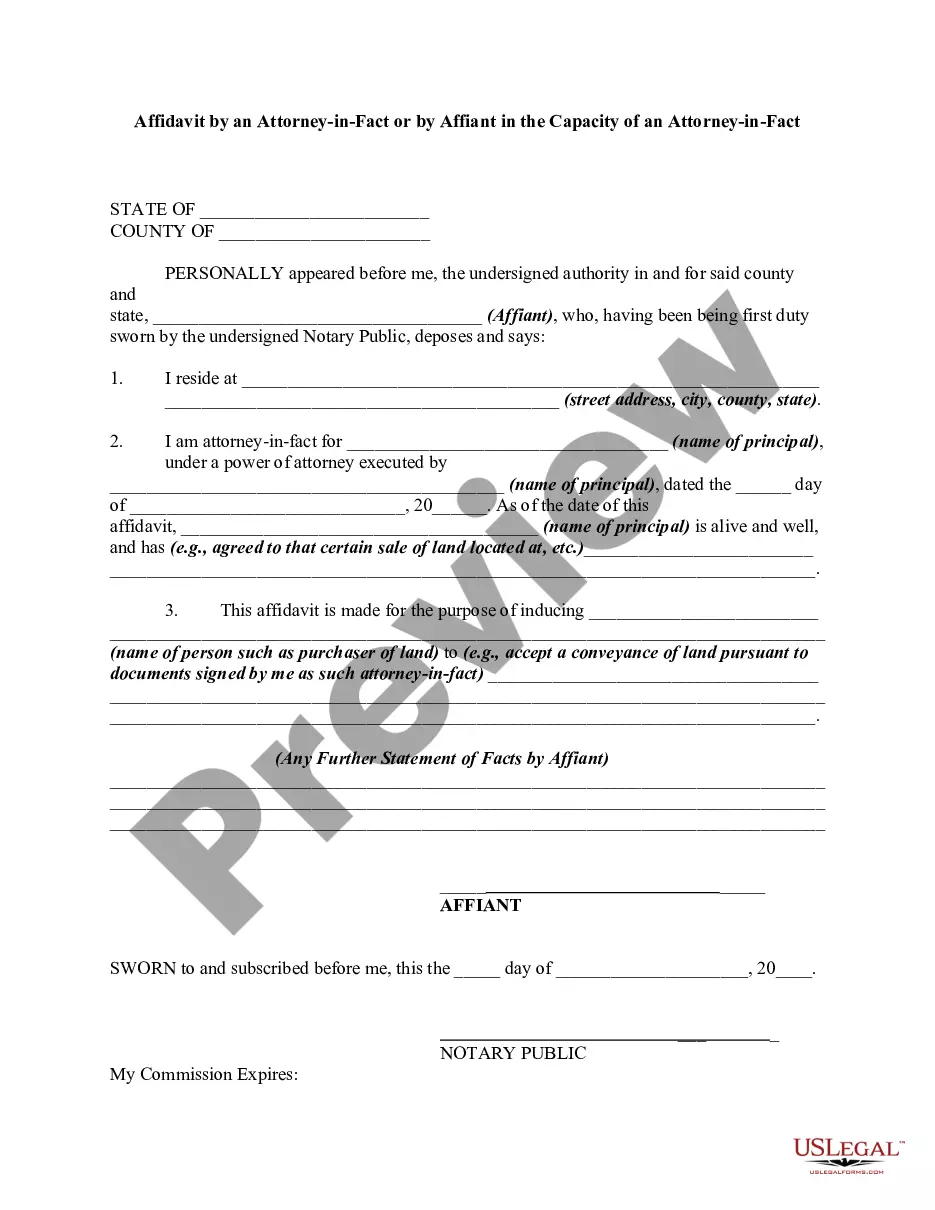
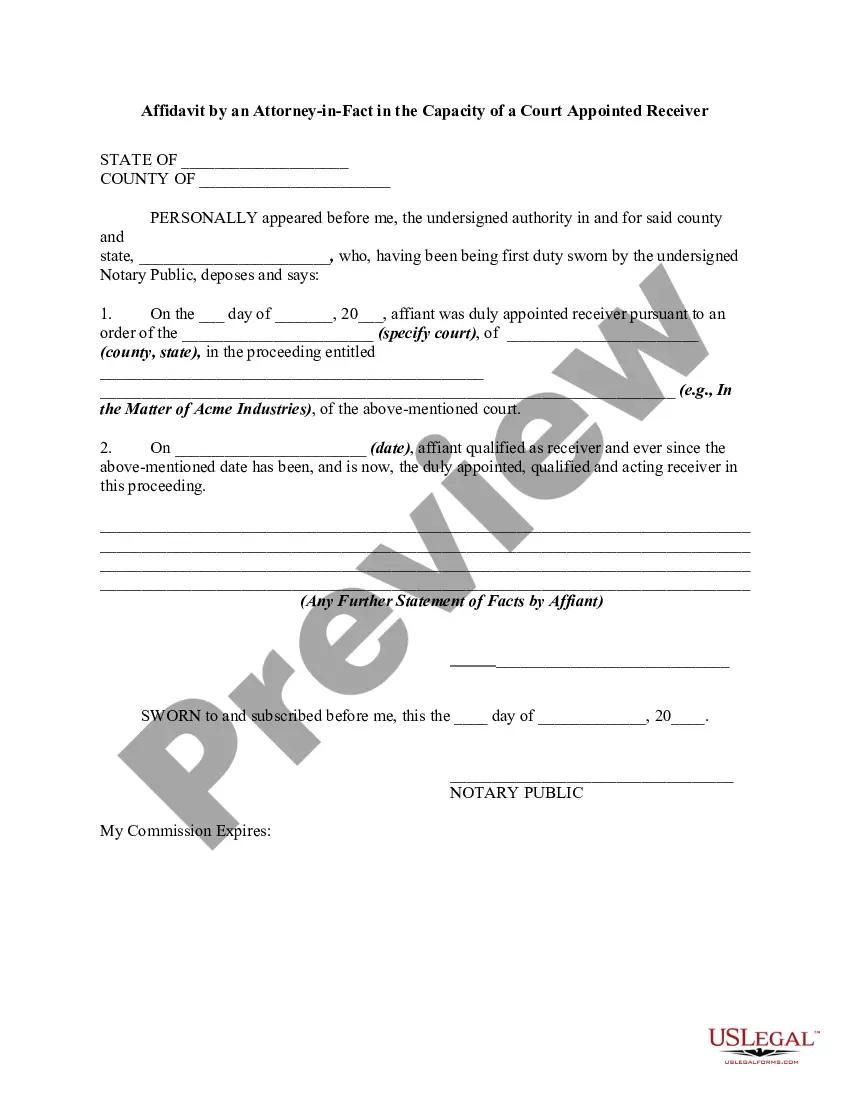
The Executor Without Key that appears on this page is a versatile legal template created by experienced attorneys in compliance with federal and local regulations.
For over 25 years, US Legal Forms has supplied individuals, companies, and legal professionals with more than 85,000 validated, state-specific documents for any business and personal needs. It is the fastest, easiest, and most reliable method to acquire the necessary paperwork, as the service promises bank-grade data protection and anti-malware safeguards.
Subscribe to US Legal Forms to have authenticated legal templates for all of life’s situations readily available.
- Search for the document you require and examine it.
- Browse the example you looked up and preview it or read the form description to confirm it meets your requirements. If it does not, utilize the search bar to find the correct one. Click Buy Now once you have found the template you need.
- Register and Log In to your account.
- Select the pricing plan that works for you and sign up for an account. Use PayPal or a credit card for a quick payment. If you already have an account, Log In and review your subscription to continue.
- Obtain the editable template.
- Pick the format you prefer for your Executor Without Key (PDF, Word, RTF) and store the sample on your device.
- Complete and sign the document.
- Print the template to fill it out manually. Alternatively, use an online all-in-one PDF editor to quickly and accurately complete and sign your form with a valid signature.
- Retrieve your documents again.
- Reuse the same document whenever necessary. Access the My documents tab in your profile to redownload any previously acquired forms.
Form popularity
FAQ
If an executor refuses to perform their duties, you may need to seek the court's intervention. The court can evaluate the situation and potentially appoint a new executor if necessary. Understanding your options in this scenario can be complex, but uslegalforms offers insights and guidance to navigate these legal challenges successfully.
The primary document that proves you are an executor is the letters testamentary granted by the probate court. This legal document confirms your authority to act on behalf of the estate. If you find yourself needing assistance to acquire this document or understand its implications, uslegalforms has tools to help guide you through the process.
A proving executor refers to an individual appointed by the court to validate the deceased's will. This executor administers the estate according to the will’s instructions and ensures all legal obligations are fulfilled. If you have questions about this role, uslegalforms can provide resources to help clarify the responsibilities of a proving executor.
To establish an executor, you need to file a petition with the probate court where the deceased lived. The court will review the will, if one exists, and grant letters testamentary to the chosen executor. If you need guidance on filing the right paperwork for this role, uslegalforms offers useful templates that simplify the process.
Proof of being the executor of an estate primarily includes letters testamentary or letters of administration issued by the probate court. These documents assert your right to manage the estate according to the deceased's wishes. Visiting uslegalforms can provide clarity on what additional documents may be necessary for your specific situation.
As the executor, you will need official documents like letters testamentary to manage the deceased's mail. These documents serve as proof of your authority to handle the estate’s affairs. If you're looking for templates or further assistance in organizing this proof, uslegalforms offers reliable solutions to streamline the process.
To prove you are the executor of an estate, you first need to present the court-issued letters testamentary. This document confirms your authority to act on behalf of the deceased. If you lack this document, you cannot function as the executor with no key. Consulting resources on uslegalforms can help ensure you gather the correct documents.