Executor Estate Form With Surviving Spouse
Description
Get your form ready online
Our built-in tools help you complete, sign, share, and store your documents in one place.
Make edits, fill in missing information, and update formatting in US Legal Forms—just like you would in MS Word.
Download a copy, print it, send it by email, or mail it via USPS—whatever works best for your next step.
Sign and collect signatures with our SignNow integration. Send to multiple recipients, set reminders, and more. Go Premium to unlock E-Sign.
If this form requires notarization, complete it online through a secure video call—no need to meet a notary in person or wait for an appointment.
We protect your documents and personal data by following strict security and privacy standards.

Make edits, fill in missing information, and update formatting in US Legal Forms—just like you would in MS Word.

Download a copy, print it, send it by email, or mail it via USPS—whatever works best for your next step.

Sign and collect signatures with our SignNow integration. Send to multiple recipients, set reminders, and more. Go Premium to unlock E-Sign.

If this form requires notarization, complete it online through a secure video call—no need to meet a notary in person or wait for an appointment.

We protect your documents and personal data by following strict security and privacy standards.
Looking for another form?





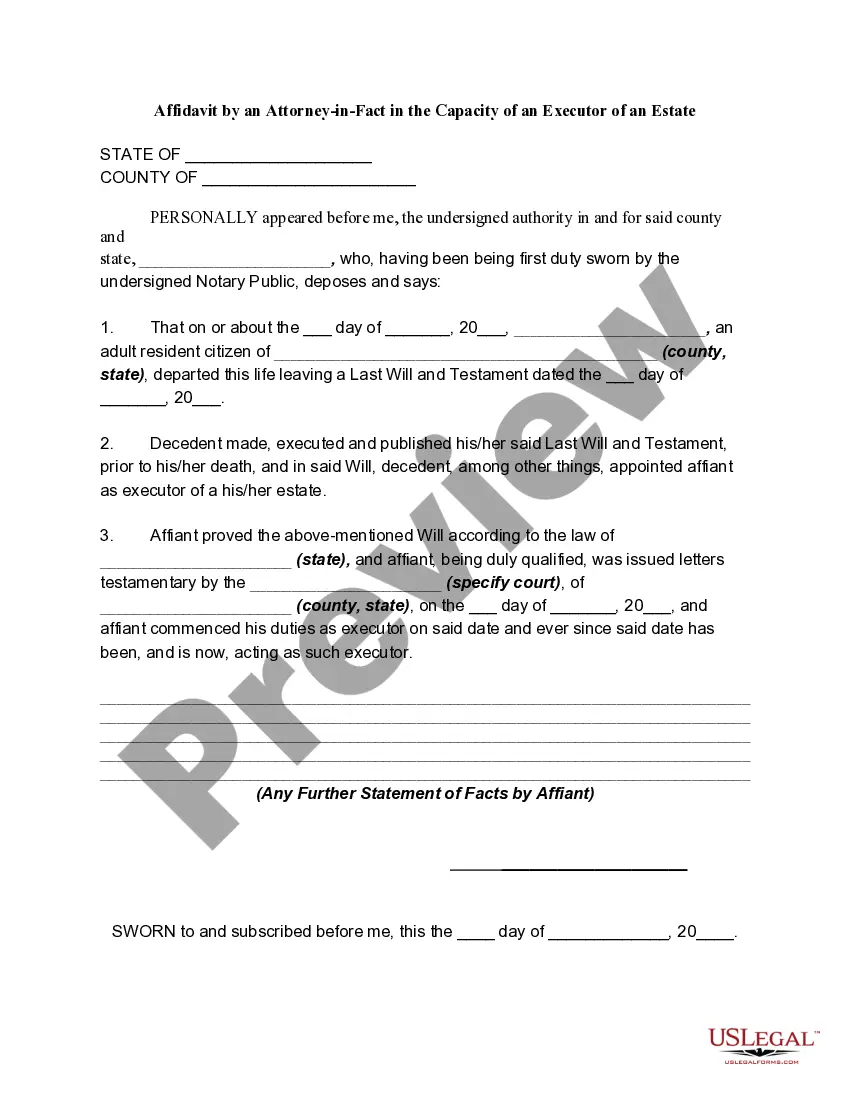
How to fill out Affidavit By An Attorney-in-Fact In The Capacity Of An Executor Of An Estate?
Dealing with legal paperwork and procedures can be a lengthy addition to the day.
Executor Estate Form With Surviving Spouse and similar forms typically necessitate you to locate them and navigate how to fill them out correctly.
Thus, if you are managing financial, legal, or personal affairs, employing a comprehensive and user-friendly online collection of forms when necessary will significantly help.
US Legal Forms is the leading online platform for legal templates, featuring over 85,000 state-specific forms and a variety of resources to assist you in effortlessly completing your documents.
Is this your first time utilizing US Legal Forms? Sign up and establish your account in a few moments, and you will gain entry to the form library and Executor Estate Form With Surviving Spouse. Then, follow the steps outlined below to finalize your form.
- Examine the library of pertinent documents available to you with a single click.
- US Legal Forms provides you with state- and county-specific forms available at any time for download.
- Protect your document management tasks using a top-notch service that allows you to create any form within minutes without incurring extra or concealed fees.
- Simply Log Into your account, find Executor Estate Form With Surviving Spouse, and download it instantly from the My documents section.
- You may also access previously downloaded forms.
Form popularity
FAQ
Typically, a surviving spouse must file an estate tax return if the estate's gross value exceeds the exemption limit. Filing the return ensures that the estate complies with federal and state tax laws. Utilizing the executor estate form with surviving spouse can simplify this process by providing the necessary information for proper filings. Understanding your responsibilities can help you navigate this challenging time more effectively.
To serve as the executor of an estate, you will need several key documents, including the death certificate, the will, and any applicable estate forms. Additionally, the executor estate form with surviving spouse may be required to clarify your role in managing the estate. Preparing this paperwork properly is essential, as it helps streamline the probate process and ensures clear communication with beneficiaries.
In most cases, a surviving spouse must file an estate tax return if the estate's value exceeds a specific threshold set by the IRS. It’s important to assess the total value of the estate carefully. Completing the right executor estate form with surviving spouse can help ensure compliance while protecting your rights as the inheritor. Seeking guidance from a tax expert can help clarify your obligations.
Yes, a surviving spouse often qualifies for an estate tax exemption, allowing them to inherit without incurring significant tax liabilities. This exemption can provide substantial relief during a challenging time. Understanding the nuances of the estate tax exemption is important, especially when filling out the executor estate form with surviving spouse. Consulting with tax professionals can provide clarity on your specific situation.
When a spouse passes away, avoid making hasty decisions about their estate. You should refrain from distributing assets without a clear understanding of the estate’s obligations, including debts and taxes. It’s crucial to consult an experienced professional to guide you through the process, especially when dealing with the executor estate form with surviving spouse. This focus ensures that you honor your spouse's wishes while fulfilling legal requirements.
Yes, in Alabama, some estates can be settled without probate, especially if they do not exceed a certain value or if all assets are held jointly or designated with beneficiaries. Using an executor estate form with surviving spouse allows you to manage administration smoothly without additional court involvement. However, understanding the legal requirements in your situation is crucial.
A surviving spouse may need to file Form 1041 if the deceased had assets that generate income during the estate administration. When acting as an executor and completing an executor estate form with surviving spouse, remember that this form reports the income earned by the estate. It's advisable to consult a tax professional for personalized advice on your filing obligations.
Certain assets typically bypass probate, including life insurance policies with designated beneficiaries, retirement accounts, and property held in trust. If your spouse left assets designated in this manner, the process can be more straightforward without needing an executor estate form with surviving spouse. It’s important to understand these distinctions to ease your estate settlement process.
Form 1310, which claims a refund due to a deceased taxpayer, is sometimes required for a surviving spouse. If you are the executor and filing an executor estate form with surviving spouse, you may need this form if the decedent had an overpayment of taxes. Consult a tax professional to determine your specific requirements based on your financial situation.
Whether you must go through probate after your husband's passing depends on several factors, including the assets that were held in his name. If he left a will or designated you as the executor using an executor estate form with surviving spouse, you may need to follow the probate process. However, some assets might bypass probate, such as property held in joint tenancy.