Contract Contractor Building Without Permit Consequences In Washington
Description

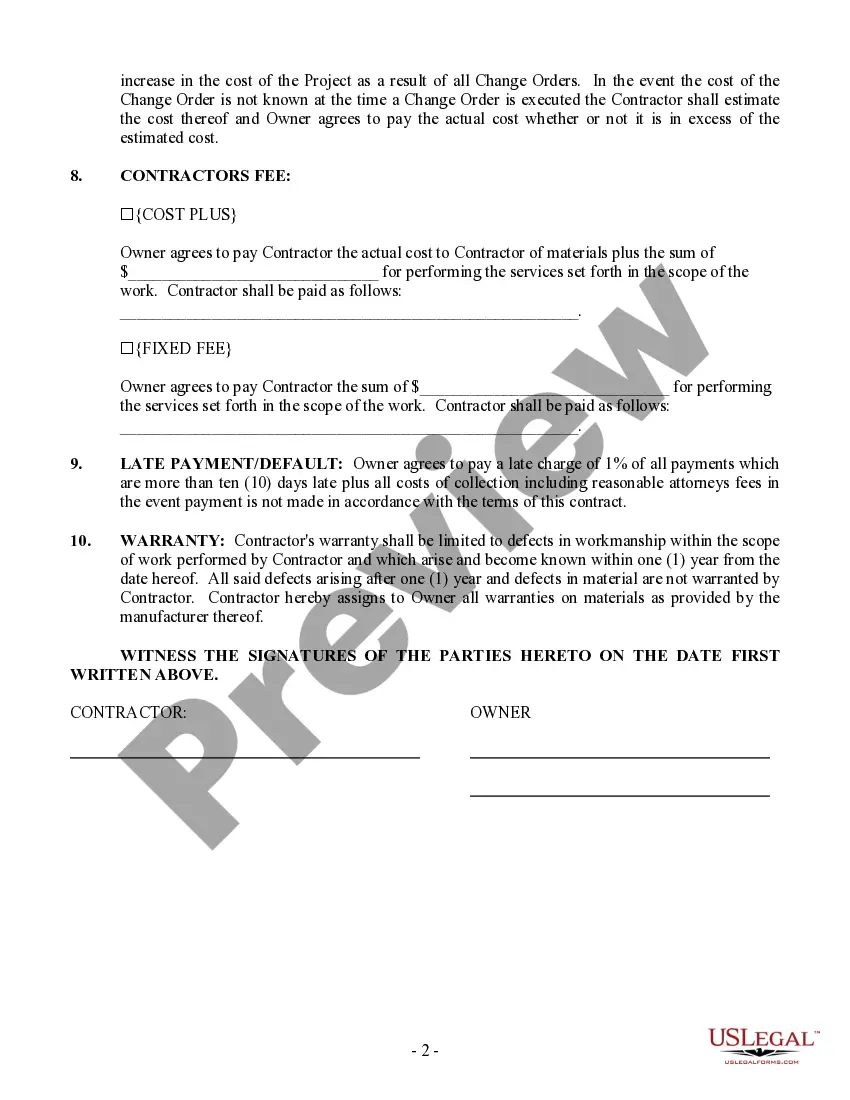
Get your form ready online
Our built-in tools help you complete, sign, share, and store your documents in one place.
Make edits, fill in missing information, and update formatting in US Legal Forms—just like you would in MS Word.
Download a copy, print it, send it by email, or mail it via USPS—whatever works best for your next step.
Sign and collect signatures with our SignNow integration. Send to multiple recipients, set reminders, and more. Go Premium to unlock E-Sign.
If this form requires notarization, complete it online through a secure video call—no need to meet a notary in person or wait for an appointment.
We protect your documents and personal data by following strict security and privacy standards.

Make edits, fill in missing information, and update formatting in US Legal Forms—just like you would in MS Word.

Download a copy, print it, send it by email, or mail it via USPS—whatever works best for your next step.

Sign and collect signatures with our SignNow integration. Send to multiple recipients, set reminders, and more. Go Premium to unlock E-Sign.

If this form requires notarization, complete it online through a secure video call—no need to meet a notary in person or wait for an appointment.

We protect your documents and personal data by following strict security and privacy standards.
Looking for another form?




Form popularity
FAQ
The quick and simple answer is: you usually don't need a permit if the shed is 120 square feet or less. In California, most jurisdictions have adopted the 120 square foot rule. If your shed area is larger than 120 square feet, it needs a building permit.
A permit is typically required for sheds larger than 200 square feet.
You don't need a permit to build a shed if it meets all of these criteria: The total area (or “footprint”) of the shed's roof is 120 square feet or less. The shed is a single-story building. The shed sits on a simple concrete slab, pier blocks, or soil.
A building permit shall not be required for the following: One-story detached accessory buildings used as tool and storage sheds, playhouses and similar uses, provided the projected roof area does not exceed one hundred twenty square feet. Fences not over six feet high. Oil derricks.
Exempt Structure - 200 Square Feet or Less. Important: The 200 square foot (or less) Exempt Structure may be constructed on a lot with or without a residence. If there is a residence on the same lot, you may build an exempt accessory structure up to 800 SF.
All work shall be limited to minor and casual work of existing residential maintenance and repair with a total dollar value of time and materials under two thousand dollars.
Construction Contractors Must Be Registered. Washington State requires all construction contractors to register with L&I. State law also requires construction contractors to be bonded and insured to protect the public. Once registered, contractors can bid, advertise, and perform construction work.
Report a fraudulent or unregistered contractor online, or call the Report-a-Fraud line at 1-888-811-5974.
A permit is typically required for sheds larger than 200 square feet.
