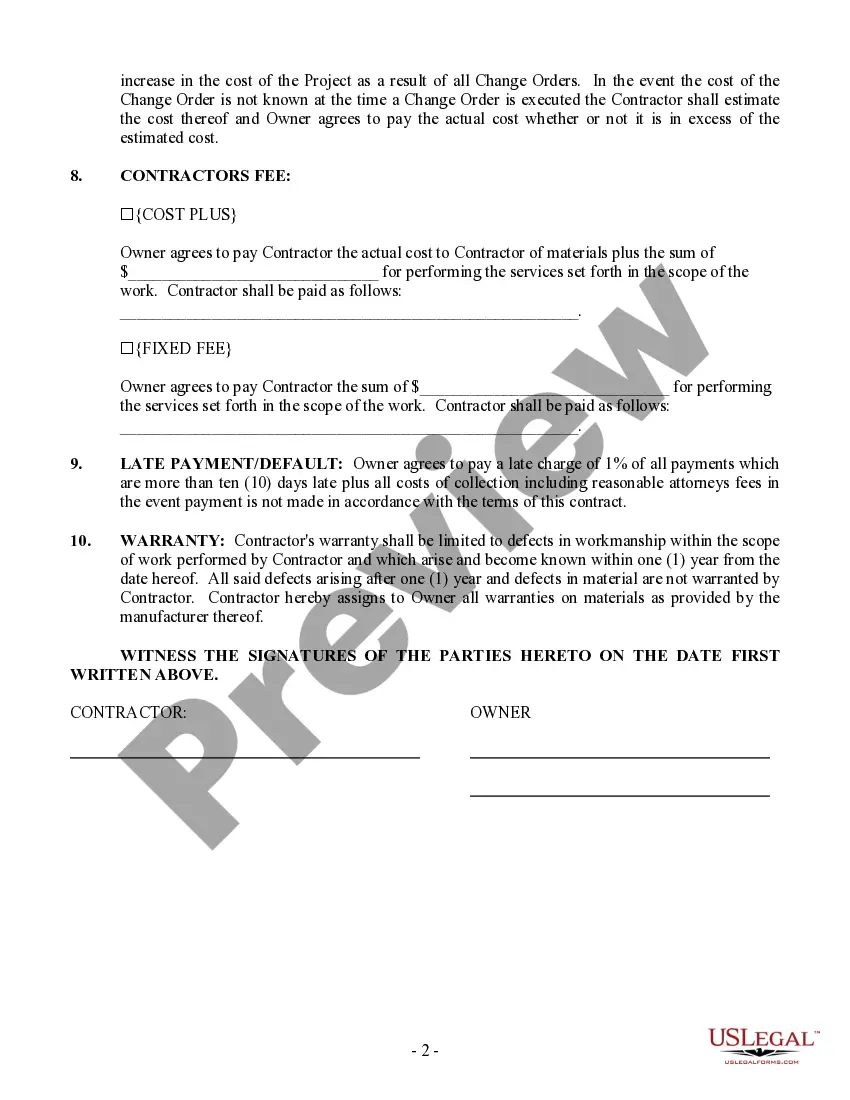
Construction Project In Building In North Carolina
Description

Get your form ready online
Our built-in tools help you complete, sign, share, and store your documents in one place.
Make edits, fill in missing information, and update formatting in US Legal Forms—just like you would in MS Word.
Download a copy, print it, send it by email, or mail it via USPS—whatever works best for your next step.
Sign and collect signatures with our SignNow integration. Send to multiple recipients, set reminders, and more. Go Premium to unlock E-Sign.
If this form requires notarization, complete it online through a secure video call—no need to meet a notary in person or wait for an appointment.
We protect your documents and personal data by following strict security and privacy standards.

Make edits, fill in missing information, and update formatting in US Legal Forms—just like you would in MS Word.

Download a copy, print it, send it by email, or mail it via USPS—whatever works best for your next step.

Sign and collect signatures with our SignNow integration. Send to multiple recipients, set reminders, and more. Go Premium to unlock E-Sign.

If this form requires notarization, complete it online through a secure video call—no need to meet a notary in person or wait for an appointment.

We protect your documents and personal data by following strict security and privacy standards.
Looking for another form?



Form popularity
FAQ
North Carolina grants owners an exemption to act as their own general contractor if they meet the following requirements. The property MUST be listed in your name. The property CANNOT be for rent, lease or sale for one year after the project is completed.
An NC general contractor license is required for any project $40,000 or more. Navigating the North Carolina Licensing Board for General Contractors can be confusing. You must understand the licensing requirements, which type of license to apply for and how the application process works.
Anything below $40,000 as of October 1st, 2023, is fine. You don't have to have a general contractor license in the state of North Carolina to do any sort of work that would be qualified as a general contracting type job.
North Carolina grants owners an exemption to act as their own general contractor if they meet the following requirements. The property MUST be listed in your name. The property CANNOT be for rent, lease or sale for one year after the project is completed.
Building permits must be obtained from the appropriate inspection office for the geographical location of the construction project. Sub-permits for mechanical, plumbing or electrical work may be obtained at any of the offices regardless of the construction location.
In addition, the statutes give the Board authority to enjoin unlicensed practice. What this means is that when the Board discovers that an unlicensed person or company is engaging in conduct that requires a license, it can file a lawsuit to stop that conduct.
Because the state does not require a handyman license, NC workers in this profession can take on a wide variety of projects — as long the value of each job stays below $40,000. Handypeople usually work on minor repairs and maintenance, like fixture replacements, furniture assembly and small carpentry tasks.
5 steps to becoming a residential builder in North America Gain experience or education. There are many ways to gain experience in construction and education in the skills you'll need to be a builder. Apply for a license. Get funding and buy tools. Marketing. Gather referrals.
If you're just starting out and trying to figure out how to find construction projects, the short answer is that you'll need to use online tools. We recommend using Construction Journal, PlanHub, Dodge Data & Analytics to find construction projects, and we'll go in depth with each one more below.
Construction Project Planning Steps Meet with Stakeholders to Gather Requirements. Conduct a Feasibility Study. Perform a Site Analysis. Define the Project Scope with a Work Breakdown Structure. Conduct a Material Takeoff. Make a Bill of Quantities. Request Vendor Quotes. Estimate Costs of Materials and Labor.
