Building Contract For Renovations In Nevada
Description

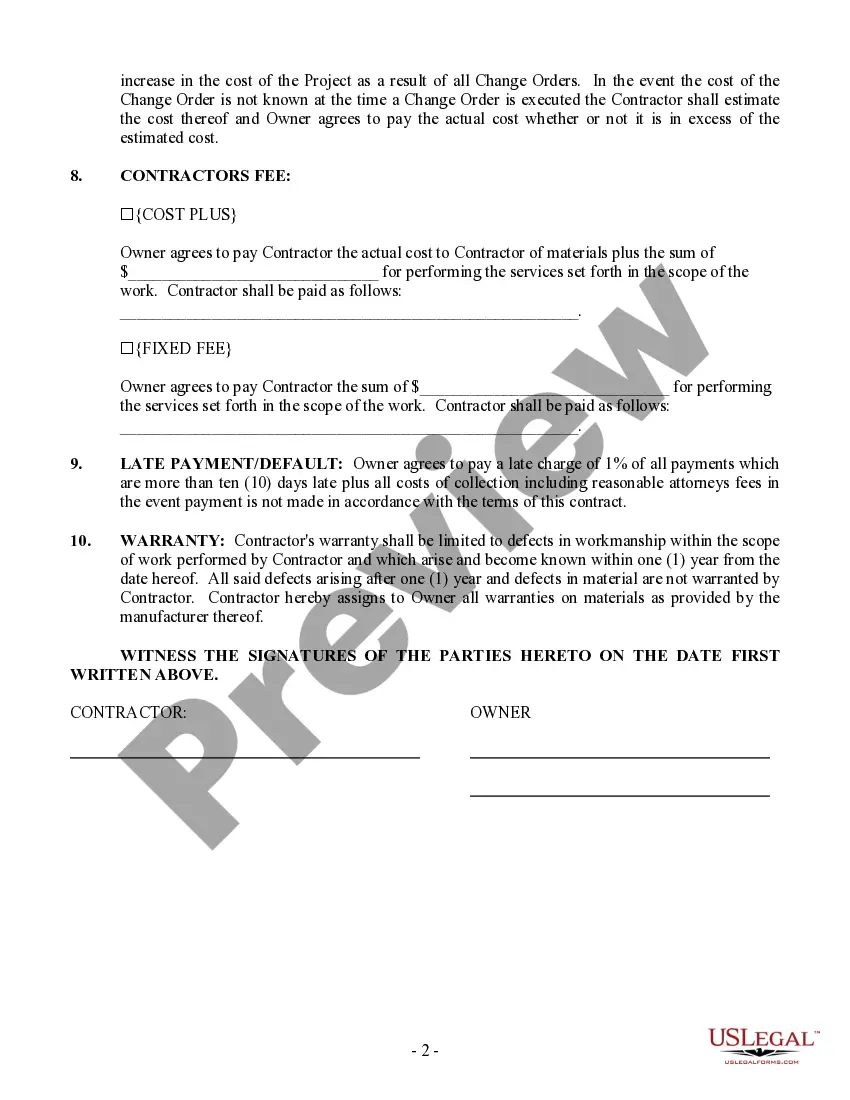
Get your form ready online
Our built-in tools help you complete, sign, share, and store your documents in one place.
Make edits, fill in missing information, and update formatting in US Legal Forms—just like you would in MS Word.
Download a copy, print it, send it by email, or mail it via USPS—whatever works best for your next step.
Sign and collect signatures with our SignNow integration. Send to multiple recipients, set reminders, and more. Go Premium to unlock E-Sign.
If this form requires notarization, complete it online through a secure video call—no need to meet a notary in person or wait for an appointment.
We protect your documents and personal data by following strict security and privacy standards.

Make edits, fill in missing information, and update formatting in US Legal Forms—just like you would in MS Word.

Download a copy, print it, send it by email, or mail it via USPS—whatever works best for your next step.

Sign and collect signatures with our SignNow integration. Send to multiple recipients, set reminders, and more. Go Premium to unlock E-Sign.

If this form requires notarization, complete it online through a secure video call—no need to meet a notary in person or wait for an appointment.

We protect your documents and personal data by following strict security and privacy standards.
Looking for another form?









Form popularity
FAQ
When two or more parties agree to do or not to do something, these parties enter a legally binding contract in Nevada. The obligations under the contract are enforceable by mutual understanding—until a dispute arises. Then, the parties go to court, where the Nevada judiciary adjudicates the case.
Work to repair or maintain property valued at less than $1,000, including labor and materials, unless certain conditions apply (e.g., building permit required, type of work, contractor's license). Sale or installation of finished products or materials that do not become a permanent fixed part of a structure.
For a contract to be binding it needs to satisfy four principles, offer, acceptance, consideration, and the intention to create legal relations. Generally, the law believes that an agreement is made when one party makes an offer and the other party accepts it.
To be enforceable, the contract must be entered into voluntarily, have clearly agreed upon terms and conditions and demonstrate the exchange of “consideration”. Clearly agreed upon terms refers to the idea that everyone understands the nature of the deal being made.
The 4/10 Rule and Alternative Work Schedules This written agreement clearly outlines the schedule and ensures compliance with Nevada's overtime laws. If an employee works beyond 10 hours in a single day under the 4/10 schedule, the extra hours must be compensated at 1.5 times their regular hourly rate.
How To Write A Construction Contract With 7 Steps Step 1: Define the Parties Involved. Step 2: Outline the Scope of Work. Step 3: Establish the Timeline. Step 4: Determine the Payment Terms. Step 5: Include Necessary Legal Clauses. Step 6: Address Change Orders and Modifications. Step 7: Sign and Execute the Contract.
Penalties A first-time offense of violating NRS 624.700 is a misdemeanor, carrying: up to $1,000 in fines, and. up to 6 months in jail, and. possible restitution payments.
The License Monetary Limit is the maximum contract amount that can be undertaken for one client on a single construction site.
All businesses or individuals who construct or alter any building, highway, road, parking facility, railroad, excavation, or other structure in Nevada must be licensed by the Nevada State Contractors Board. Contractors, including subcontractors and specialty contractors must be licensed before submitting bids.
