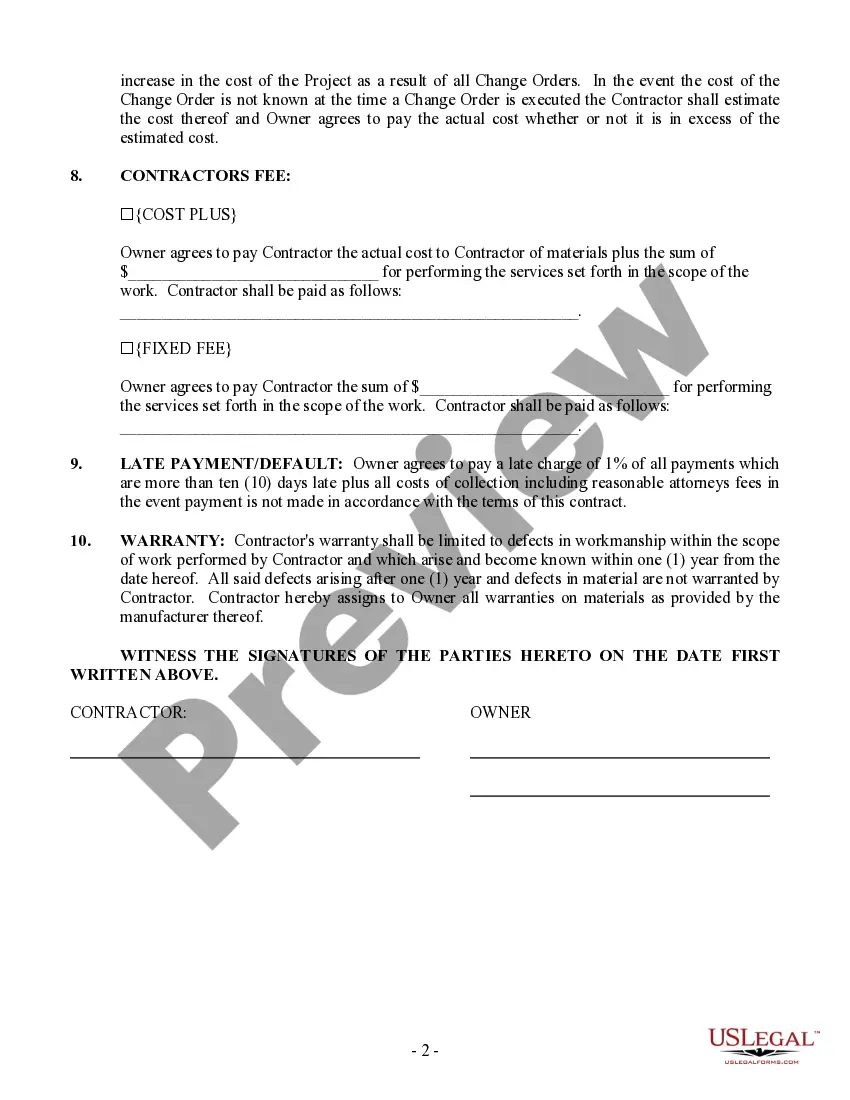
Construction Contract Form Without Completion Date In Montgomery
Description

Get your form ready online
Our built-in tools help you complete, sign, share, and store your documents in one place.
Make edits, fill in missing information, and update formatting in US Legal Forms—just like you would in MS Word.
Download a copy, print it, send it by email, or mail it via USPS—whatever works best for your next step.
Sign and collect signatures with our SignNow integration. Send to multiple recipients, set reminders, and more. Go Premium to unlock E-Sign.
If this form requires notarization, complete it online through a secure video call—no need to meet a notary in person or wait for an appointment.
We protect your documents and personal data by following strict security and privacy standards.

Make edits, fill in missing information, and update formatting in US Legal Forms—just like you would in MS Word.

Download a copy, print it, send it by email, or mail it via USPS—whatever works best for your next step.

Sign and collect signatures with our SignNow integration. Send to multiple recipients, set reminders, and more. Go Premium to unlock E-Sign.

If this form requires notarization, complete it online through a secure video call—no need to meet a notary in person or wait for an appointment.

We protect your documents and personal data by following strict security and privacy standards.
Looking for another form?




Form popularity
FAQ
Contract Completion Date is the date, determined by SCC on which the Project is to reach Substantial Completion. The Contract Completion Date will be determined based on the duration for the Project set by the Contract as adjusted by any Contract Modifications that extend or reduce the duration of the Project.
A payment becomes due on the later of: the expiry of 7 days following the “Relevant Period” (if the contract does not specify a relevant period or one cannot be calculated by reference to the contract then this period is 28 days; or the making of a claim by the payee.
The contract does not become open-ended and the contractor is still obliged to complete the works. Time being at large simply means that the completion date is not specified or calculable by reference to the contract and must therefore be determined with reference to what is reasonable in the circumstances.
Starting a contract without a clear end date raises critical questions about duration and termination rights. These agreements—often referred to as "indefinite" or "perpetual" contracts—remain active until specific events trigger their end.
In construction, the completion date is when all construction work is done and the project meets the agreed standards. The possession date is when the owner or client officially takes ownership of the property. These dates might be the same, but sometimes possession happens later to allow for inspections or permits.
The due date, also known as the payment due date or the date for payment, is the date by which the contractor is entitled to receive payment for the work completed. It is established in the contract and is typically a specific number of days after the valuation date.
Understanding Payment Due Date ing to the Scheme for Construction Contracts, if the contract does not explicitly mention the Payment Due Date, it is assumed to be 28 days after the end of the 'relevant period,' which is a prescribed period after the completion of work.
Indefinite contracts do not have a fixed end date; instead, they remain in effect until terminated by one of the parties under specified conditions, known as “cause.” These conditions could include breach of contract, failure to meet performance standards, or mutual agreement to conclude the contract.
