Construction Contract Cost Force Majeure Clause Example
Description

Get your form ready online
Our built-in tools help you complete, sign, share, and store your documents in one place.
Make edits, fill in missing information, and update formatting in US Legal Forms—just like you would in MS Word.
Download a copy, print it, send it by email, or mail it via USPS—whatever works best for your next step.
Sign and collect signatures with our SignNow integration. Send to multiple recipients, set reminders, and more. Go Premium to unlock E-Sign.
If this form requires notarization, complete it online through a secure video call—no need to meet a notary in person or wait for an appointment.
We protect your documents and personal data by following strict security and privacy standards.

Make edits, fill in missing information, and update formatting in US Legal Forms—just like you would in MS Word.

Download a copy, print it, send it by email, or mail it via USPS—whatever works best for your next step.

Sign and collect signatures with our SignNow integration. Send to multiple recipients, set reminders, and more. Go Premium to unlock E-Sign.

If this form requires notarization, complete it online through a secure video call—no need to meet a notary in person or wait for an appointment.

We protect your documents and personal data by following strict security and privacy standards.
Looking for another form?
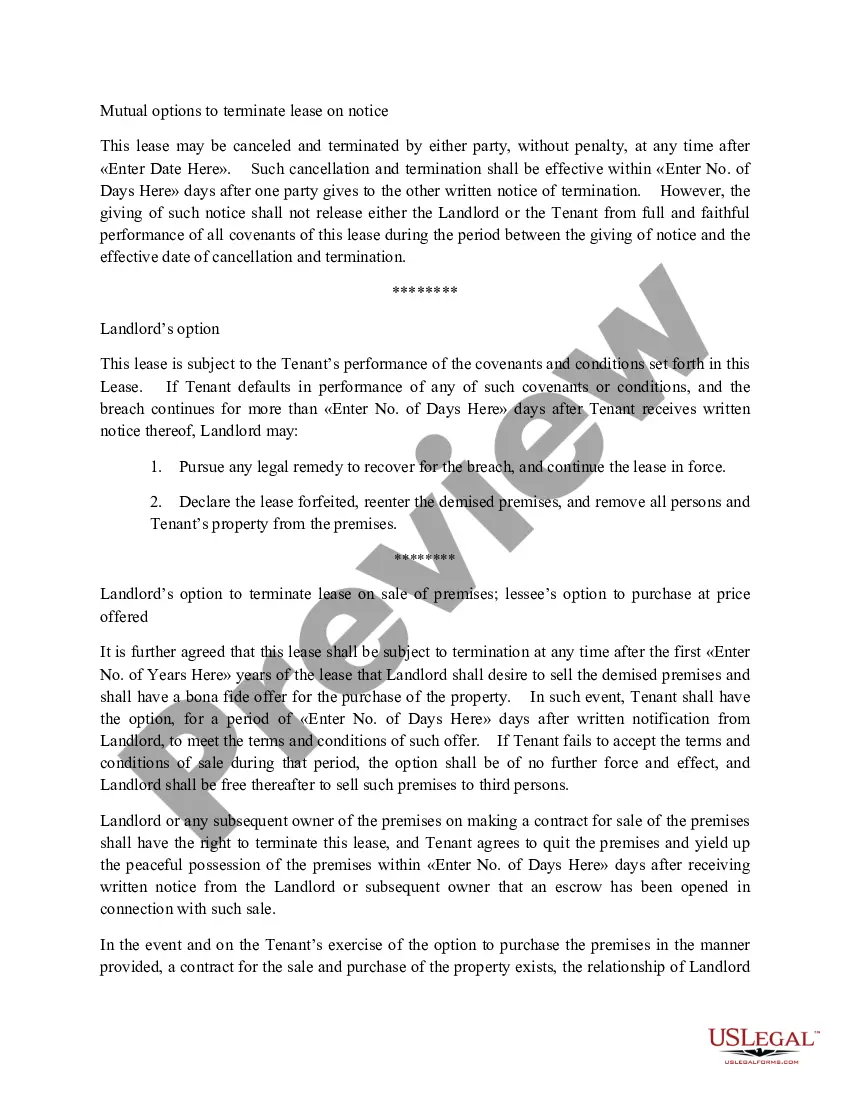





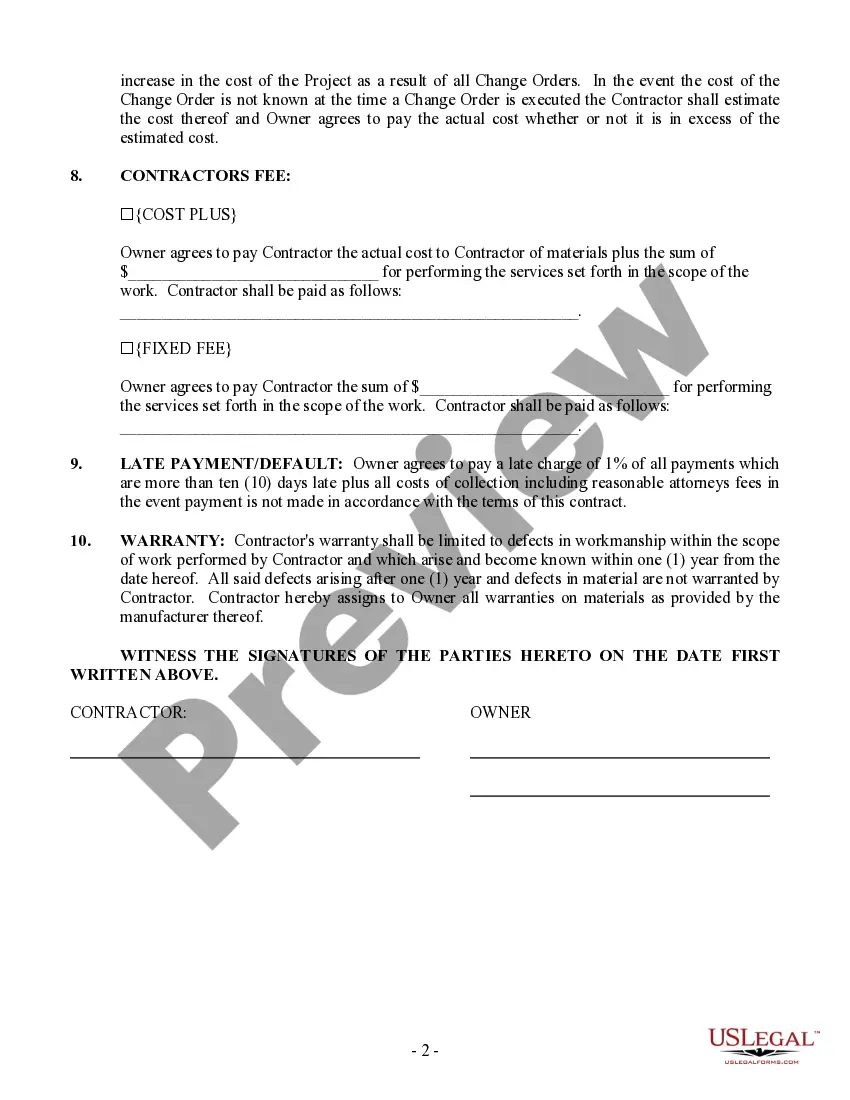
How to fill out Construction Contract For Home - Fixed Fee Or Cost Plus?
Locating a dependable source for obtaining the latest and pertinent legal templates constitutes a significant portion of the challenge associated with navigating bureaucracy.
Obtaining the correct legal documents necessitates precision and meticulousness, which is why it is crucial to acquire examples of Construction Contract Cost Force Majeure Clause Only from trustworthy sources, such as US Legal Forms. A flawed template can squander your time and delay your current situation.
Once you have the form on your device, you can modify it using the editor or print it out and complete it manually. Eliminate the hassle associated with your legal documents by exploring the extensive US Legal Forms library where you can discover legal templates, assess their relevance to your situation, and download them instantly.
- Use the catalog browsing or search tool to locate your template.
- Review the form’s description to determine if it meets the requirements of your state and county.
- View the form preview, if available, to confirm that the template is indeed the one you want.
- Return to the search if the Construction Contract Cost Force Majeure Clause does not suit your needs.
- If you are certain about the form’s applicability, download it.
- As a verified customer, click Log in to verify and access your selected templates in My documents.
- If you do not yet have an account, click Buy now to acquire the form.
- Select the pricing plan that matches your needs.
- Move forward to complete your purchase.
- Finalize your transaction by choosing a payment method (credit card or PayPal).
- Choose the format for downloading the Construction Contract Cost Force Majeure Clause.
Form popularity
FAQ
A force majeure clause should include a clear definition of qualifying events, notice requirements, and the effects on obligations and deadlines. It is vital to outline the responsibilities of each party during a force majeure event as well. This clarity can prevent misunderstandings and protect your interests, making it beneficial to review a construction contract cost force majeure clause example.
An example of a force majeure clause may state that neither party shall be liable for delays caused by events beyond their control, such as natural disasters, acts of government, or labor disputes. It typically defines how and when parties should notify each other of such events. For a practical implementation, refer to a construction contract cost force majeure clause example on platforms like uslegalforms.
Examples of force majeure include natural disasters, such as earthquakes or floods, and events like wars, strikes, or pandemics. Each scenario can significantly disrupt construction schedules and costs. Understanding these examples helps you appreciate the importance of including a well-drafted construction contract cost force majeure clause example in your agreements.
To invoke a force majeure clause, you must notify the other party in writing as soon as the force majeure event occurs. Your notification should include details about how the event affects your ability to meet contract obligations. Following this procedure ensures that you maintain transparency and adhere to any contractual requirements outlined in your agreement.
While not mandatory, including a force majeure clause in a contract is highly advisable, especially in construction agreements. This clause can prevent disputes and financial losses by clearly defining how unforeseen events will be handled. Without this clause, you may face significant legal issues should a disruptive event occur.
A strong force majeure clause includes a comprehensive list of events that cover a wide range of possible disruptions. It also offers guidance on the process for invoking the clause and details the consequences of such events on contract performance. By utilizing a construction contract cost force majeure clause example, you can compare and refine your clause for maximum protection.
Writing a force majeure clause involves clearly describing the events that qualify as force majeure, such as natural disasters or government actions. You should outline the procedures for notifying the other party about the occurrence and the potential impacts on obligations and deadlines. For a thorough understanding, consider using a construction contract cost force majeure clause example from reliable sources like uslegalforms.
The force majeure clause in a construction contract is a provision that relieves parties from liability or obligation when an extraordinary event occurs, making it impossible to fulfill the contract. Common events include natural disasters, war, or pandemics. This clause ensures that you are protected from unexpected occurrences that could impact your project's timeline and costs, making it essential for any construction contract.
When a contract lacks a force majeure clause, parties may face significant challenges if unexpected events arise. Without this clause, they could end up being liable for delays or non-performance despite circumstances beyond their control. It is crucial to understand that a construction contract cost force majeure clause example can provide necessary protection and define the rights and obligations of both parties when facing disruptions. Thus, incorporating this clause during contract negotiation can prevent potential disputes.
Force majeure, as defined by Fidic, refers to unpreventable events that impact the performance of a construction contract. Such events could include natural disasters, wars, or other extraordinary circumstances. In this context, a construction contract cost force majeure clause example is essential as it clarifies which events allow for an extension of time or adjustment in costs. This clause protects both parties by ensuring fairness during unforeseen disruptions.