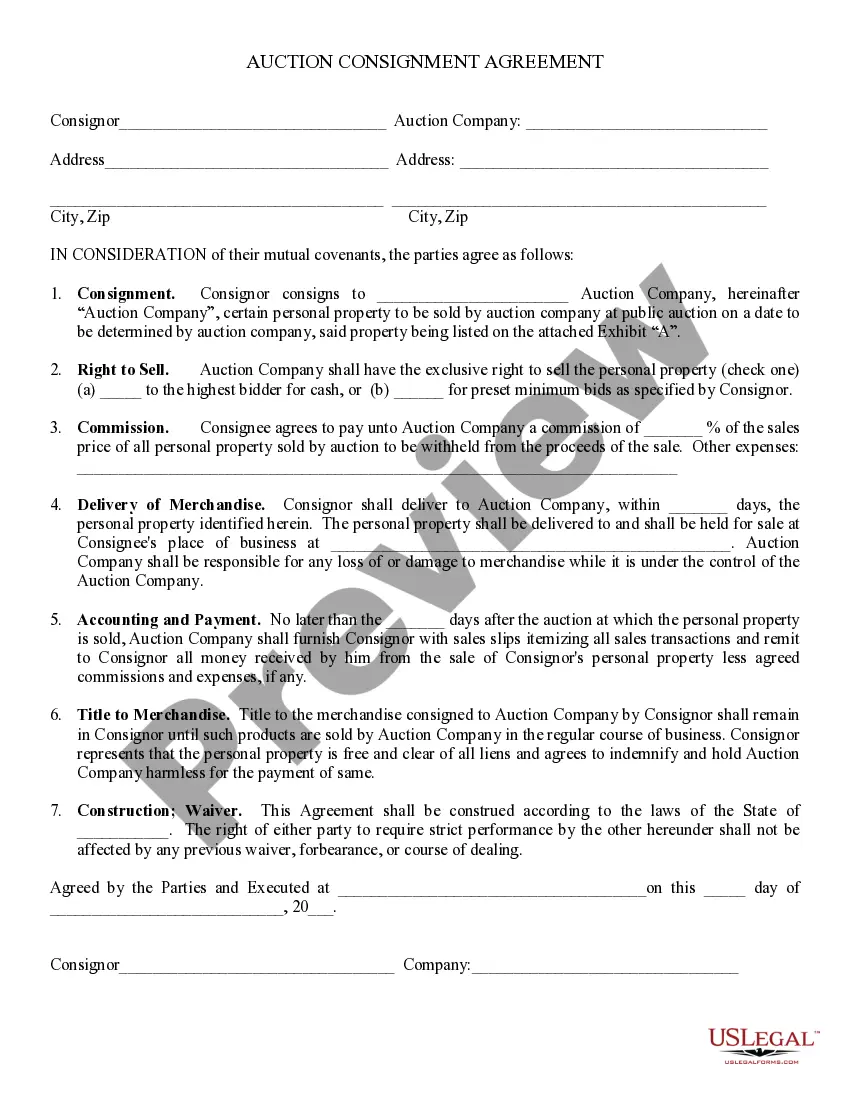
Consignment Form Template For Sale
Description

Get your form ready online
Our built-in tools help you complete, sign, share, and store your documents in one place.
Make edits, fill in missing information, and update formatting in US Legal Forms—just like you would in MS Word.
Download a copy, print it, send it by email, or mail it via USPS—whatever works best for your next step.
Sign and collect signatures with our SignNow integration. Send to multiple recipients, set reminders, and more. Go Premium to unlock E-Sign.
If this form requires notarization, complete it online through a secure video call—no need to meet a notary in person or wait for an appointment.
We protect your documents and personal data by following strict security and privacy standards.

Make edits, fill in missing information, and update formatting in US Legal Forms—just like you would in MS Word.

Download a copy, print it, send it by email, or mail it via USPS—whatever works best for your next step.

Sign and collect signatures with our SignNow integration. Send to multiple recipients, set reminders, and more. Go Premium to unlock E-Sign.

If this form requires notarization, complete it online through a secure video call—no need to meet a notary in person or wait for an appointment.

We protect your documents and personal data by following strict security and privacy standards.
Looking for another form?


How to fill out Consignment Agreement?
Locating a reliable source for the latest and pertinent legal templates is a significant part of navigating bureaucracy. Selecting the appropriate legal documents requires accuracy and meticulousness, which is why it is crucial to obtain samples of Consignment Form Template For Sale exclusively from credible sources, such as US Legal Forms. An incorrect template can squander your time and hinder your current situation. With US Legal Forms, you have minimal concerns. You can access and review all the information regarding the document’s application and its relevance for your specific circumstance and location.
Follow the steps below to complete your Consignment Form Template For Sale.
Once you have the form on your device, you can modify it using the editor or print it and fill it out by hand. Remove the inconvenience associated with your legal documentation. Explore the extensive US Legal Forms library where you can discover legal samples, verify their relevance to your situation, and download them instantly.
- Use the library navigation or search bar to find your template.
- Examine the form’s details to confirm if it aligns with the requirements of your state and county.
- Check the form preview, if available, to make sure the template is indeed the one you need.
- Return to the search to locate the suitable document if the Consignment Form Template For Sale does not meet your needs.
- When you are confident about the form’s relevance, download it.
- If you are a registered user, click Log in to verify your identity and access your selected forms in My documents.
- If you do not yet have an account, click Buy now to acquire the form.
- Choose the pricing option that suits your requirements.
- Proceed with the registration to finalize your purchase.
- Conclude your purchase by selecting a payment method (credit card or PayPal).
- Choose the document format for downloading Consignment Form Template For Sale.
Form popularity
FAQ
Selling on consignment can pose challenges, such as delayed payments and potential loss of inventory. When items are not sold, you might find it difficult to manage your stock effectively. Additionally, using a consignment form template for sale can help clarify terms, but it does not eliminate the inherent risks of consignment agreements. Weigh the pros and cons carefully to determine if this selling method aligns with your business goals.
To effectively keep track of consignment sales, you can use a consignment form template for sale, which simplifies record-keeping. Ensure that you document each transaction clearly, including item details, sale prices, and dates. Regularly update your records to reflect current inventory and sales trends. This practice not only helps you maintain accurate records but also supports better financial management.
To write up a simple agreement, start by clearly identifying the parties involved and the subject of the agreement. Outline the key terms, including the duration, payment structure, and any other relevant conditions. A consignment form template for sale can simplify this process, helping you format your agreement in a straightforward manner that is easy to understand.
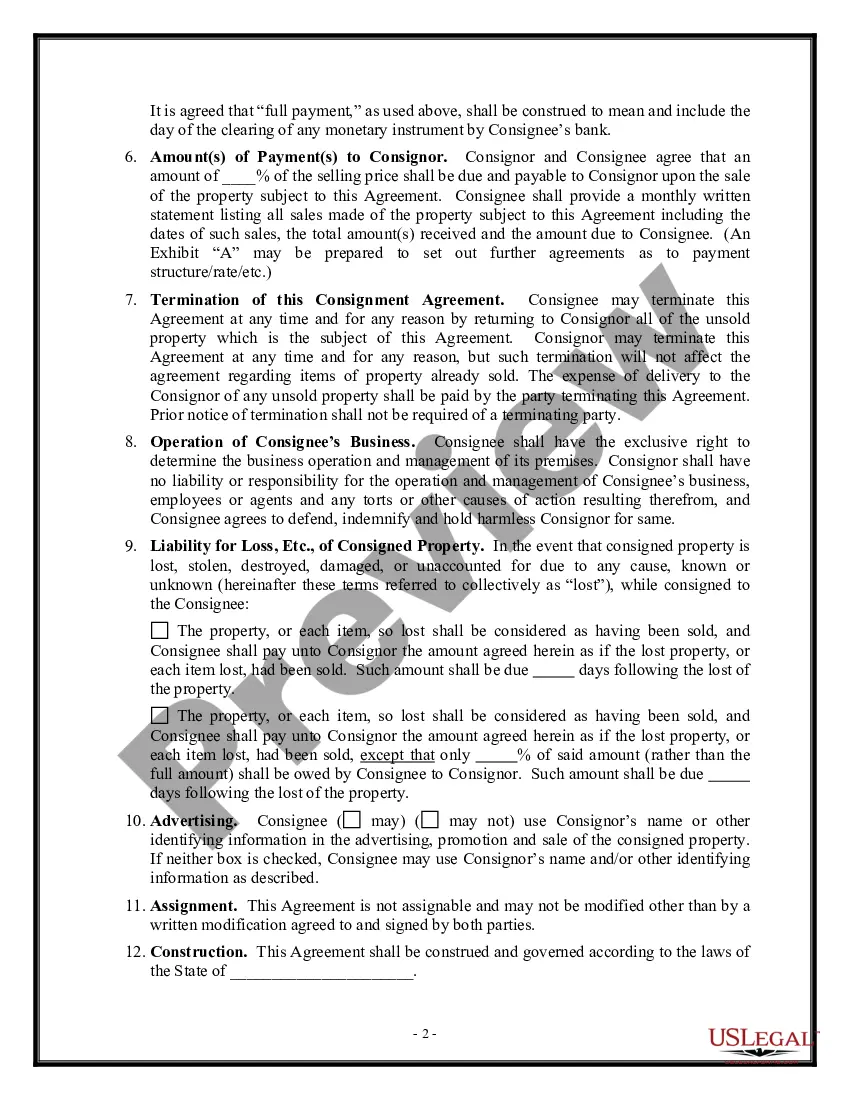
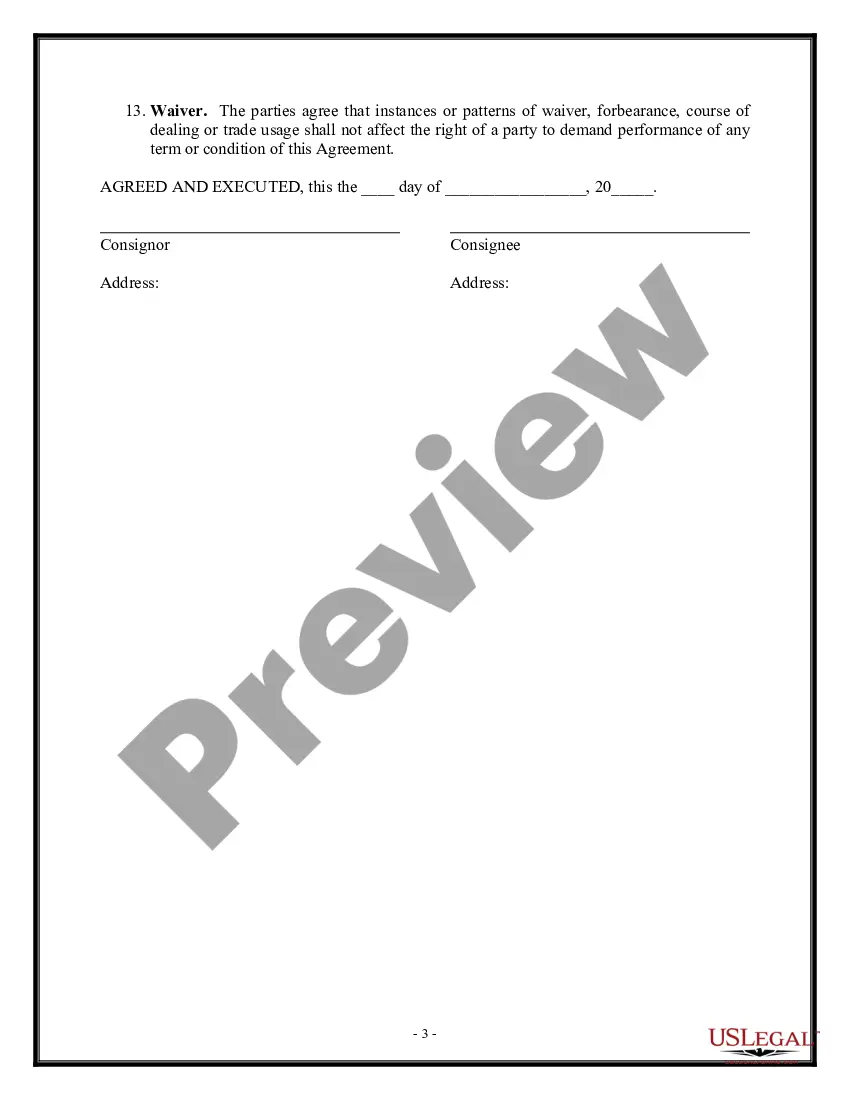
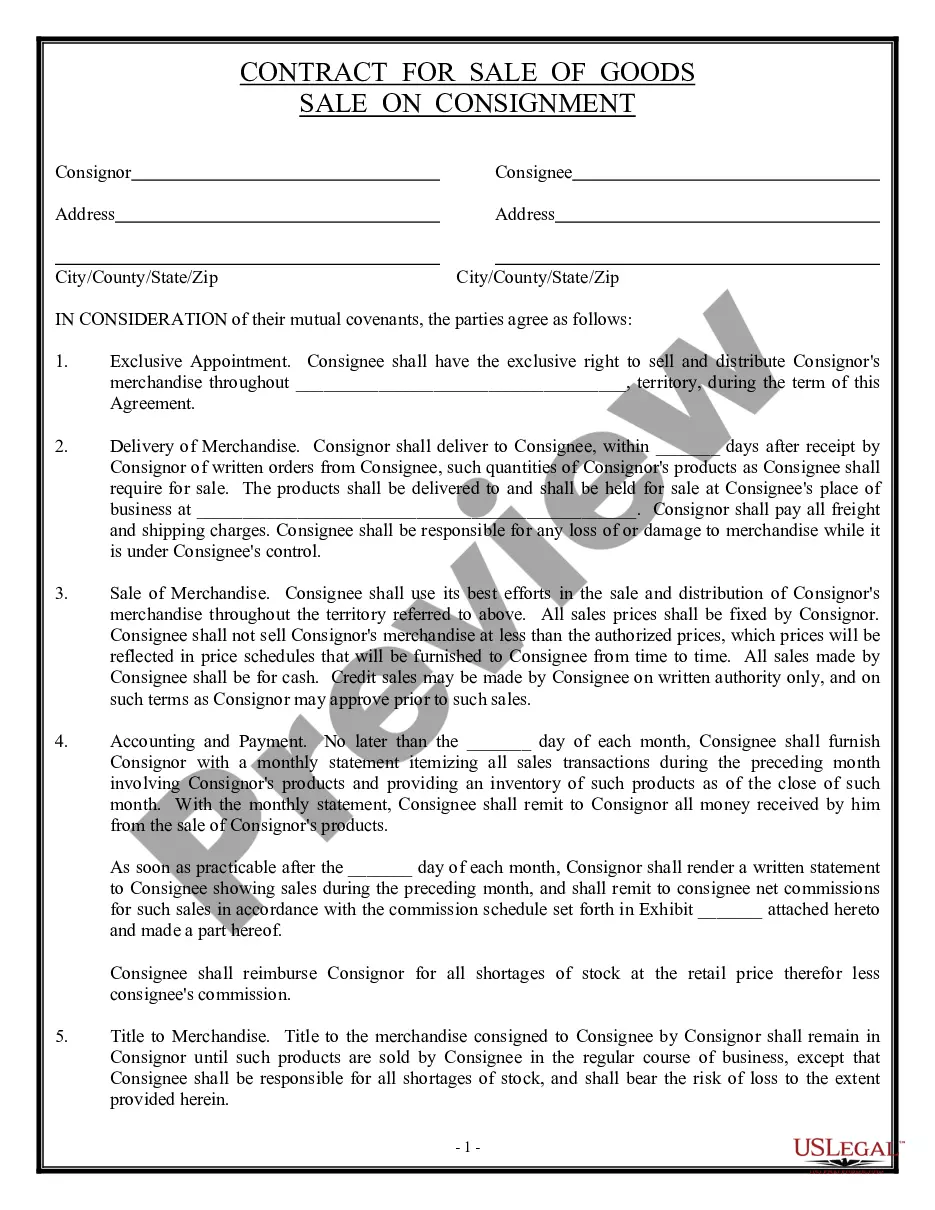
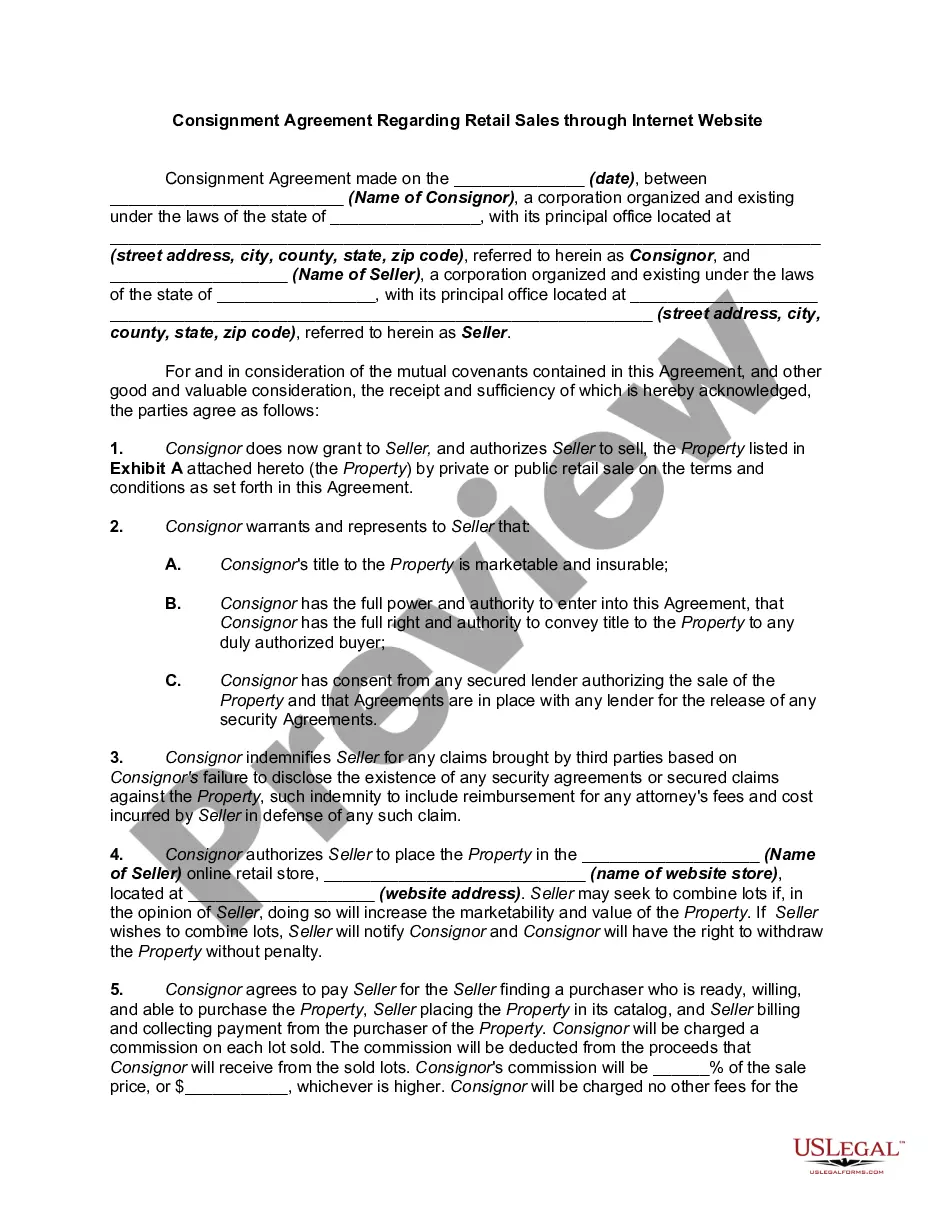
A typical consignment agreement outlines the expectations and responsibilities of both the consignor and the consignee. It includes details such as the items being sold, the commission rate, and payment terms. To create a solid understanding between both parties, consider using a consignment form template for sale, which provides a clear and organized way to present this information.
A consignment arrangement typically involves a seller providing goods to a retailer who sells the products on their behalf. In this setup, the retailer only pays for the items that are sold, while unsold items can be returned to the seller. Utilizing a consignment form template for sale can help you clearly outline the terms of this arrangement, ensuring both parties understand their rights and responsibilities.
3. Consignment agreement instructions Introduction of Parties. Identifies the parties and the date of the agreement. ... Recitals. ... Section 1: Consigned property. ... Section 2: Delivery of goods. ... Section 3: Consignment period. ... Section 4: Efforts to sell. ... Section 5: Title to products. ... Section 6: Payment; commission.
For example, a consignment store might sell previously owned prom dresses by offering to pay a 20% revenue fee to anyone who wants to sell a dress through their store. Some examples of goods you may often see for sale using the consignment business model include: Antiques and collectibles. Magazines and newspapers.
The contract normally states that the consignor is the actual owner of the item for sale and the consignee is responsible for its care and for any loss or damage to the item while in the consignee's possession. Insurance. The consignee is usually required to carry insurance that will cover the consigned item.
Consignment is an arrangement in which goods are left with a third party to sell. The party that sells the goods on consignment receives a portion of the profits, either as a flat rate fee or commission. Selling via a consignment arrangement can be a low-commission, low-time-investment way of selling items or services.