S Corporation Definition For Dummies
Description


Get your form ready online
Our built-in tools help you complete, sign, share, and store your documents in one place.
Make edits, fill in missing information, and update formatting in US Legal Forms—just like you would in MS Word.
Download a copy, print it, send it by email, or mail it via USPS—whatever works best for your next step.
Sign and collect signatures with our SignNow integration. Send to multiple recipients, set reminders, and more. Go Premium to unlock E-Sign.
If this form requires notarization, complete it online through a secure video call—no need to meet a notary in person or wait for an appointment.
We protect your documents and personal data by following strict security and privacy standards.

Make edits, fill in missing information, and update formatting in US Legal Forms—just like you would in MS Word.

Download a copy, print it, send it by email, or mail it via USPS—whatever works best for your next step.

Sign and collect signatures with our SignNow integration. Send to multiple recipients, set reminders, and more. Go Premium to unlock E-Sign.

If this form requires notarization, complete it online through a secure video call—no need to meet a notary in person or wait for an appointment.

We protect your documents and personal data by following strict security and privacy standards.
Looking for another form?




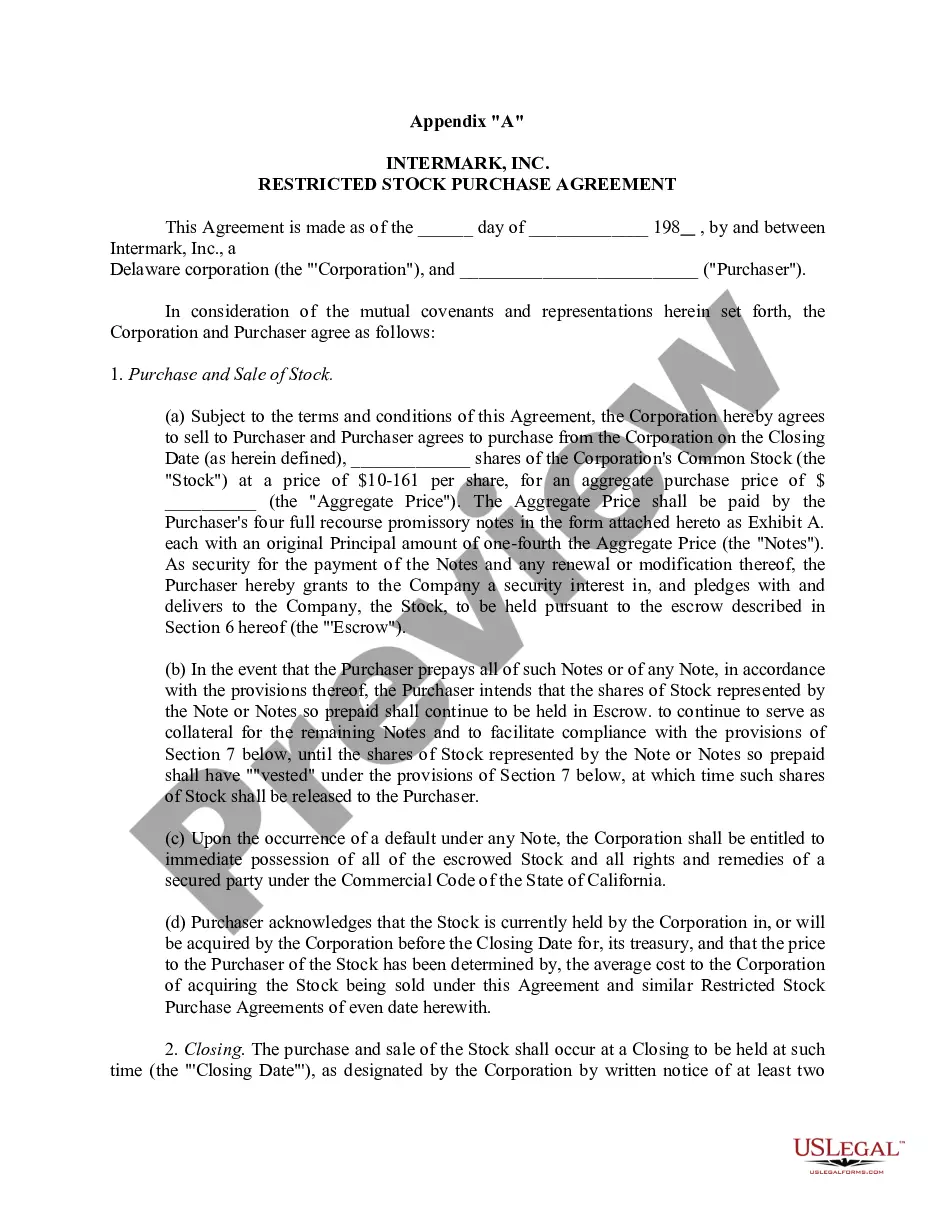





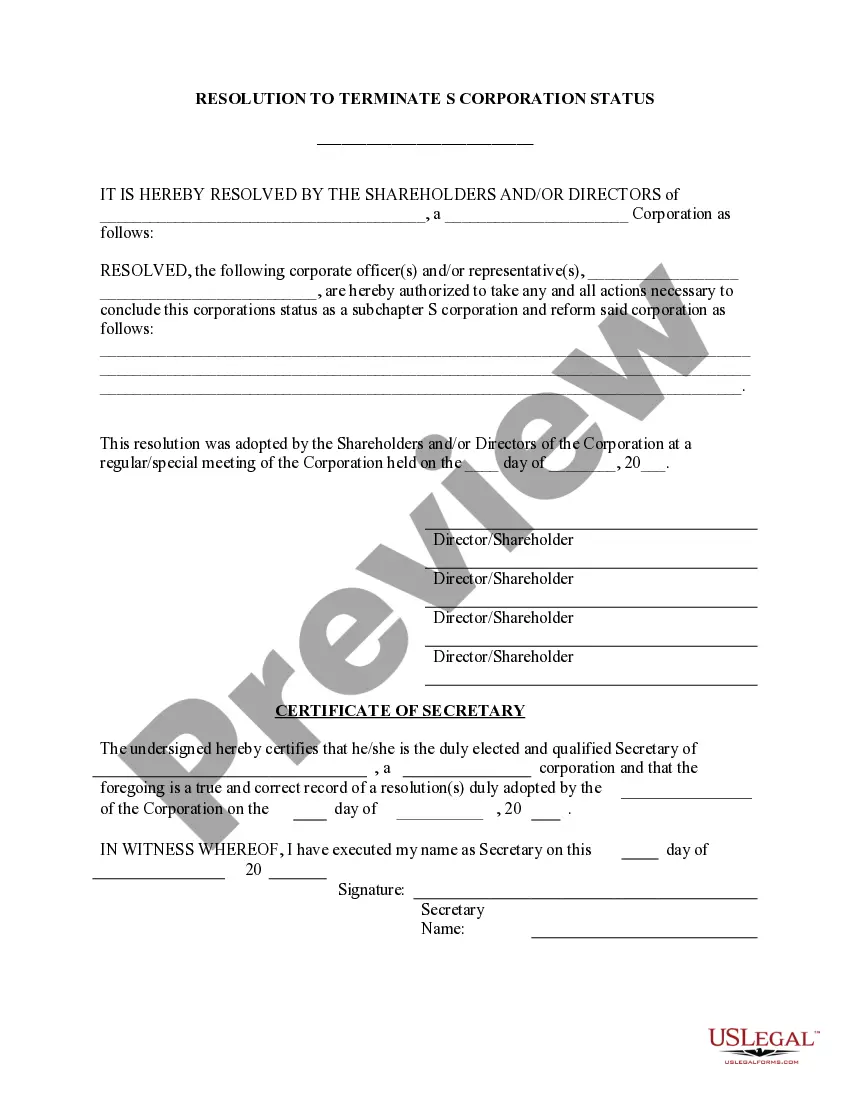
How to fill out Obtain S Corporation Status - Corporate Resolutions Forms?
- If you're a returning user, log in to access your account and retrieve the necessary form template by clicking the Download button. Ensure your subscription is active; renew it if required.
- For new users, begin by navigating to the form library and reviewing the Preview mode to find a template that aligns with your specific needs and complies with local regulations.
- If the template you selected doesn't meet your requirements, utilize the Search bar to browse for alternatives. When you find the right document, proceed to the next step.
- To acquire the document, click the Buy Now button and select your preferred subscription plan. You need to create an account for full access to the library.
- Complete your purchase by entering your credit card details or using your PayPal account to finalize the subscription.
- After the transaction, download your form to your device for completion. You can also access it later in the My Forms section of your profile.
US Legal Forms empowers both individuals and attorneys to rapidly execute legal documents with an extensive and user-friendly library that offers a vast repository of legal forms.
With a robust collection, superior to competitors at similar prices, and access to premium experts for form assistance, US Legal Forms ensures your documents are precise and legally sound. Start streamlining your legal process today!
Form popularity
FAQ
Imagine a small business like a local cafe that has opted to elect S corporation status. In this scenario, the cafe benefits from pass-through taxation, allowing the owners to report the business income on their personal tax returns. This example illustrates how an S corporation operates in a real-world setting, making it easier to understand the S corporation definition for dummies.
The first disadvantage of an S corporation is that it has strict eligibility requirements, such as a limit on the number of shareholders and the necessity of being a domestic corporation. The second disadvantage is that S corporations cannot have more than one class of stock, limiting some financial flexibility. These factors make an S corporation definition for dummies an important concept to grasp for anyone considering this business structure.
A company may choose to be an S corporation for several compelling reasons. The S corporation definition for dummies highlights tax advantages like avoiding double taxation on corporate profits, which can lead to greater personal income. Additionally, other benefits include enhanced credibility with customers and partners and the ability to raise funds through the sale of shares.
There are downsides to consider when it comes to S corporations. For instance, S corps have strict operational processes and limitations on types and number of shareholders. Additionally, certain business activities may not qualify under the S corporation definition for dummies, which restricts the scope of your business. These factors are crucial to assess before making a decision.
The distinction between an LLC and an S corporation often confuses many. Both offer limited liability protection, but their tax treatment differs. An LLC provides flexibility in taxation, usually treating income as personal income, while an S corporation follows the S corporation definition for dummies, allowing profits to pass directly to shareholders. Understanding these differences can help you choose the right structure.
Deciding whether to go for an S corporation or a C corporation often depends on your business goals. Generally, if your goal is to retain earnings, a C corp might be advantageous because it allows for reinvesting profits without immediate taxation. However, if you prefer to draw income directly and avoid double taxation, then an S corporation definition for dummies might better suit your needs.
An important difference between an S corporation and a regular corporation lies in their tax treatment. While regular corporations, or C corps, face double taxation on earnings, S corps do not. This distinction is key to understanding the S corporation definition for dummies. Furthermore, S corps have restrictions on the number of shareholders which C corps do not.
The main advantage of an S corporation, often simplified in an S corporation definition for dummies, is its tax structure. S corps allow profits to pass directly to shareholders, avoiding double taxation at the corporate level. This means that you can potentially save more of your earnings. Additionally, it provides limited liability protection, safeguarding personal assets.
Fringe benefits for S Corp 2% owners are an important topic in the S corporation definition for dummies. These benefits can include health insurance and retirement plan contributions, but special tax rules apply. Notably, 2% shareholders may need to report these benefits as income, affecting their overall tax liability, so it is essential to track these appropriately.
The 2% rule refers to the same concept as the 2% owner rule in the S corporation definition for dummies. It affects shareholders who own more than 2% of the company, especially concerning tax treatment of certain fringe benefits. Essentially, these benefits may be treated differently, impacting how taxes are applied and reported.