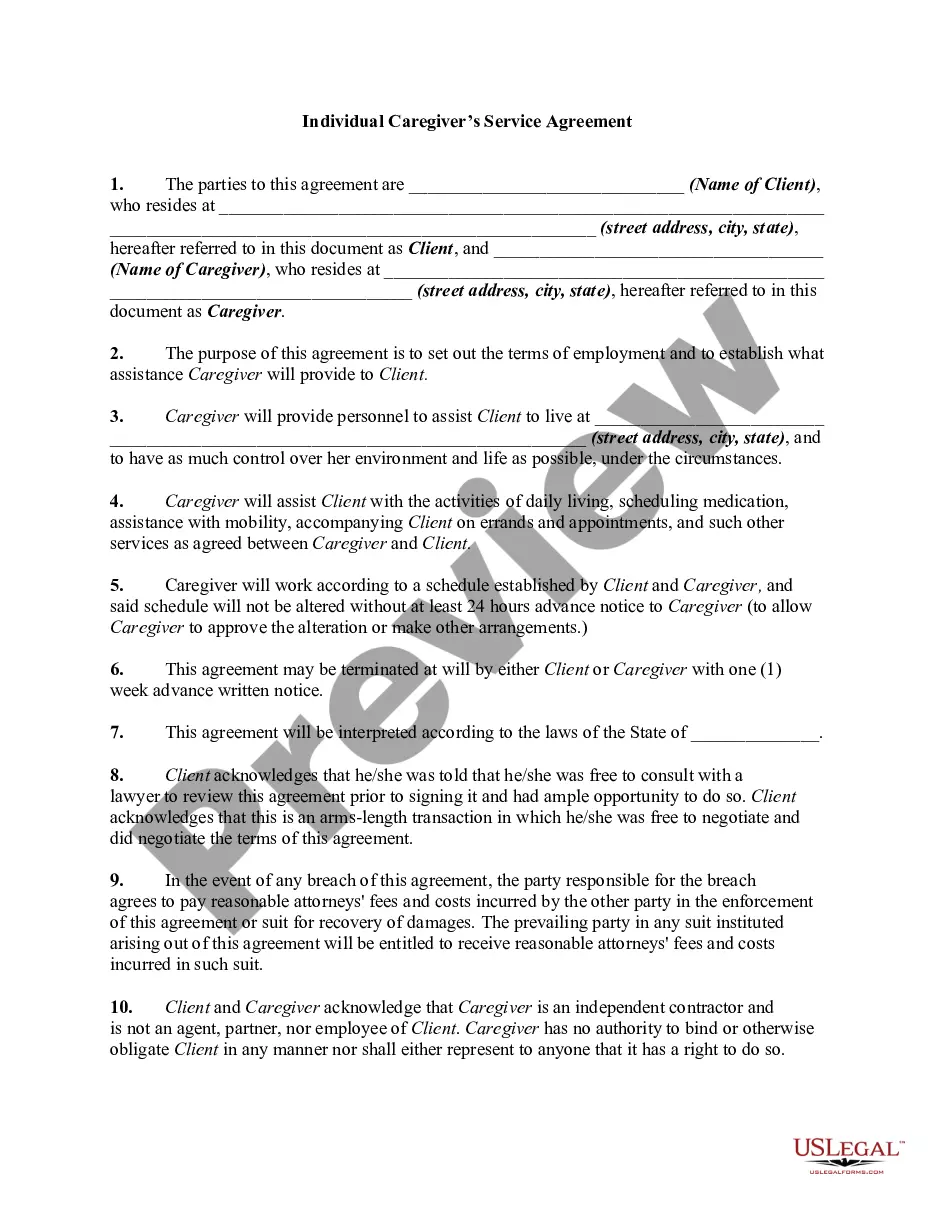
Agreement Caregiver Contract With Employer In Suffolk
Description





Get your form ready online
Our built-in tools help you complete, sign, share, and store your documents in one place.
Make edits, fill in missing information, and update formatting in US Legal Forms—just like you would in MS Word.
Download a copy, print it, send it by email, or mail it via USPS—whatever works best for your next step.
Sign and collect signatures with our SignNow integration. Send to multiple recipients, set reminders, and more. Go Premium to unlock E-Sign.
If this form requires notarization, complete it online through a secure video call—no need to meet a notary in person or wait for an appointment.
We protect your documents and personal data by following strict security and privacy standards.

Make edits, fill in missing information, and update formatting in US Legal Forms—just like you would in MS Word.

Download a copy, print it, send it by email, or mail it via USPS—whatever works best for your next step.

Sign and collect signatures with our SignNow integration. Send to multiple recipients, set reminders, and more. Go Premium to unlock E-Sign.

If this form requires notarization, complete it online through a secure video call—no need to meet a notary in person or wait for an appointment.

We protect your documents and personal data by following strict security and privacy standards.
Looking for another form?









Form popularity
FAQ
A home care contract is a crucial document that outlines the expectations, responsibilities, and terms of care services provided to a loved one. Crafting a detailed and clear contract helps ensure all parties understand their roles and obligations, promoting a harmonious and effective caregiving relationship.
A comprehensive guide on how to draft a contract Know your parties. Agree on the terms. Set clear boundaries. Spell out the consequences. Specify how you will resolve disputes. Cover confidentiality. Check the legality of the contract. Open it up to negotiation.
An adult carer support plan (ACSP) is an opportunity to discuss with the local council what support or services you need. This will look at how caring affects your life, including your physical, mental and emotional needs, and whether you are able or willing to carry on caring.
Guide to writing contracts of employment Names of the parties. The full details of the business, and the employee's full name and address. Employment contract start date. Employee's job title and description. Workplace. Working hours. Probationary period. Salary. Deductions.
The agreement outlines the role and responsibilities of the Shared Lives (SL) Carer(s) in working with the SL Service and the role and responsibilities that the SL Service has in supporting and working with the SL Carer(s).
The personal care agreement is most commonly between an adult child or and his/her parent, but other relatives may be involved, such as an adult grandchild caring for a grandparent. Drawing up an agreement clarifies for a family what tasks are expected in return for a stated compensation.
Ing to Boundy (2012), typically, a written contract will include: Date of agreement. Names of parties to the agreement. Preliminary clauses. Defined terms. Main contract clauses. Schedules/appendices and signature provisions (para. 5).
A carer is anyone, including children and adults who looks after a family member, partner or friend who needs help because of their illness, frailty, disability, a mental health problem or an addiction and cannot cope without their support. The care they give is unpaid.
The agreement is a contract typically between a family member who agrees to provide caregiver services for a disabled or aging relative and the person receiving care.