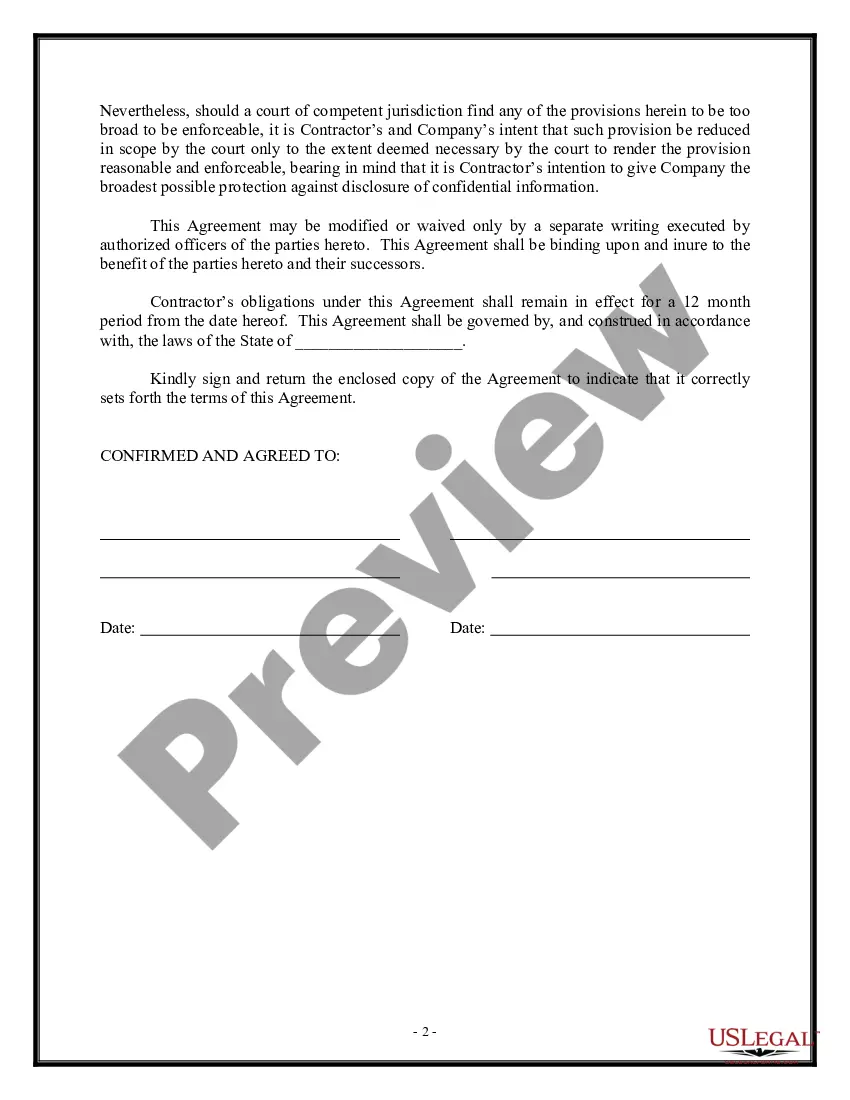
Confidential Disclosure Agreement With In Cook
Description

Get your form ready online
Our built-in tools help you complete, sign, share, and store your documents in one place.
Make edits, fill in missing information, and update formatting in US Legal Forms—just like you would in MS Word.
Download a copy, print it, send it by email, or mail it via USPS—whatever works best for your next step.
Sign and collect signatures with our SignNow integration. Send to multiple recipients, set reminders, and more. Go Premium to unlock E-Sign.
If this form requires notarization, complete it online through a secure video call—no need to meet a notary in person or wait for an appointment.
We protect your documents and personal data by following strict security and privacy standards.

Make edits, fill in missing information, and update formatting in US Legal Forms—just like you would in MS Word.

Download a copy, print it, send it by email, or mail it via USPS—whatever works best for your next step.

Sign and collect signatures with our SignNow integration. Send to multiple recipients, set reminders, and more. Go Premium to unlock E-Sign.

If this form requires notarization, complete it online through a secure video call—no need to meet a notary in person or wait for an appointment.

We protect your documents and personal data by following strict security and privacy standards.
Looking for another form?








Form popularity
FAQ
Confidential Disclosure Agreements (CDAs) -- also referred to as Confidentiality Agreements and Non-disclosure Agreements -- are binding contracts to safeguard the release or exchange of confidential information.
What is a confidentiality clause in a Memorandum of Understanding? A confidentiality clause in a Memorandum of Understanding (MoU) protects sensitive information shared between parties. It outlines what information must remain confidential and the obligations of each party regarding its handling.
circumvention agreement ensures that the intermediaries who brought the buyer and seller together are not excluded from future negotiations, whilst a nondisclosure agreement is a contract by which a party receiving information from another party agrees to keep such information confidential.
Companies looking to launch a new pharmaceutical drug in Canada must first file a New Drug Submission (NDS) with Health Canada's Therapeutic Products Directorate (TPD). In the U.S., a New Drug Application (NDA) must be submitted to the FDA.
At the top, there are three types, unilateral, bilateral, and multilateral NDAs. The rest of the specific NDA types fall under these three categories. Most are based on who has to sign the NDA. Not all NDAs are created equally, and they can only demand so much secrecy from strangers when compared to their employees.
How do I write a Non-Disclosure Agreement? Contact information for the parties involved. Details about the confidential information that needs protection. Permitted uses of the confidential information by the recipient. Time restrictions for keeping information confidential. Reason for disclosure.
An employment contract is an excellent example of a unilateral NDA. When an employee is hired, they sign a unilateral NDA agreeing not to share information learned on the job.
A confidentiality agreement should include the names and addresses of the parties to the contract. Consider also including: Reason for the agreement: Explain why you're sharing this information. The information disclosed: Be specific about the subject matter and what exactly is included in the agreement.
Five other key features must be included in your NDA to ensure it's legally binding, including a description of confidential information, obligations of the parties involved, any exclusions, the term of the agreement and consequences of a breach.
Typically, a legal professional writing the NDA will complete these steps: Step 1 - Describe the scope. Which information is considered confidential? ... Step 2 - Detail party obligations. Step 3 - Note potential exclusions. Step 4 - Set the term. Step 5 - Spell out consequences.
