Rules For Condo Owners In Los Angeles
Description













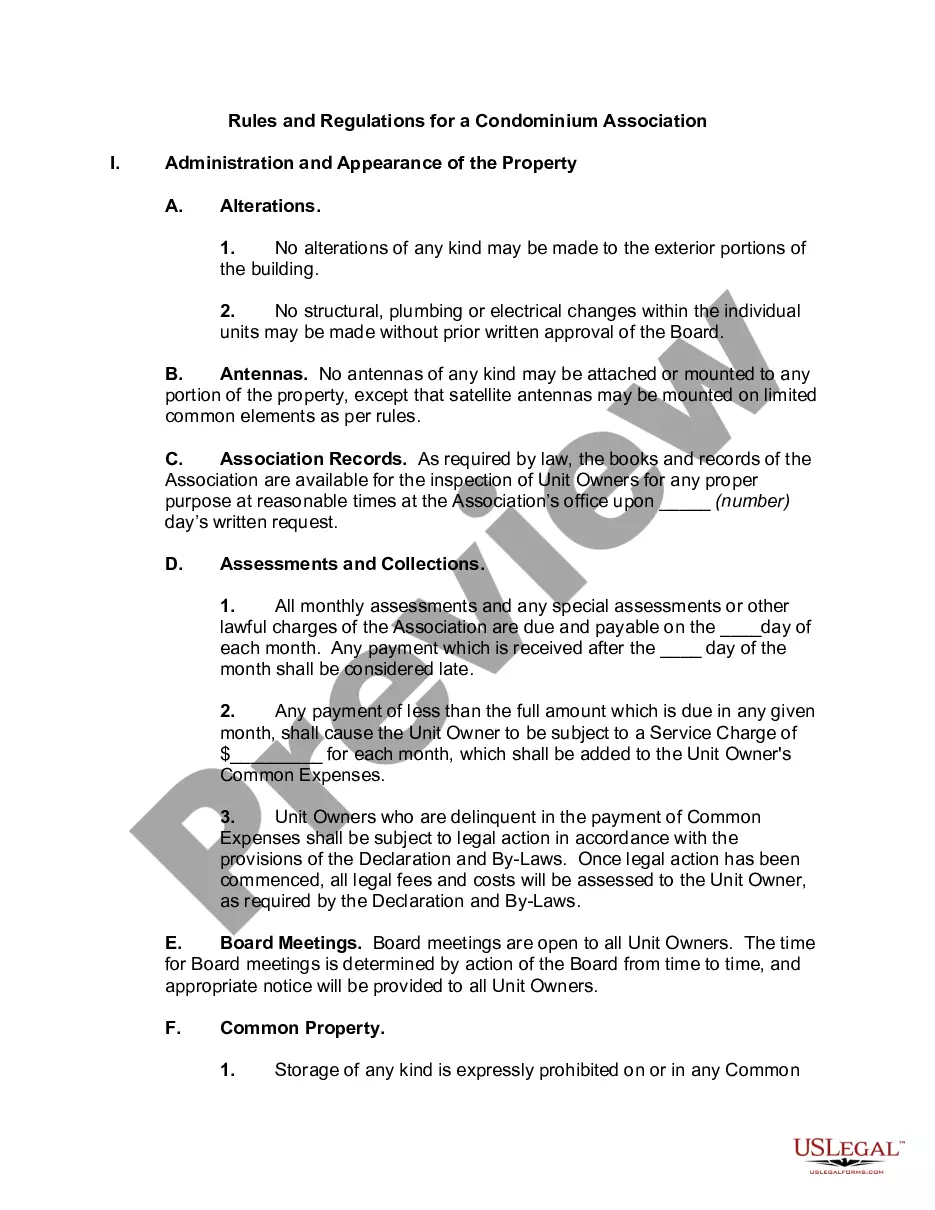

Get your form ready online
Our built-in tools help you complete, sign, share, and store your documents in one place.
Make edits, fill in missing information, and update formatting in US Legal Forms—just like you would in MS Word.
Download a copy, print it, send it by email, or mail it via USPS—whatever works best for your next step.
Sign and collect signatures with our SignNow integration. Send to multiple recipients, set reminders, and more. Go Premium to unlock E-Sign.
If this form requires notarization, complete it online through a secure video call—no need to meet a notary in person or wait for an appointment.
We protect your documents and personal data by following strict security and privacy standards.

Make edits, fill in missing information, and update formatting in US Legal Forms—just like you would in MS Word.

Download a copy, print it, send it by email, or mail it via USPS—whatever works best for your next step.

Sign and collect signatures with our SignNow integration. Send to multiple recipients, set reminders, and more. Go Premium to unlock E-Sign.

If this form requires notarization, complete it online through a secure video call—no need to meet a notary in person or wait for an appointment.

We protect your documents and personal data by following strict security and privacy standards.
Looking for another form?






Form popularity
FAQ
If you rent in the City of Los Angeles, your rental unit may be subject to the city's Rent Stabilization Ordinance (RSO), which regulates rents and evictions, if the property was built on or before October 1, 1978. Newly constructed units that replaced demolished RSO rental units may also be covered under the RSO.
Keep in mind that certain properties are exempt from California rent control law. These types of properties include: Condos and single family-homes not owned by a real estate investment trust (REIT), corporation, or corporation-owned LLC. Mobile homes.
Who Is Exempt From California Rent Control? New buildings which are not yet 15 years old. Owner-occupied buildings with less than three or four units (the number depends on the local regulations) Detached accessory dwelling units, also known as 'granny flats' or 'mother-in-law units' Government-subsidized housing units.
Is a Condo a Good Financial Investment? Home prices are higher in Los Angeles than just about any other city in America, making condos a good alternative. If it's in a good neighborhood and close to amenities, the resale value should hold, and these are the primary features you'll want to look for.
The type of ADU you build If you build an ADU in L.A. that's completely detached, it will be exempt from the local rent stabilization ordinance unless the ADU took the place of units that had been rent-controlled. The house, meanwhile, will fall under the city ordinance if it was built before October 1978.
Per the Los Angeles Municipal Code, a landlord may recover possession of a rental unit to occupy the unit as their primary place of residence for no less than two consecutive years, if the landlord possesses legal title to at least 25% of the property containing the rental unit.
What are unenforceable HOA rules? Keep you out of court. Hush up litigation. Discriminate indiscriminately. Enter your home without cause or notice. String you out on the (clothes)line. Fine you for fun. Change rules on the fly. Demand you take down your dish.
The local law supersedes the rules and regulations of the HOA, meaning that HOAs must ensure they are operating under the law.
An HOA has the authority to enforce the rules and regulations of the community using the community rules, or “bylaws and covenants.” These rules are considered “agreed upon” since homeowners approve them through board-elected representatives.
What are unenforceable HOA rules? Keep you out of court. Hush up litigation. Discriminate indiscriminately. Enter your home without cause or notice. String you out on the (clothes)line. Fine you for fun. Change rules on the fly. Demand you take down your dish.
