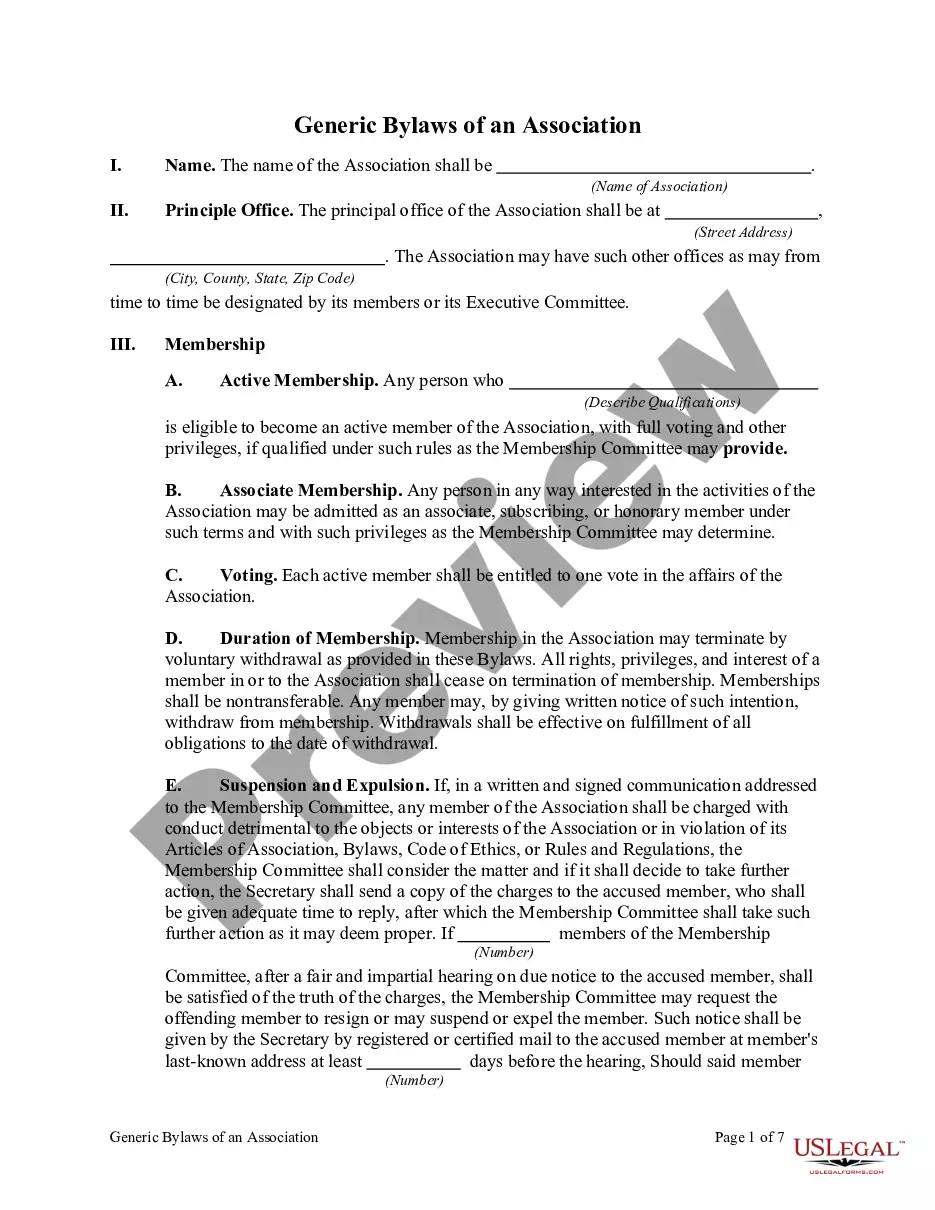
Homeowners Association Bylaws Template Format In Suffolk
Description


Get your form ready online
Our built-in tools help you complete, sign, share, and store your documents in one place.
Make edits, fill in missing information, and update formatting in US Legal Forms—just like you would in MS Word.
Download a copy, print it, send it by email, or mail it via USPS—whatever works best for your next step.
Sign and collect signatures with our SignNow integration. Send to multiple recipients, set reminders, and more. Go Premium to unlock E-Sign.
If this form requires notarization, complete it online through a secure video call—no need to meet a notary in person or wait for an appointment.
We protect your documents and personal data by following strict security and privacy standards.

Make edits, fill in missing information, and update formatting in US Legal Forms—just like you would in MS Word.

Download a copy, print it, send it by email, or mail it via USPS—whatever works best for your next step.

Sign and collect signatures with our SignNow integration. Send to multiple recipients, set reminders, and more. Go Premium to unlock E-Sign.

If this form requires notarization, complete it online through a secure video call—no need to meet a notary in person or wait for an appointment.

We protect your documents and personal data by following strict security and privacy standards.
Looking for another form?







Form popularity
FAQ
In Massachusetts, homeowners' associations, also called HOAs, are not governed by a particular law in the way that inium associations are. Generally, iniums are preferred by developers when trying to create housing arrangements with shared common spaces among different unit dwellers.
The state ranked seventh nationally for the number of associations by the Foundation for Community Association Research, a nonprofit organization that focuses on community research in the homeowner and inium association industry. The organization reports that Massachusetts has 11,800 associations.
Legal Framework Governing HOAs in Massachusetts In Massachusetts, homeowners' associations (HOAs) are subject to a robust legal framework. This framework not only aligns with federal regulations but also includes state-specific laws designed to regulate the formation, management, and operation of these associations.
One of the primary reasons HOA fees might feel high or are on the rise is inflation. The increasing costs of services, labor, and materials place HOAs in a challenging position, often leading them to make tough choices between hiking up assessments or cutting back on services and maintenance.
To comply with New York law, there are three primary pathways to establish an HOA: obtaining a no-action letter under 13 NYCRR Section 22.8, utilizing the Cooperative Policy Statement No. 7 (CPS-7), or filing an offering plan pursuant to 13 NYCRR Part 22 (Part 22).
