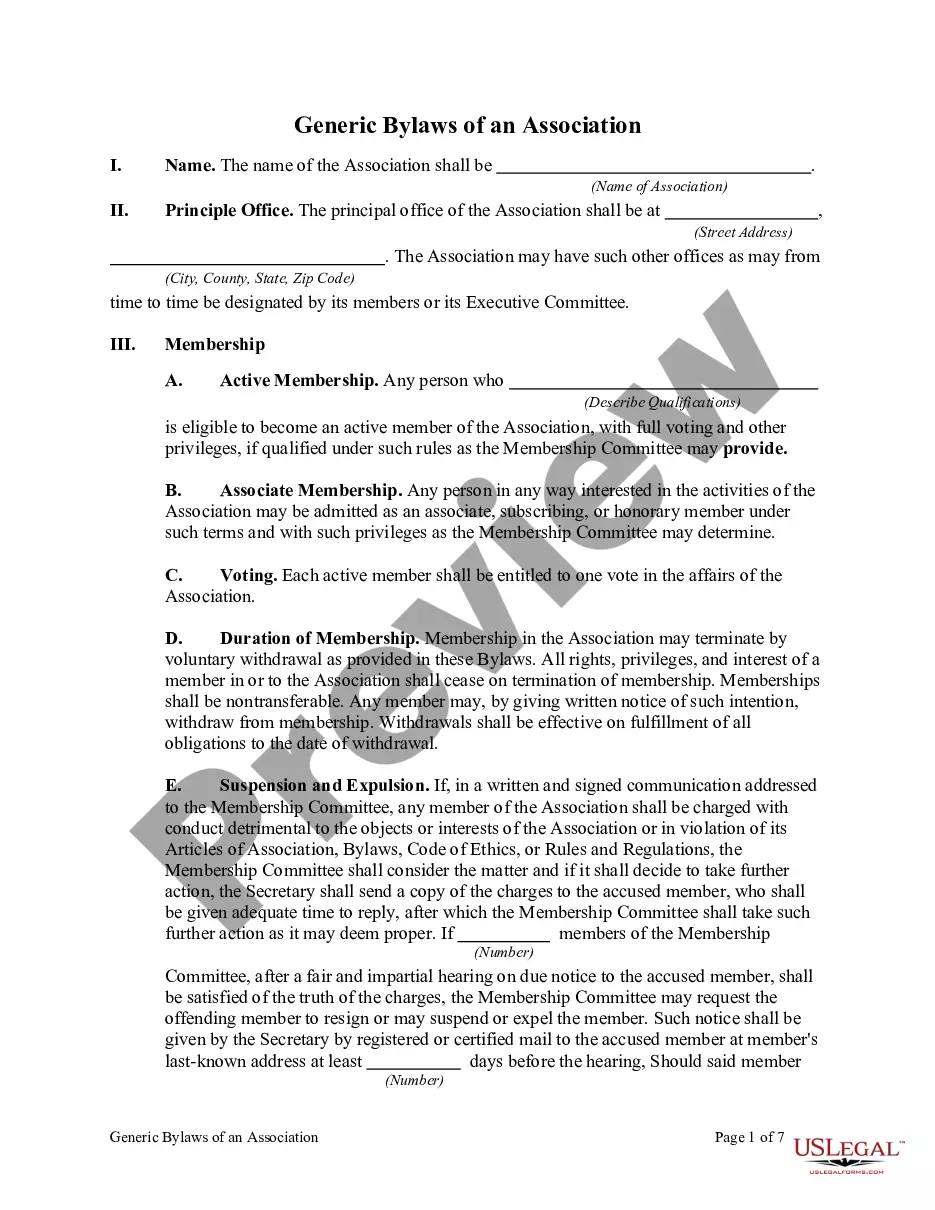
Standard Bylaws For Nonprofit In Los Angeles
Description


Get your form ready online
Our built-in tools help you complete, sign, share, and store your documents in one place.
Make edits, fill in missing information, and update formatting in US Legal Forms—just like you would in MS Word.
Download a copy, print it, send it by email, or mail it via USPS—whatever works best for your next step.
Sign and collect signatures with our SignNow integration. Send to multiple recipients, set reminders, and more. Go Premium to unlock E-Sign.
If this form requires notarization, complete it online through a secure video call—no need to meet a notary in person or wait for an appointment.
We protect your documents and personal data by following strict security and privacy standards.

Make edits, fill in missing information, and update formatting in US Legal Forms—just like you would in MS Word.

Download a copy, print it, send it by email, or mail it via USPS—whatever works best for your next step.

Sign and collect signatures with our SignNow integration. Send to multiple recipients, set reminders, and more. Go Premium to unlock E-Sign.

If this form requires notarization, complete it online through a secure video call—no need to meet a notary in person or wait for an appointment.

We protect your documents and personal data by following strict security and privacy standards.
Looking for another form?







Form popularity
FAQ
Under California law, a nonprofit board may be composed of as few as one director, but the IRS may take issue with granting recognition of 501(c)(3) status to a nonprofit with only one director.
Stat. § 460/4 | Effective Jan. 1, 2024, a charitable organization with annual contributions more than $500,000 must file an audited financial statement prepared by an independent CPA. A charitable organization with contributions between $300,000 and $500,000 must file a financial statement with the Attorney General.
Although organizations don't need to file these bylaws with the state, California law requires that the treasurer or other designated member of the organization maintains a copy on file.
California requires a minimum of one director, but the IRS will rarely give tax-exempt status to organizations with less than three directors.
Ing to a study by Bain Capital Private Equity, the optimal number of directors for boards to make a decision is seven. Every added board member after that decreases decision-making by 10%. Nonprofits can use that as a starting metric before considering the organization's life cycle, mission and fundraising needs.
All California businesses, including tax-exempt organizations, must apply for a business license to legally operate within the state.
Under California law, you must have a quorum of at least two directors or one-fifth of all authorized directors (whichever is larger) to take valid action at a board meeting. Your organization's bylaws may set higher quorum limits, so be sure to take a look through them before proceeding.
Under California law, a nonprofit board may be composed of as few as one director, but the IRS may take issue with granting recognition of 501(c)(3) status to a nonprofit with only one director. It is commonly recommended that nonprofits have between three and 25 directors.
LLCs are not required to have bylaws. However, they are governed by an operating agreement which is like a corporation's bylaws.
(b) Bylaws may be adopted, amended or repealed by approval of the members (Section 5034); provided, however, that such adoption, amendment or repeal also requires approval by the members of a class if such action would: (1) Materially and adversely affect the rights, privileges, preferences, restrictions or conditions ...
