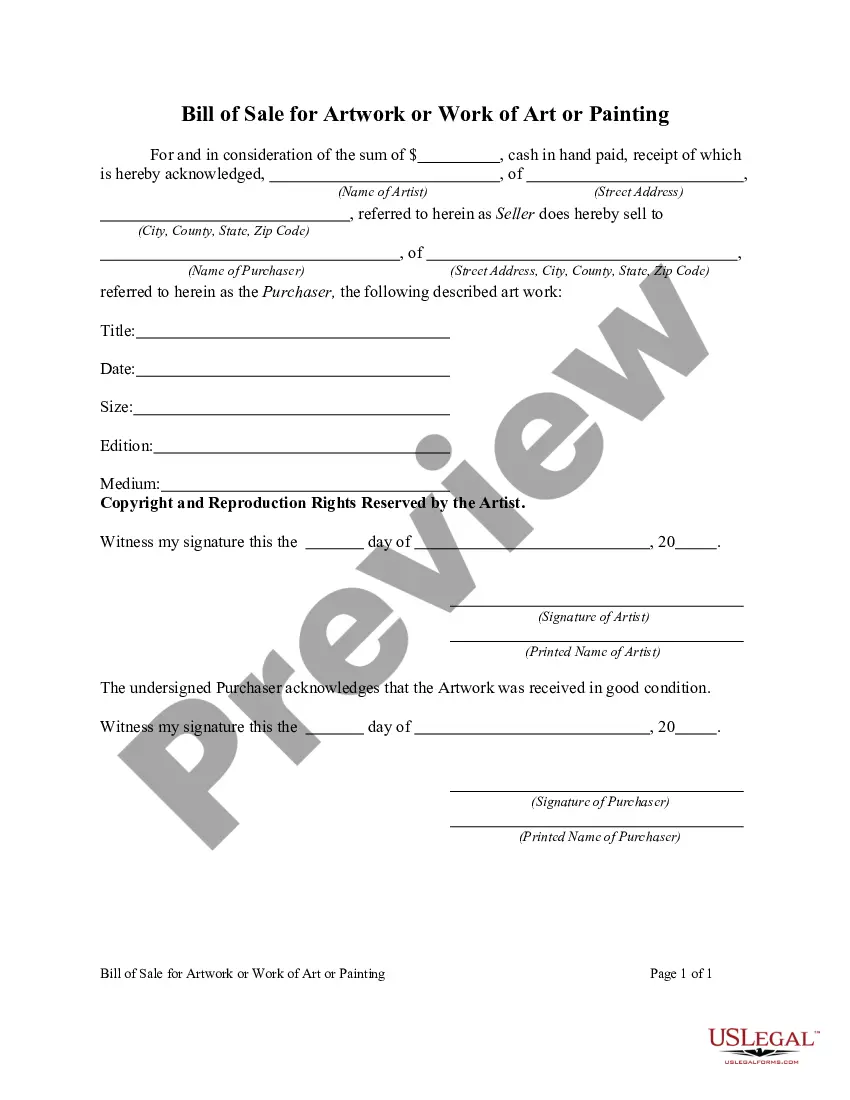
Bill Sale Art Sample For Students In King
Description
Get your form ready online
Our built-in tools help you complete, sign, share, and store your documents in one place.
Make edits, fill in missing information, and update formatting in US Legal Forms—just like you would in MS Word.
Download a copy, print it, send it by email, or mail it via USPS—whatever works best for your next step.
Sign and collect signatures with our SignNow integration. Send to multiple recipients, set reminders, and more. Go Premium to unlock E-Sign.
If this form requires notarization, complete it online through a secure video call—no need to meet a notary in person or wait for an appointment.
We protect your documents and personal data by following strict security and privacy standards.

Make edits, fill in missing information, and update formatting in US Legal Forms—just like you would in MS Word.

Download a copy, print it, send it by email, or mail it via USPS—whatever works best for your next step.

Sign and collect signatures with our SignNow integration. Send to multiple recipients, set reminders, and more. Go Premium to unlock E-Sign.

If this form requires notarization, complete it online through a secure video call—no need to meet a notary in person or wait for an appointment.

We protect your documents and personal data by following strict security and privacy standards.
Looking for another form?








Form popularity
FAQ
Use Frames Choose the Right Frame: Select frames that complement your art without overshadowing it. Use Mats: Adding a mat around your print can give it a polished look and draw attention to the artwork. Display in a Grid: Arrange framed prints in a grid pattern on the wall to create a cohesive and organized display.
On your invoice, you should include: Your details. Your business name and address. Your buyer's details. Your buyer's name and address. Information about the artwork. Separate line items for each product or service delivered. Information about the payment terms. Your hourly rate, if relevant.
Offer Special Promotions and Incentives: To attract potential buyers and generate interest in your artwork, consider offering special promotions, discounts, or incentives. Host online sales events, limited-time offers, or exclusive previews for your loyal followers and subscribers.
Invoices should contain information about: you the artist. your billing address. your client or customer. their taxable address. your tax reference code (UTR - unique tax reference code if in the UK) the tax date for the product or service rendered. description of the artwork provided or artistic service rendered.
Artwork labels indicate the title, the artist, the date, and often the location. Some labels will also include background information, which could be about the piece itself, about the artist, or a combination of both.
Titles of Works In general, major works of art mentioned or cited in text or notes should be italicized. Titles of paintings, drawings, photographs, statues, and other works of art are italicized whether the titles are original, added by someone other than the artist, or translated.
The most common way to label closed edition prints is to put the edition number on the bottom left, and the artist's signature on the bottom right. The artist can also write the name of the work in the middle of the bottom margin.
Dasal, Curator of Modern and Contemporary Art, uses a slightly different tombstone format for works of art produced more recently, where artist names and biographical information is known: Artist's name, year born. City/location born, where they (the artist) live now or their year of death. Title. Date. Medium. Credit line.
How to invoice as a freelancer: What should go on an invoice? Your name (and company name, if applicable) Address Phone number Invoice number Date of the invoice (the date you send it) An itemized list of the work you did The associated costs for the work A tally of all costs