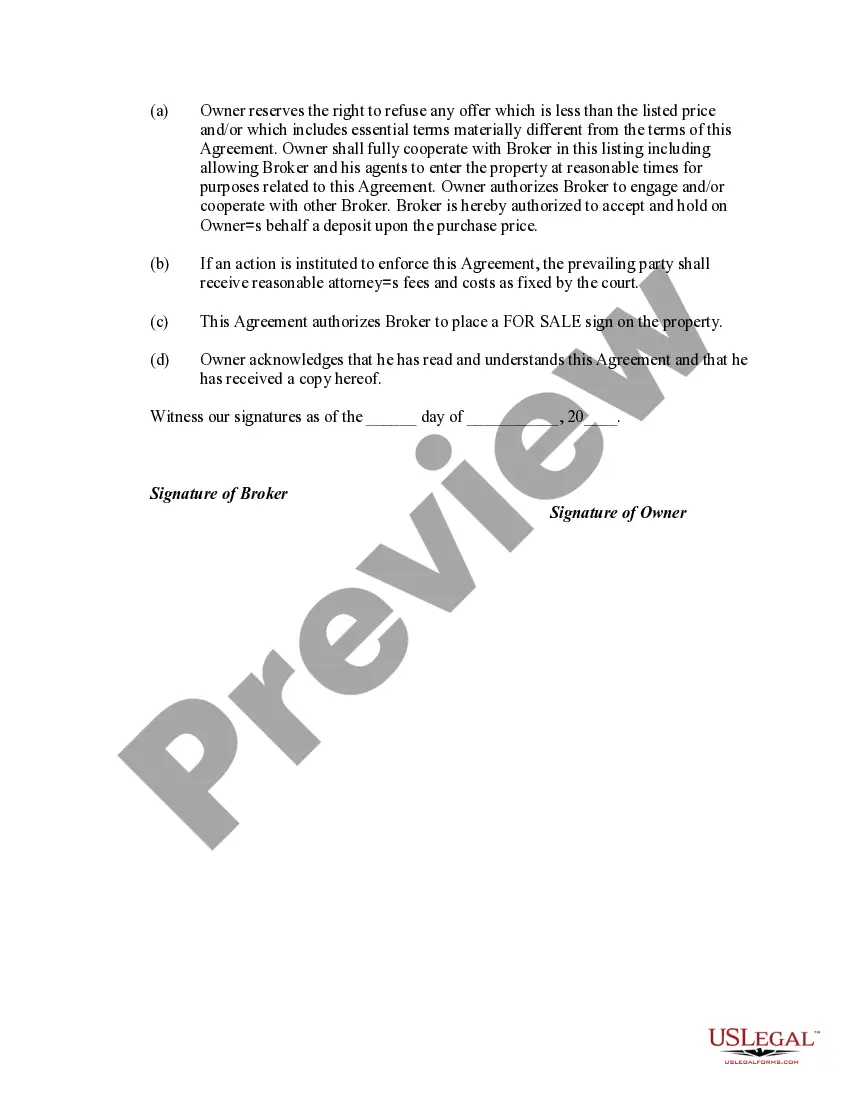
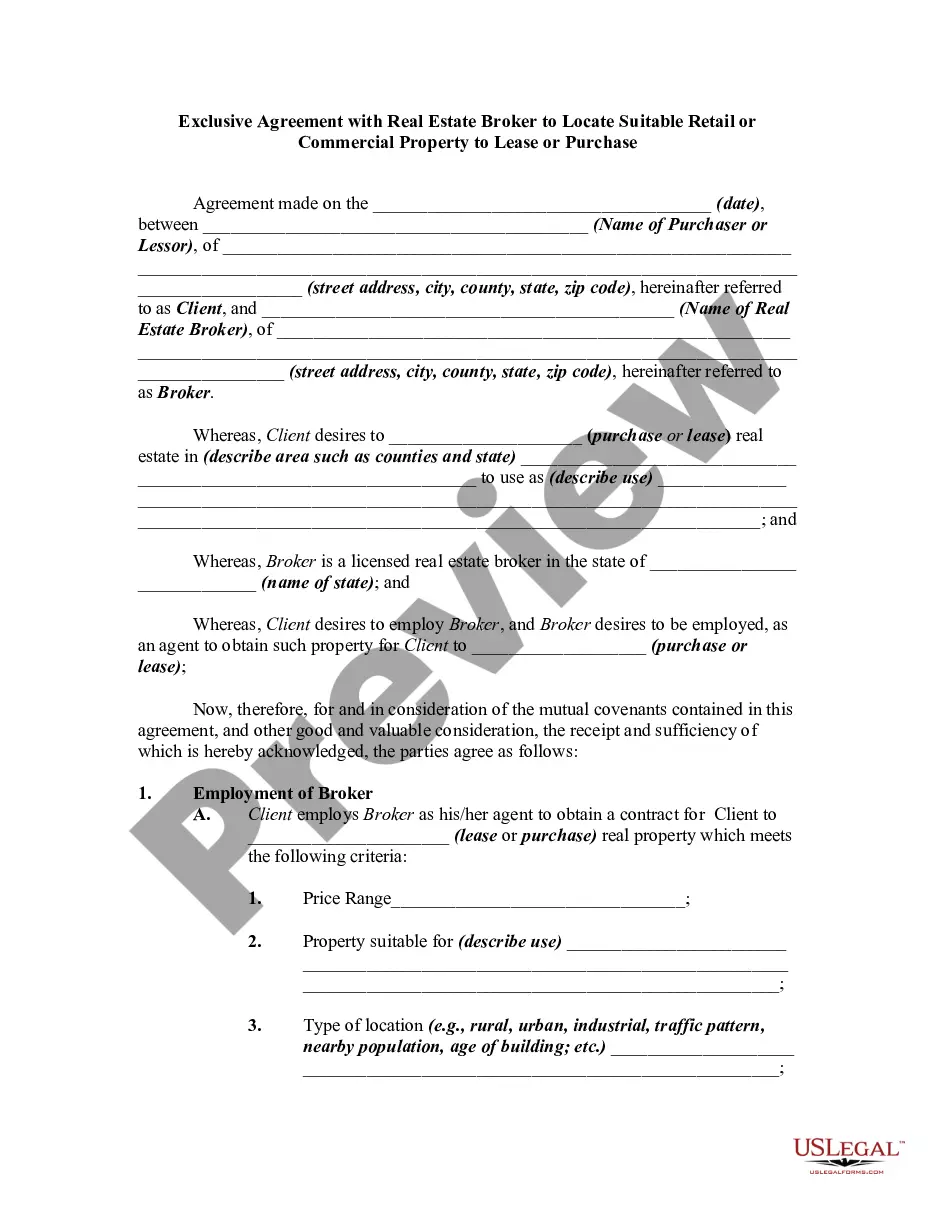
Listing Agreement For Commercial Real Estate In Riverside
Description


Get your form ready online
Our built-in tools help you complete, sign, share, and store your documents in one place.
Make edits, fill in missing information, and update formatting in US Legal Forms—just like you would in MS Word.
Download a copy, print it, send it by email, or mail it via USPS—whatever works best for your next step.
Sign and collect signatures with our SignNow integration. Send to multiple recipients, set reminders, and more. Go Premium to unlock E-Sign.
If this form requires notarization, complete it online through a secure video call—no need to meet a notary in person or wait for an appointment.
We protect your documents and personal data by following strict security and privacy standards.

Make edits, fill in missing information, and update formatting in US Legal Forms—just like you would in MS Word.

Download a copy, print it, send it by email, or mail it via USPS—whatever works best for your next step.

Sign and collect signatures with our SignNow integration. Send to multiple recipients, set reminders, and more. Go Premium to unlock E-Sign.

If this form requires notarization, complete it online through a secure video call—no need to meet a notary in person or wait for an appointment.

We protect your documents and personal data by following strict security and privacy standards.
Looking for another form?






Form popularity
FAQ
An LOI stands for Letter of Intent. In commercial real estate, a Letter of Intent is a preliminary agreement that is negotiated between a tenant and landlord or buyer and seller. The LOI or Letter of Intent states the primary economics and deal points with proposed terms.
Form 200 (formerly the only option) creates brokerage-level representation and 271 creates Designated Representation. In the majority of cases a Seller of a residential home is better served by Designated Representation because it largely avoids multiple representation scenarios.
A letter of intent (LOI), expresses the University's intention to submit a proposal in response to a particular program announcement or request for proposal (RFP). They can either be required as a pre-condition for invitation to submit a full proposal, or not required but encouraged.
Components of a LOI Opening Paragraph: Your summary statement. Statement of Need: The "why" of the project. ( ... Project Activity: The "what" and "how" of the project. ( ... Outcomes (1–2 paragraphs; before or after the Project Activity) ... Credentials (1–2 paragraphs) ... Budget (1–2 paragraphs) ... Closing (1 paragraph) ... Signature.
The letter of intent should include the following six things: A Statement Declaring Your Interest in Leasing the Space. A Description of Your Company. An Outline of On-Site Employees, Equipment, and Machinery. Your Business Hours. An Overview of Your Current Space. Contact Details.
This online real estate database allows any other member of the same real estate board to view the listing, and contact those trying to sell it. An Exclusive Listing, on the other hand, is a property that is not added to the MLS system by the seller's agent.
Listing agreements vary. Each type has its own advantages and disadvantages: Exclusive Right-to-Sell Listing: The most common type. It grants the broker the exclusive right to sell your home, regardless of who finds the buyer.
The settlement required real estate licensees to have a written agreement with a buyer before showing properties listed on the Multiple Listing Service (MLS). AB 2992 expands this requirement to all properties, whether it is listed on an MLS or not, and also imposes several additional requirements.
Most Common Disclosures in Real Estate Natural Hazards Disclosure. First on the list is the natural hazards disclosure. Market Conditions Advisory (MCA) Market Conditions Advisory, also known as MCA, covers items more financial in nature. State Transfer Disclosure. Local Transfer Disclosure. Megan's Law Disclosures.
Exclusive Right to Sell Listing As the most commonly used listing agreement, the Exclusive Right to Sell Listing's name pretty much says it all. With an Exclusive Right to Sell Listing Agreement, the real estate agent or broker has total control over the transaction.
