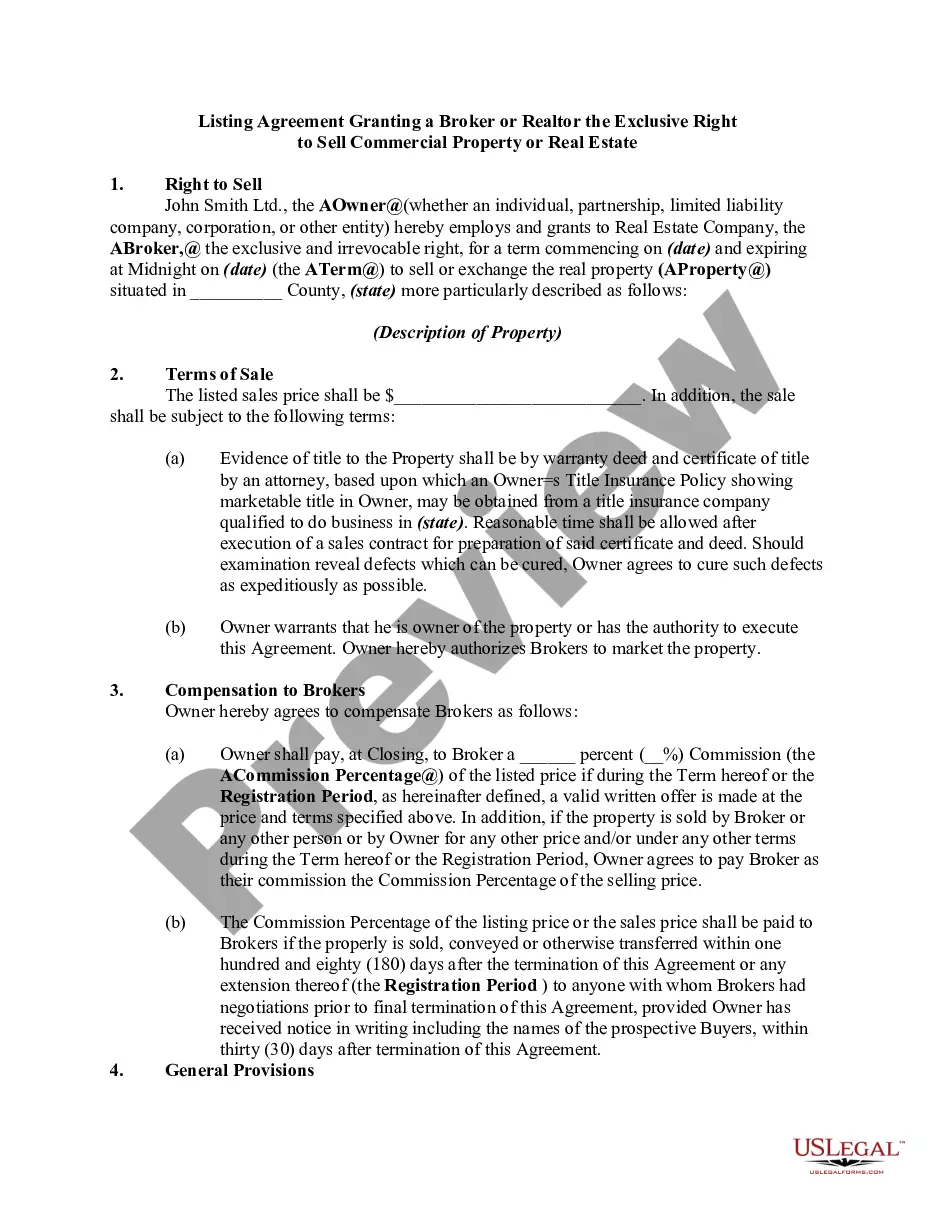
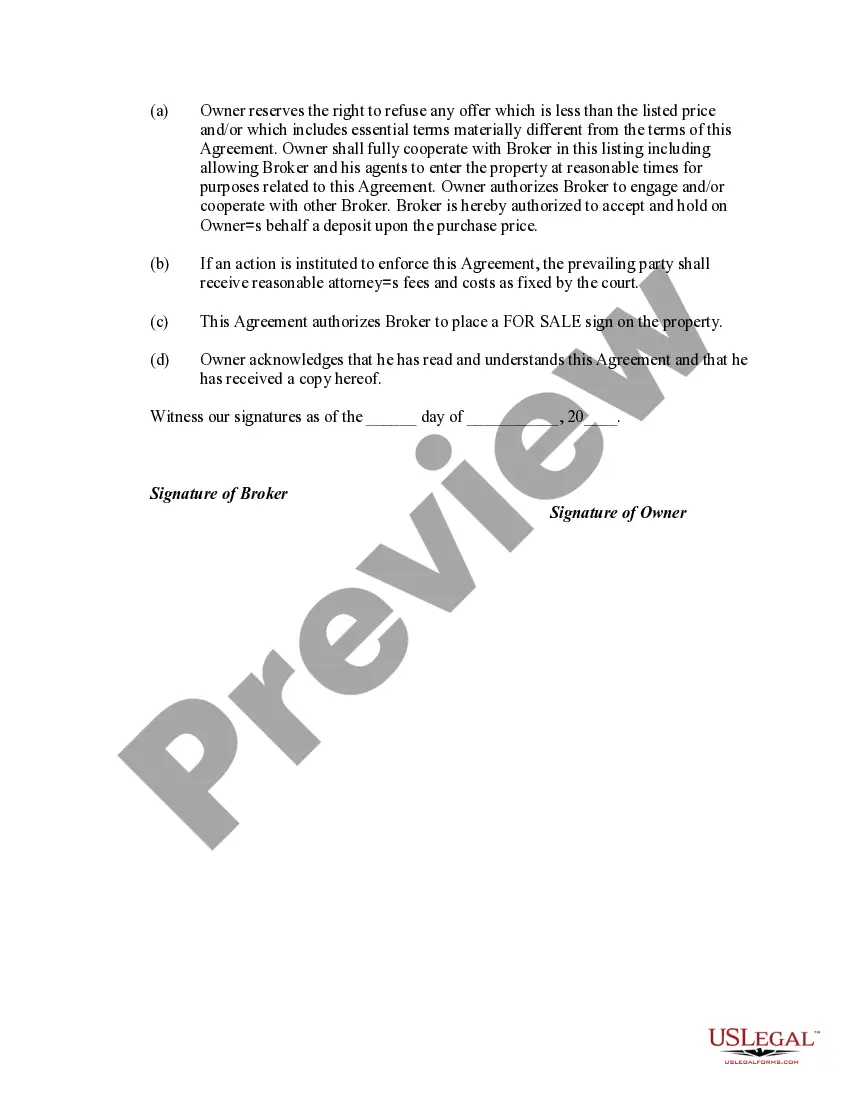
Listing Agreement Commercial Form With 2 Points
Description
Get your form ready online
Our built-in tools help you complete, sign, share, and store your documents in one place.
Make edits, fill in missing information, and update formatting in US Legal Forms—just like you would in MS Word.
Download a copy, print it, send it by email, or mail it via USPS—whatever works best for your next step.
Sign and collect signatures with our SignNow integration. Send to multiple recipients, set reminders, and more. Go Premium to unlock E-Sign.
If this form requires notarization, complete it online through a secure video call—no need to meet a notary in person or wait for an appointment.
We protect your documents and personal data by following strict security and privacy standards.

Make edits, fill in missing information, and update formatting in US Legal Forms—just like you would in MS Word.

Download a copy, print it, send it by email, or mail it via USPS—whatever works best for your next step.

Sign and collect signatures with our SignNow integration. Send to multiple recipients, set reminders, and more. Go Premium to unlock E-Sign.

If this form requires notarization, complete it online through a secure video call—no need to meet a notary in person or wait for an appointment.

We protect your documents and personal data by following strict security and privacy standards.
Looking for another form?
How to fill out Listing Agreement Granting A Broker Or Realtor The Exclusive Right To Sell Commercial Property Or Real Estate?
The Listing Agreement Commercial Document With 2 Points you observe on this page is a reusable legal template crafted by skilled attorneys in accordance with federal and state statutes.
For over 25 years, US Legal Forms has supplied individuals, organizations, and lawyers with more than 85,000 authenticated, state-specific documents for any business and personal circumstance. It’s the quickest, most straightforward, and most dependable method to acquire the paperwork you require, as the service ensures bank-level data security and anti-malware safeguards.
Subscribe to US Legal Forms to have verified legal templates for all of life’s circumstances readily available.
- Search for the document you require and review it.
- Browse through the file you searched and preview it or examine the form description to ensure it meets your requirements. If it doesn’t, utilize the search feature to find the correct one. Click Buy Now once you have found the template you require.
- Register and Log In.
- Select the pricing plan that works for you and create an account. Use PayPal or a credit card to complete a swift payment. If you already possess an account, Log In and verify your subscription to proceed.
- Acquire the editable template.
- Choose the format you prefer for your Listing Agreement Commercial Document With 2 Points (PDF, DOCX, RTF) and store the sample on your device.
- Complete and sign the documents.
- Print out the template to fill it out manually. Alternatively, use an online multi-functional PDF editor to quickly and accurately complete and sign your form with a legally binding electronic signature.
- Re-download your documents as needed.
- Use the same document again whenever necessary. Access the My documents tab in your profile to re-download any previously saved forms.
Form popularity
FAQ
Vermont residents can research and print Vermont probate for free on Ancestry.com through an account on MyVermont.gov.
Vermont probate follows this general flow: contact the court, get appointed as personal representative, submit will if it exists, inventory and submit valuations of all relevant assets, have the court and beneficiaries approve it, and then distribute the assets to beneficiaries.
V.R.P.P. Rule 80.4, Delivery of Will by Custodian; Copy of Will Filed for Safekeeping. If the decedent (the person who died) did not own any real estate other than a timeshare and the estate is worth less than $45,000.00, you can use the small estate procedure to probate the estate.
Go to the Probate Division in the county where the decedent lived at the time of death. The court will appoint the ?executor.? It is the executor's job to locate and gather all of the assets, and then pay debts and distribute property ing to the terms of a will. The probate court will supervise this process.
It involves proving the will is valid, identifying and inventorying the deceased person's property, having the property appraised, paying debts and taxes, and distributing the remaining property as the will directs. In Vermont, the cost for probate can range from $2,700 to $6,950 or more.
The timeline from when probate is opened to when it is closed will vary based on many factors. You can expect a minimum of four to five months, since creditors are given this amount of time to file a claim. However, probate can take well over a year or even several years if there are complications.
In Vermont, the following assets are subject to probate: Solely-owned property: Any asset that was solely owned by the deceased person with no designated beneficiary is subject to probate. This could include bank accounts, cars, houses, personal belongings, and business interests.
Even without a statutory guideline on executor fees in Vermont, the common understanding among legal professionals suggests that an executor can expect to receive about 2-5% of the estate's value. However, this percentage can vary based on the specifics of the estate and the executor's duties.