Listing Agreement For Debt Securities In Houston
Description


Get your form ready online
Our built-in tools help you complete, sign, share, and store your documents in one place.
Make edits, fill in missing information, and update formatting in US Legal Forms—just like you would in MS Word.
Download a copy, print it, send it by email, or mail it via USPS—whatever works best for your next step.
Sign and collect signatures with our SignNow integration. Send to multiple recipients, set reminders, and more. Go Premium to unlock E-Sign.
If this form requires notarization, complete it online through a secure video call—no need to meet a notary in person or wait for an appointment.
We protect your documents and personal data by following strict security and privacy standards.

Make edits, fill in missing information, and update formatting in US Legal Forms—just like you would in MS Word.

Download a copy, print it, send it by email, or mail it via USPS—whatever works best for your next step.

Sign and collect signatures with our SignNow integration. Send to multiple recipients, set reminders, and more. Go Premium to unlock E-Sign.

If this form requires notarization, complete it online through a secure video call—no need to meet a notary in person or wait for an appointment.

We protect your documents and personal data by following strict security and privacy standards.
Looking for another form?







Form popularity
FAQ
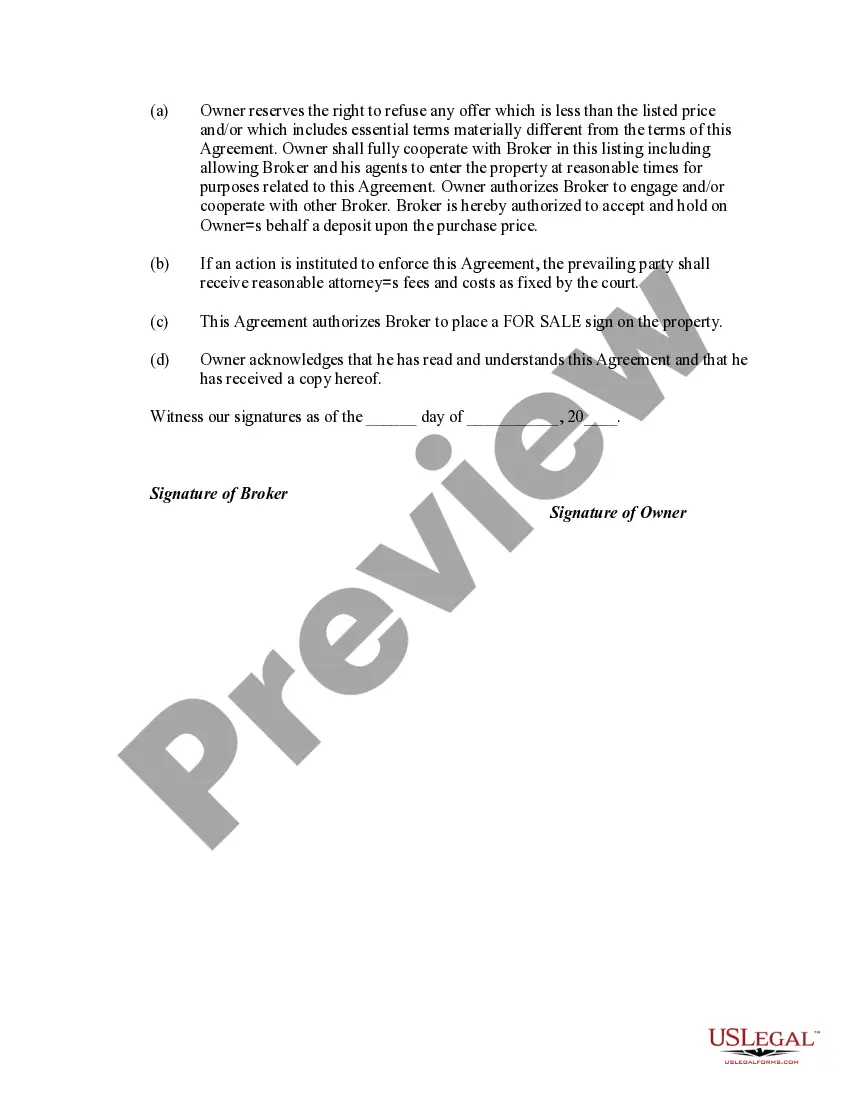
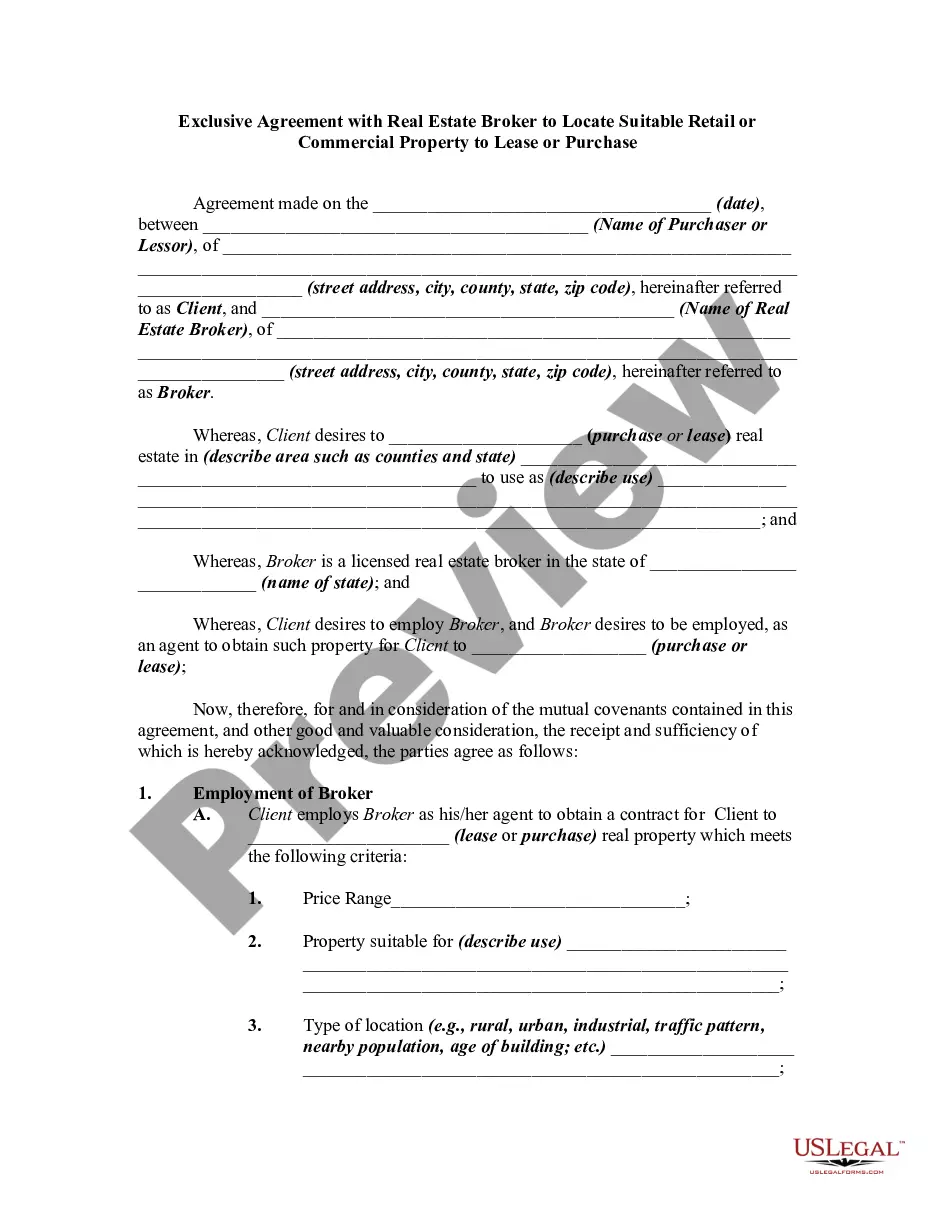
A real estate listing agreement – also known as a seller's agent agreement – is a contract between a property owner and a real estate broker. It permits the broker to sell the home on the seller's terms, locating an appropriate buyer. The property owner pays the brokerage a commission for acting as the listing agent.
A listing agreement is a contract between a property owner and a real estate brokerage that authorizes the broker to represent the seller and act as their agent in the sale of the property.
In Texas, you typically need to wait about 90 days for the protection period to pass after the listing agreement expires. This period is part of the protection clause included in most listing agreements, which ensures agents are protected if the seller sells to a buyer they introduced to the property.
The "Exclusive Right to Sell" is the most common, but there is the "open listing," the "exclusive agency listing," and the "one-time show." The "open listing" is mostly used by people trying to sell their home by owner who are also willing to work with real estate agents.
Reasons for Termination: Your contract might list specific reasons why you can end the agreement early. This could include things like poor communication or if your agent isn't doing a good job. Penalties or Fees: Some contracts have penalties if you want to end them early.
Exclusive Rights-to-Sell Listing This gives the real estate agent the exclusive rights to market your home and list it on MLS. They will receive the full commission as long the home is sold within the designated timeframe. This is the preferred agreement for most real estate agents.
A listing agreement is “a legally binding contract that creates an agency relationship authorizing a broker to serve as the agent for a principal in a real estate transaction.” In other words, a listing agreement is an employment contract between a client and a broker that spells out what the broker is responsible for ...
Just like shares are listed on the stock exchange, debt securities are also listed on a stock exchange.
On a T+3 basis) specifies that the listing of debt securities and Non-convertible Redeemable Preference Shares (NCRPS) issued through public issue process shall be completed within T+6 working days from the date of closure of the issue.
Available-for-sale securities (AFS) are debt or equity securities purchased with the intent of selling before they reach maturity. Available-for-sale securities are reported at fair value. Unrealized gains and losses are included in accumulated other comprehensive income within the equity section of the balance sheet.
