Difference Between Domicile And Deemed Domicile In Philadelphia
Description
Get your form ready online
Our built-in tools help you complete, sign, share, and store your documents in one place.
Make edits, fill in missing information, and update formatting in US Legal Forms—just like you would in MS Word.
Download a copy, print it, send it by email, or mail it via USPS—whatever works best for your next step.
Sign and collect signatures with our SignNow integration. Send to multiple recipients, set reminders, and more. Go Premium to unlock E-Sign.
If this form requires notarization, complete it online through a secure video call—no need to meet a notary in person or wait for an appointment.
We protect your documents and personal data by following strict security and privacy standards.

Make edits, fill in missing information, and update formatting in US Legal Forms—just like you would in MS Word.

Download a copy, print it, send it by email, or mail it via USPS—whatever works best for your next step.

Sign and collect signatures with our SignNow integration. Send to multiple recipients, set reminders, and more. Go Premium to unlock E-Sign.

If this form requires notarization, complete it online through a secure video call—no need to meet a notary in person or wait for an appointment.

We protect your documents and personal data by following strict security and privacy standards.
Looking for another form?









Form popularity
FAQ
Statutory residency is established if a person domiciled outside the commonwealth: Has a permanent place of abode in Pennsylvania; and. Spends more than 183 days (midnight to midnight) of the taxable year in Pennsylvania.
A resident of Pennsylvania is someone who is living and intends to reside in Pennsylvania, with or without a fixed or permanent address.
A domicile is a very formal/old-fashioned word for home: The structure where one lives. One's address is the index to the location of one's domicile: A description of where it is in terms of community, street name, and street number.
U.S. immigration laws generally require sponsors to have a U.S. domicile, meaning they live in the U.S. or plan to return permanently. If a sponsor is living abroad, they need to show strong ties to the U.S., like property, a job, or intent to return.
The common question is, “What does domicile mean?” Domicile refers to a person's permanent legal residence, which is the place where they have the most significant connections, such as family, property ownership, and voting registration. Residency, however, refers to where a person lives, temporarily or permanently.
Statutory residency means you have a permanent “place of abode” in Pennsylvania or New Jersey and are physically present in the state for more than 183 days.
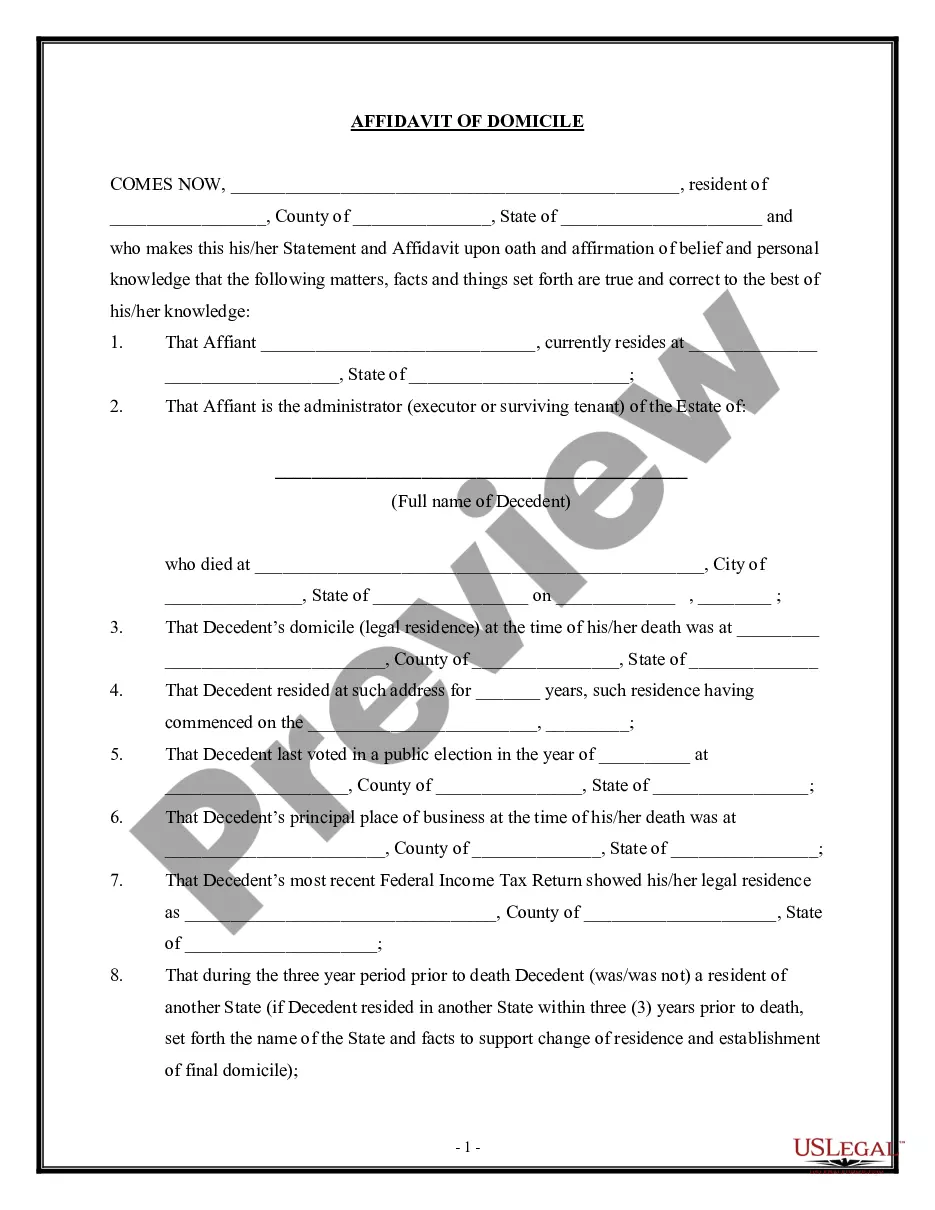
A domicile is the place at which an individual maintains his/ her permanent abode and to which he/she intends to return whenever absent. A person may only have one domicile at any one time.
Philadelphia Code Section 19-1804 authorizes the School District to tax the net income of any person who resided in Philadelphia for the applicable tax year.
Losing deemed domicile status You can lose deemed domiciled status under Condition B, if you leave the UK and there are at least 6 tax years as a non UK resident in the 20 tax years before the relevant tax year.
You're usually non-resident if either: you spent fewer than 16 days in the UK (or 46 days if you have not been a UK resident for the 3 previous tax years) you worked abroad full-time (averaging at least 35 hours a week), and spent fewer than 91 days in the UK, of which no more than 30 were spent working.
